
National Award 2025
2025 Industry Master Award - Da-sheng, Lee
As AI technology deeply penetrates various industries, Da-sheng, Lee, a Distinguished Professor of the Department of Energy and Refrigerating Air-Conditioning Engineering at National Taipei University of Technology, focuses his efforts on “AI-enabled intelligent energy conservation and carbon reduction”. He integrates AI into energy systems and incorporates this theme into his teaching curriculum, combining control theory, data science, and AI algorithms with applications in refrigeration and air-conditioning energy conservation, energy storage systems, intelligent building energy management, and high-energy-consuming industrial processes. One of his notable achievements is the development of an AI-based intelligent combustion control technology, which has been implemented in incineration plants. The technology is applied to waste calorific value analysis and waste transportation auditing systems, effectively controlling the quality of incoming waste, improving operational procedures, and increasing operational efficiency to 92%.
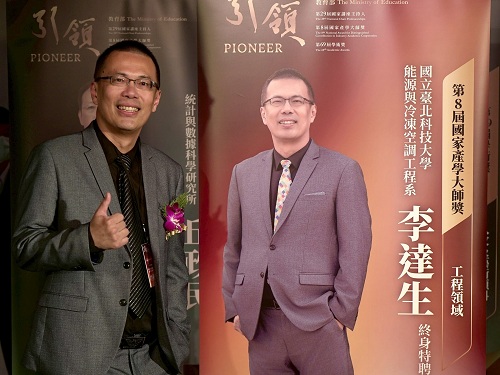
Students mentored by Professor Lee are now active across fields such as energy technology, refrigeration and air conditioning, smart buildings, information and communication technology, and green manufacturing. Over the past decade, he has led 55 industry-academia collaboration projects, securing nearly NT$300 million in contract funding and generating over NT$10 million in technology transfer revenue. His close collaboration with industry has made significant contributions to industry-academia cooperation, talent cultivation, and resource integration, indirectly benefiting Taiwan’s industrial development.
Entrepreneurial Failures: Valuable Lessons for an Industry-Academia Career
Unlike many professors who pursue an academic career immediately after earning a Ph.D., Professor Lee always wanted to dedicate himself to entrepreneurship. He believed that combining academic knowledge with practical experience was the key to turning ideas into reality. His first entrepreneurial venture took place while he was pursuing his Ph.D. Together with a group of friends from industry and the Industrial Technology Research Institute (ITRI), he attempted to introduce advanced semiconductor manufacturing technology from a German company. Although the plan seemed promising and the team was highly capable, they had strong academic backgrounds but lacked practical industry experience. Many experienced professionals, as well as their partner companies, warned them that their approach would not work on an actual production line. As a result, when the company reached the stage of mass production, it was unable to overcome the challenges involved. Eventually, the business failed and was forced to shut down.
Then, he refused to give up and started a second entrepreneurial venture. However, the outcome was even more painful than the first. This time, he entered the rapidly growing field of Micro-Electro-Mechanical Systems (MEMS) and focused on developing wavelength-division multiplexers for optical fiber communications. Having learned from their previous failure, Professor Lee and his team adopted standardized manufacturing processes, and their products were successfully sold in the United States. However, they overlooked one critical factor: quality control. Problems arose after the products were installed at customer sites. The compensation demanded by clients was not limited to the defective components themselves but also included the substantial losses caused by the failure of entire systems. Looking back on this difficult experience, Professor Lee realized the importance of maintaining high production yields and implementing strict quality control measures.
For his third entrepreneurial venture, Professor Lee learned from his previous failures and decided to avoid the risks associated with manufacturing. He joined a team led by two senior alumni from the Department of Electrical Engineering and shifted his focus to the distribution of MEMS integrated circuits (ICs), while also providing software and firmware design services. This venture achieved moderate success and generated steady revenue. The company also played an important role in helping a major U.S. semiconductor company expand its business and market presence in Taiwan. However, management issues eventually emerged. Differences in vision among shareholders, along with organizational and management challenges, gradually created conflicts within the company. In the end, Professor Lee chose to leave the team despite the business's achievements.
Through these three entrepreneurial failures, Professor Lee came to realize that industry-academia collaboration is not only about developing excellent technologies. It also requires an understanding of business logic, industry standards, and the importance of maintaining high production yields. As a result, Professor Lee often reminds his students that innovation alone is not enough. If an idea cannot be applied in real-world situations or meet industry requirements, it will be viewed by the industry as nothing more than a high-risk toy.
Reaching for the Stars with Creativity, Keeping One's Feet on the Ground with Craftsmanship
After experiencing the setbacks of his entrepreneurial ventures, Professor Lee was offered an opportunity by National Taipei University of Technology to join the Department of Energy and Refrigerating Air-Conditioning Engineering as an assistant professor. At a university that places great emphasis on hands-on learning, he met a group of students with exceptional practical skills, which eventually contributed to the peak of his career. He discovered that students from vocational education backgrounds were highly capable of solving complex hardware-related problems, making them the perfect complement to his strong academic expertise. Having followed a traditional academic path—from a prestigious high school to earning a Ph.D. in Mechanical Engineering—Professor Lee began to reflect deeply on the true purpose and meaning of education.
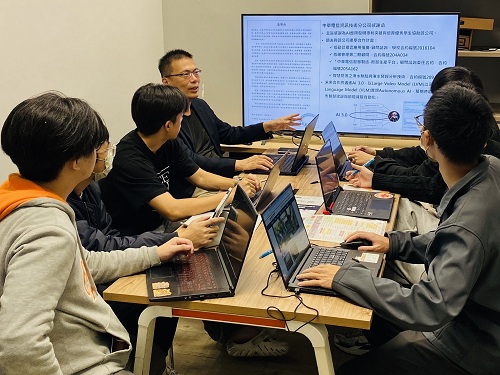
Professor Lee observed that students at traditional universities tend to acquire knowledge through reading and visual learning. They are well suited for academic research and often come up with innovative and creative ideas. However, these ideas sometimes lack practical considerations, making them difficult to turn into real-world applications. In contrast, students from vocational education backgrounds learn primarily through hands-on experience. Although they may not be particularly skilled at expressing themselves verbally, they possess exceptional practical abilities and demonstrate an almost stubborn commitment to following specifications and standards.
Professor Lee often uses the example of pipe bending to illustrate the spirit of technical practice. He explained that in industrial settings, if a specification requires a pipe to be bent to exactly 90 degrees, then a bend of 90.1 degrees would already be considered unacceptable. While a deviation of 0.1 degrees may seem insignificant in a theoretical model, in real industrial applications, even such a small error can prevent pipes from connecting properly and may eventually lead to leakage or even system failure. Professor Lee emphasized that Taiwan does not lack people who know how to write academic papers. Rather, what Taiwan truly lacks are professionals who can transform creative ideas into products that meet industrial standards and specifications. Therefore, he combines the innovative thinking commonly found in traditional universities with the practical discipline cultivated through vocational education. This philosophy has become the foundation of his approach to industry-academia collaboration—one that requires both the creativity to reach for the stars and the craftsmanship to keep one's feet firmly on the ground.
AI-Driven Decarbonization: Striking Success in University-Industry Collaboration
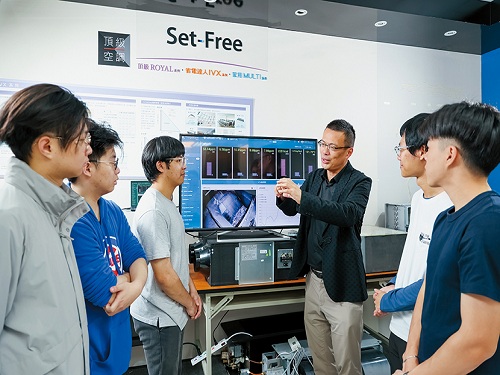
Professor Lee leads his research team in one of the nation’s most important areas of development: energy conservation and carbon reduction. Taking waste incineration plants as an example, controlling the combustion process has traditionally been very challenging because the composition of waste varies greatly, resulting in unstable calorific values. To address this issue, Professor Lee collaborated with environmental authorities to develop Taiwan’s first AI-based waste incineration control system. The system effectively provides the incinerator with “eyes” and a “brain.” Using dual-camera image recognition technology, it monitors combustion conditions in real time, while AI predictive models automatically adjust airflow and waste-feeding rates to optimize the burning process. This technology was successfully implemented at the Yilan incineration plant, where it increased operational efficiency to 92%—the highest level in Taiwan. In addition, the system significantly reduced pollutant emissions, demonstrating the effectiveness of AI in promoting energy conservation and environmental sustainability.
In the field of building and air-conditioning energy efficiency, Professor Lee collaborated closely with Chunghwa Telecom and Hitachi Air Conditioning Taiwan for seven years. Together, they developed AI-based energy-saving control modules and implemented them in telecommunications facilities and commercial buildings. By using AI to predict energy loads and optimize the operation of equipment and facilities, the system significantly reduced electricity consumption and operating costs. This achievement became a successful example of AI-driven energy conservation and carbon reduction, demonstrating the potential of artificial intelligence in promoting sustainable development.
Beyond technological research and development, Professor Lee has also actively expanded his influence within the industrial sector. While serving as the Technical Convener of the Taiwan Energy Storage System Industry Promotion Alliance under the Taiwan Electrical and Electronic Manufacturers’ Association, he proposed a key recommendation: “Energy storage participation in demand-response programs should be included in the calculation of the 1% energy-saving requirement.” This forward-looking proposal was eventually adopted by the Ministry of Economic Affairs as an official policy. As a result, energy storage systems are no longer viewed merely as backup power sources; they are now recognized as effective tools for achieving energy-saving targets. The policy has greatly increased incentives for businesses to invest in energy storage systems while also making a substantial contribution to enhancing the resilience and stability of Taiwan’s power grid.
Acting as Students’ Entrepreneurial Partner: Learning Through Market Competition and Real-World Challenges
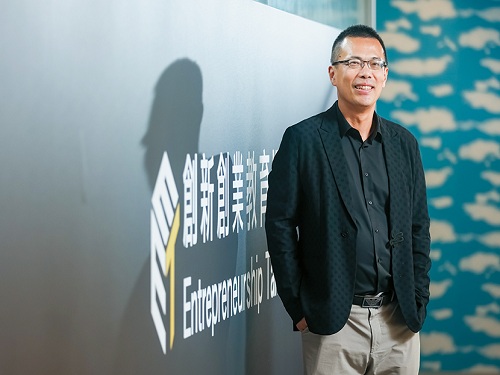
Professor Lee does not see himself as a traditional teacher. Instead, he considers himself more of an entrepreneurial partner to his students. His laboratory is filled with energy and enthusiasm, and students feel comfortable enough to joke with him openly. He frequently takes students directly into factories and boiler facilities, guiding them through hands-on, apprenticeship-style learning. This close mentorship has been one of the key driving forces behind his outstanding industry-academia achievements. By transforming the lessons learned from his entrepreneurial failures into valuable practical wisdom, Professor Lee has successfully incubated several promising startup teams. He believes that entrepreneurship must be learned through action. Therefore, in addition to introducing students to important industry connections and resources, he encourages them to adopt a strategy of learning through competition by exposing themselves directly to the challenges of the marketplace.
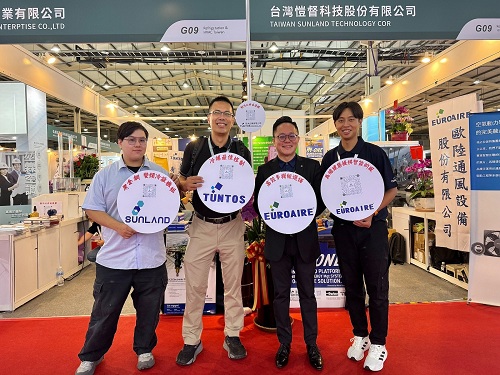
Many of his students have gone on to achieve remarkable entrepreneurial success. Shang-Tse Lee, CEO of GasolineAI, commercialized Professor Lee’s AI combustion control technology, and the company’s valuation has exceeded NT$110 million. One of Professor Lee’s greatest strengths is his ability to bridge the gap between academia and industry, enabling students to face real-world business challenges with confidence. Jen-Chieh Huang, founder of Euroaire Ventilation, focuses on EC fans and intelligent monitoring systems. The company has achieved annual revenues of NT$250 million. In addition, doctoral student Liang-Cheng Chang founded Infilink, which successfully assisted Chunghwa Telecom in implementing a cloud-based energy management platform. These examples demonstrate that within the vocational education system, the relationship between teachers and students can evolve into a genuine partnership of co-creation. Teachers contribute technology, expertise, and professional networks, while students provide creativity and execution. Together, they transform laboratory innovations into marketable products and create tangible economic value.
A Disciplined, High-Intensity Lifestyle: The Secret Behind Exceptional Productivity
Despite maintaining an incredibly demanding schedule that includes teaching, research, industry-academia collaboration projects, and multiple government advisory positions, Professor Lee consistently demonstrates remarkable energy and productivity. The source of this energy lies in his iron discipline and highly structured lifestyle. Living in Yilan while working in Taipei, he commutes daily to balance his family life and professional responsibilities. Every morning at 5:30 a.m., while most people are still asleep, he is already awake, putting on his running shoes and beginning his daily jog in the fresh air of Yilan.
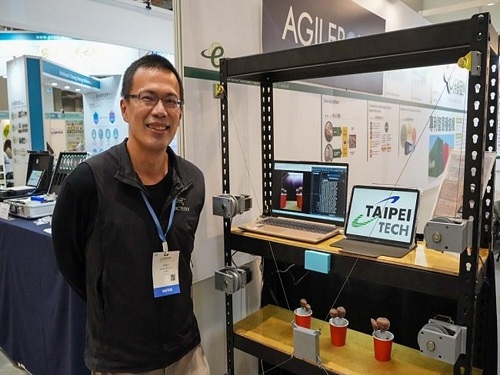
Although he often jokes that he lives “on the edge of overwork,” his morning run is more than just physical exercise. It provides valuable time to clear his mind and plan the day ahead. Likewise, his commute from Yilan to Taipei serves as a transition period, allowing him to shift smoothly between his various roles and responsibilities. This disciplined and high-intensity lifestyle has become the foundation of his exceptional productivity.
Standing at the forefront of the AI revolution, Professor Lee emphasizes that although AI is powerful, it is meaningless without domain expertise. In a manufacturing environment, practical constraints such as hardware limitations, sensor capabilities, and production-line processes must all be taken into consideration. Otherwise, AI may generate solutions at extraordinary speed while the hardware remains incapable of executing them, resulting in recommendations that are impossible to implement. Taiwan possesses world-class manufacturing capabilities and hardware expertise, which Professor Lee regards as some of the nation's most valuable forms of domain knowledge. He believes that Taiwan cannot rely solely on its semiconductor industry. Through the empowerment of AI, sectors such as machinery, energy, and traditional manufacturing must also undergo transformation and upgrading.
From a doctoral student who experienced entrepreneurial failure to a leading figure in industry-academia collaboration, Professor Lee has consistently served as a bridge between academia and industry. He remains committed to transforming academia's precious 1% of inspiration into the 99% of tangible profits and sustainable value required by industry through rigorous industrial standards and practical business logic.
- Research Area
- Research Overview
- Design & Humanities
- Environment & Sustainability
- Green & Energy
- Life & Health
- Materials
- Technology
- Research Highlights
- Highlights
- Top Journal Publications
- National Award

Best viewed with Chrome / Edge or higher with 1280 x 768 resolution
Copyright© National Taipei University of Technology. Taipei, Taiwan; all rights reserved.