

Static and dynamic mechanical characteristics of 3D-Printed anisotropic basalt fiber-reinforced cement mortar
This paper investigates the static and dynamic mechanical properties of 3D-printed basalt fiber-reinforced cement mortar (BFRCM). Chopped basalt fibers at four volume ratios (2.5–10 vol‰) were incorporated into mortar, and printability parameters — extrudability, flowability, setting time, and buildability — were optimized. Both 3D-printed and mold-cast specimens were evaluated for compressive and flexural strengths, plus dynamic performance via drop-weight impact and stress reversal split Hopkinson pressure bar (SRSHPB) tests, revealing significant anisotropic behavior driven by the layer-by-layer printing process.
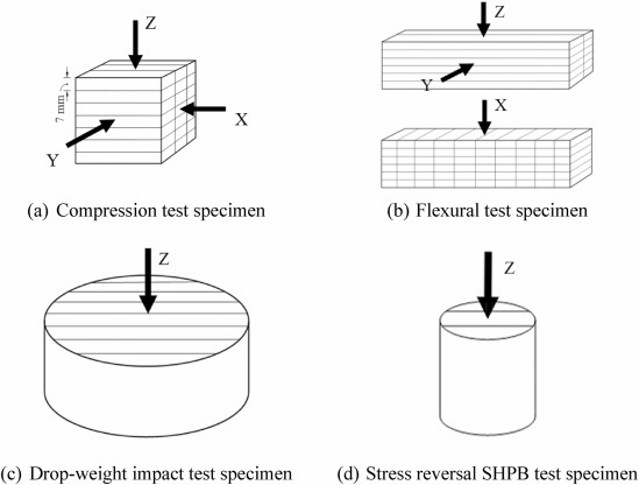
Fig. 3. The schematic diagram of test specimens under different loading directions.
Technology Overview
The study uses a gantry-type 3D printer with basalt fiber-reinforced mortar, combining heat-treated and pneumatically dispersed 6 mm fibers with superplasticizers and accelerators to achieve printable slump values. Dynamic properties are assessed via SRSHPB testing, which generates controlled single compression-tension wave pulses to measure strain rate, stress, and dynamic increase factor.
Applications & Benefits
Applicable to innovative construction and structural engineering, 3D-printed BFRCM offers improved compressive and flexural strengths — peaking at 7.5 vol‰ fiber ratio — reduced material waste, and design flexibility. The Z-direction pressurized extrusion enhances interlayer bonding, though dynamic impact resistance remains a limitation compared to conventional cast specimens.
Abstract:
Three-dimensional (3D) printed mortar, represents an innovative approach to construction, utilizing additive manufacturing techniques, distinct from traditional reinforced concrete (RC) formwork methods. In this study, chopped basalt fibers, each 6 mm in length, were added to the mortar at different volume ratios (2.5 ‰, 5 ‰, 7.5 ‰, and 10 ‰). The printable properties of basalt fiber-reinforced cement mortar (BFRCM), such as the extrudability, fluidity, setting time, and buildability, were evaluated to determine the optimal mix for 3D printing applications. The compressive and flexural strengths of 3D-printed anisotropic specimens with those of mold-cast specimens after 28 days of wet curing were compared. Additionally, the dynamic mechanical properties under various impact conditions were assessed using both the drop-weight impact test and the stress reversal split Hopkinson pressure bar (SRSHPB) test. The findings revealed that a fiber ratio of 7.5 vol‰ resulted in the highest compressive and flexural strengths. It is noteworthy that the anisotropic mechanical properties of the 3D-printed specimens exhibited a considerable enhancement in strength in the load direction perpendicular to the printing side. However, the results of the dynamic strength tests revealed that the interlayer adhesion at the printing interfaces of the 3D-printed specimens was weaker than that of the mold-cast specimens in both the drop-weight impact test and the SRSHPB test.

Static and dynamic mechanical characteristics of 3D-Printed anisotropic basalt fiber-reinforced cement mortar
Author:Li Yeou-Fong, Liang Yu-Fang, Syu Jin-Yuan, Huang Chih-Hong, Tsai Ying-Kuan, Lok Man-Hoi
Year:2025
Source publication: Journal of Building Engineering, Volume 100, April 2025, 111692
Subfield Highest percentage: 99% Architecture #2/210