

Development of an ultrasensitive sensor for detecting metol in environmental water samples using ruddlesden-popper type layered perovskite (La2NiO4) combined with graphene oxide
This study presents an ultrasensitive electrochemical sensor for detecting metol (MTO), a hazardous organic pollutant commonly found in photographic wastewater. A novel La₂NiO₄@GO nanocomposite, combining Ruddlesden–Popper layered perovskite (La₂NiO₄) with graphene oxide, was synthesized and used to modify a glassy carbon electrode. The sensor demonstrated excellent conductivity, high sensitivity, and strong selectivity, achieving a detection limit of 6.4 nM. Successful detection of MTO in river water and human urine samples highlights its potential for environmental monitoring and pollution control.
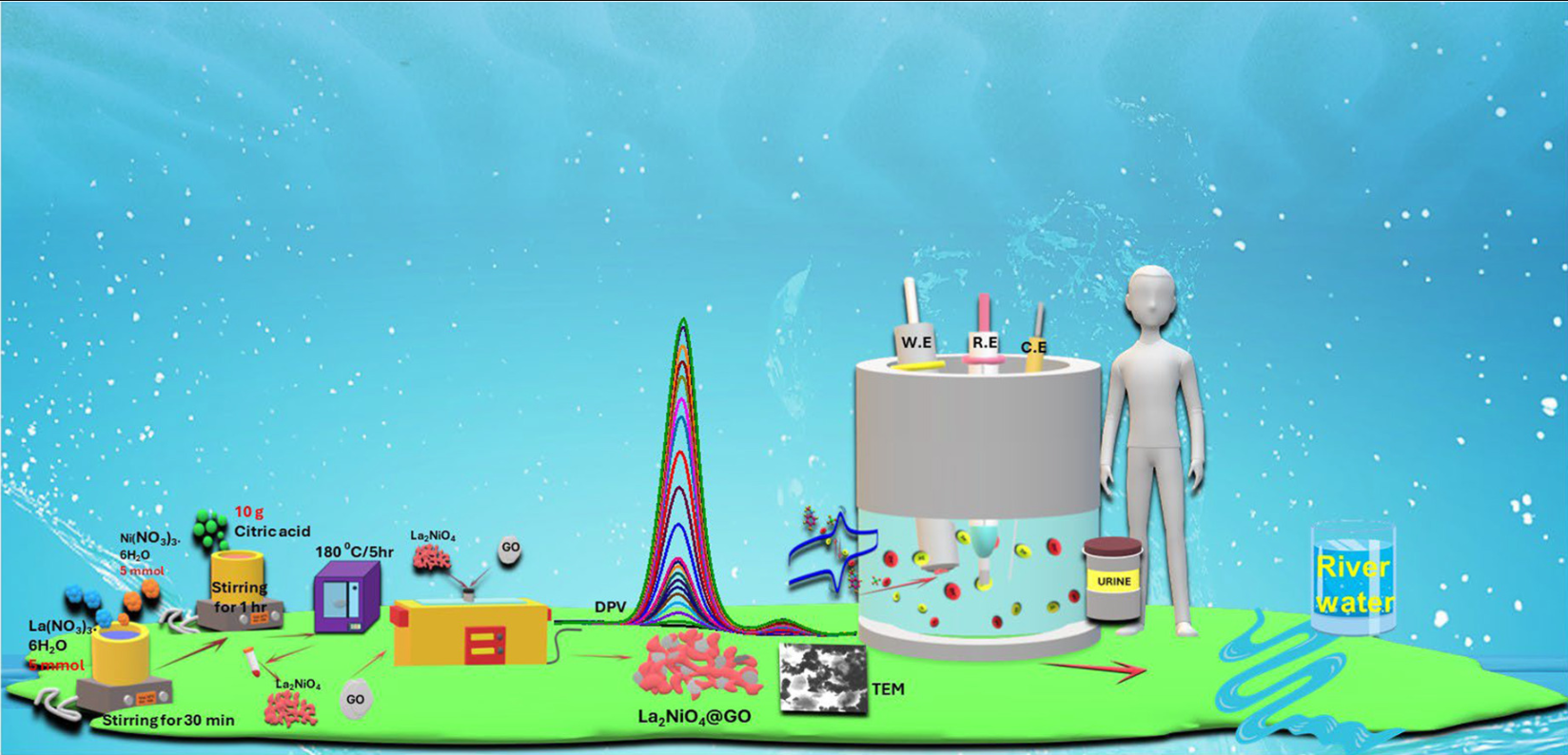
Fig. Graphical Abstract.
Technology Overview
A La₂NiO₄@GO nanocomposite was fabricated through hydrothermal synthesis and ultrasonication. The material was integrated onto a glassy carbon electrode to create an electrochemical sensor with enhanced electron transfer, large active surface area, and high catalytic activity for ultrasensitive metol detection.
Applications & Benefits
The sensor enables rapid and accurate detection of metol in environmental water and biological samples. It offers a low detection limit (6.4 nM), high sensitivity, excellent anti-interference performance, and reliable long-term stability, making it suitable for environmental monitoring and water quality assessment.
Abstract:
Metol (MTO), a commonly used photographic developer, has become an environmental pollutant due to its extensive use and subsequent release into water sources. The accumulation of MTO poses significant risks, including aquatic toxicity and potential bioaccumulation, leading to adverse effects on ecosystems. To address these environmental challenges, we developed a La₂NiO4 combined with graphene oxide (La₂NiO₄@GO) nanocomposite modified glassy carbon electrode (GCE) for the ultrasensitive detection of MTO. The La₂NiO₄ was synthesized via a hydrothermal method and subsequently integrated with graphene oxide through a sonochemical technique, with comprehensive characterization using Fourier-transform infrared spectroscopy (FT-IR), X-ray photoelectron spectroscopy (XPS), and High-resolution transmission electron microscopy (HR-TEM). Electrochemical analysis revealed that the La₂NiO₄@GO-modified electrode exhibited a low charge transfer resistance of 20 Ω. Using differential pulse voltammetry (DPV), the electrode demonstrated a limit of detection (LOD) of 6.4 nM for MTO, with a high sensitivity of 10.84 µA µM⁻¹cm⁻² and excellent anti-inference property towards MTO tested along with interfering substances. The sensor was successfully applied to real environmental water samples and human urine samples, showing excellent recovery rates of MTO. This work underscores the potential of La₂NiO₄@GO-modified electrodes in monitoring and mitigating the environmental impact of MTO, contributing to a healthy environment.

Development of an ultrasensitive sensor for detecting metol in environmental water samples using ruddlesden-popper type layered perovskite (La2NiO4) combined with graphene oxide
Author:Manimaran Parthasarathi, Tamilalagan Elayappan, Chen Shen-Ming, Govindharaj Abirami
Year:2025
Source publication: Water Research, Volume 273, April 2025, 122998
Subfield Highest percentage: 99% Civil and Structural Engineering #3 / 434