

Construction safety inspection with contrastive language-image pre-training (CLIP) image captioning and attention
This paper addresses critical inefficiencies in traditional construction safety inspections, where manually documenting site violations through photographs and textual descriptions is highly labor-intensive, time-consuming, and prone to inconsistency. To mitigate these challenges, the authors propose an automated, AI-powered framework that leverages Contrastive Language-Image Pre-training (CLIP) fine-tuning and prefix captioning. By automatically generating safety observations directly from site images and streamlining report compilation through a dedicated mobile application, this approach significantly reduces manual workloads while accelerating the digital transformation of construction sites.
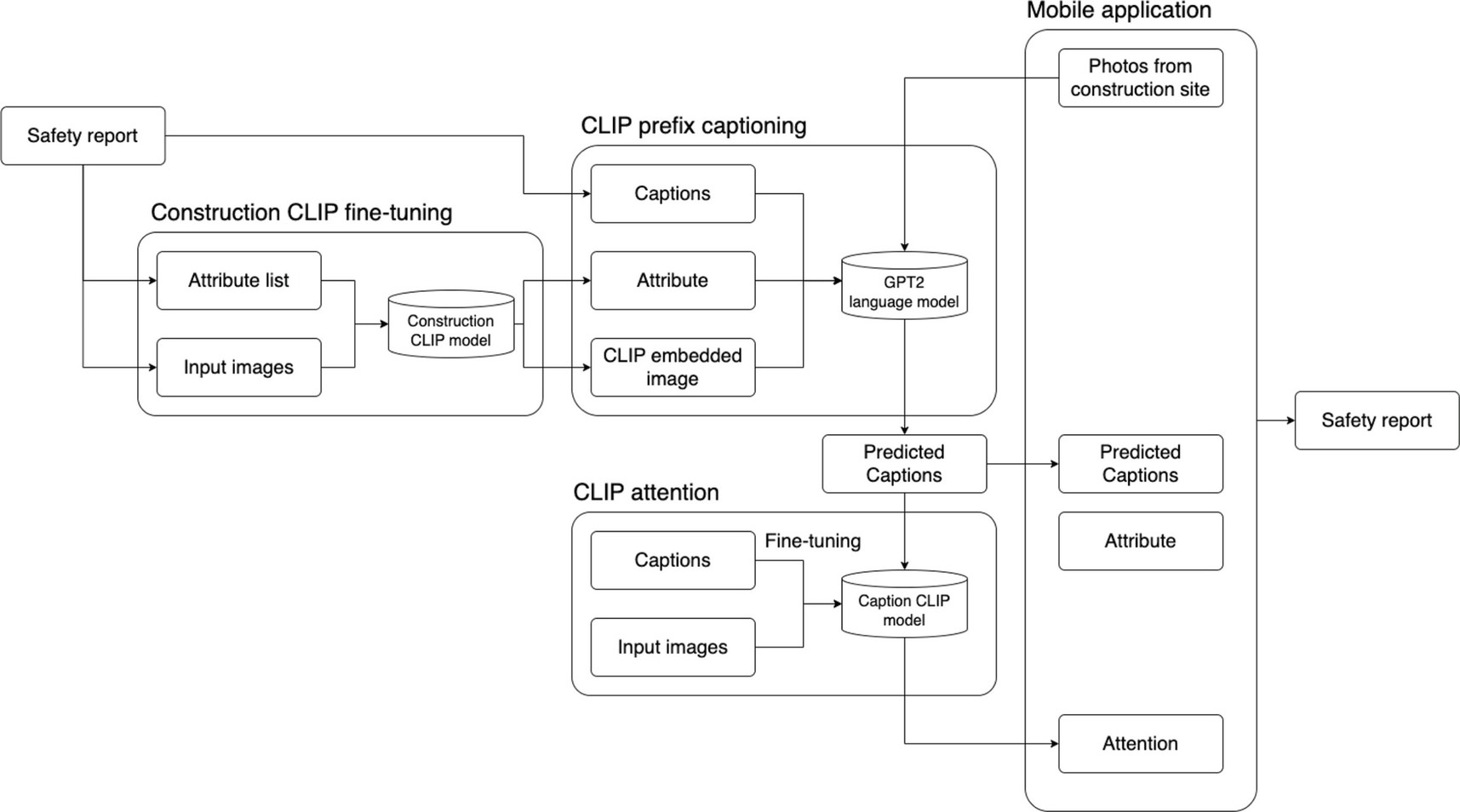
Fig. 1. Overview of proposed framework.
Technology Overview
The core of SSG lies in utilizing photothermal materials to convert solar energy into thermal energy, which evaporates saline or contaminated water into clean steam. To maximize this solar-to-vapor conversion efficiency, light management must be optimized synergistically across multiple structural scales. At the molecular and sub-nanoscale levels, materials are fine-tuned to enable broad-spectrum solar absorption. Advancing to the nano- and microscale, structures are tailored to enhance light trapping through internal reflections, scattering, and optical confinement effects. Finally, at the macroscopic level, device geometries and spatial configurations are strategically engineered to maximize light capture from various incident angles while minimizing optical losses, ensuring the full potential of photothermal conversion is unlocked.
Applications & Benefits
By leveraging sunlight as the sole energy input, hierarchically engineered SSG provides a cost-effective, sustainable, and scalable solution for freshwater production, directly addressing the impending global water crisis. Beyond standard desalination and wastewater treatment, these advanced systems can serve as multifunctional platforms—simultaneously driving water purification alongside green hydrogen generation or thermoelectric co-generation. This adaptable approach requires no complex infrastructure, making it highly viable for decentralized water-energy nexus applications.
Abstract:
Solar steam generation (SSG) presents a promising approach to addressing the global water crisis. Central to SSG is solar photothermal conversion that requires efficient light harvesting and management. Hierarchical structures with multi-scale light management are therefore crucial for SSG. At the molecular and sub-nanoscale levels, materials are fine-tuned for broadband light absorption. Advancing to the nano- and microscale, structures are tailored to enhance light harvesting through internal reflections, scattering, and diverse confinement effects. At the macroscopic level, light capture is optimized through rationally designed device geometries, configurations, and arrangements of solar absorber materials. While the performance of SSG relies on various factors including heat transport, physicochemical interactions at the water/air and material/water interfaces, salt dynamics, etc., efficient light capture and utilization holds a predominant role because sunlight is the sole energy source. This review focuses on the critical, yet often underestimated, role of hierarchical light harvesting/management at different dimensional scales in SSG. By correlating light management with the structure-property relationships, the recent advances in SSG are discussed, shedding light on the current challenges and possible future trends and opportunities in this domain.

Construction safety inspection with contrastive language-image pre-training (CLIP) image captioning and attention
Author:Tsai Wei-Lun, Le Phuong-Linh, Ho Wang-Fat, Chi Nai-Wen, Lin Jacob J., Tang Shuai, Hsieh Shang-Hsien
Year:2025
Source publication:Automation in Construction, Volume 169, January 2025, 105863
Subfield Highest percentage: 99% Civil and Structural Engineering #1 / 434