

Enhancing self-induced polarization of PVDF-based triboelectric film by P-doped g-C3N4 for ultrasensitive triboelectric pressure sensors
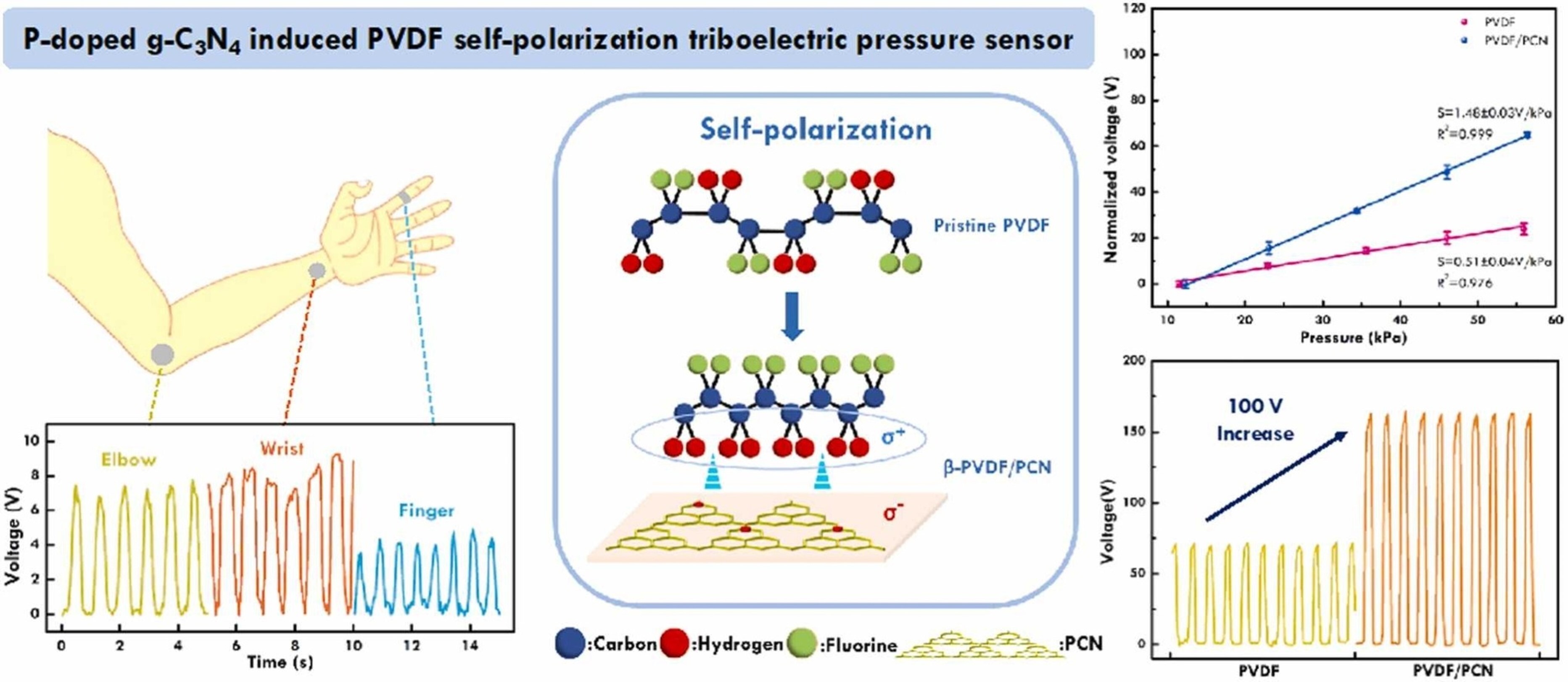
In this work, our focus was on optimizing the sensitivity and triboelectric output by integrating phosphorus-doped g-C3N4 (PCN) in PVDF film to achieve self-induced polarization. By altering the doping temperature of phosphorus in g-C3N4, it stimulates self-polarization in PVDF, resulting in the formation of β phase chains which exhibit better triboelectric properties.
Technology Overview
A self-powered triboelectric pressure sensor was constructed based on phosphorus-doped g-C3N4 modified PVDF. The electronegativity of g-C3N4 can be enhanced by phosphorus atoms, resulting in a more negative PVDF. The phosphorus electron delocalizes into the π-electrons of g-C3N4, enhancing self-polarization of PVDF. PVDF/PCN triboelectric pressure sensor exhibits nearly a 3-fold increase compared to pristine PVDF one.
Applications & Benefits
To summarize, a rationally constructed strategy for higher sensitivity generated by triboelectric pressure sensor was developed. The PVDF/PCN triboelectric nanogenerator not only provides high output performance but also shows high flexibility and sensitivity, which has great potential for being widely used in self-powered wearable sources.
Abstract:
Progress in wearable energy devices has reached the point of popularity over a few decades, as reflected by the rise of numerous sensors and storage devices driven by the urgent need for Internet of Things (IoT) applications. Triboelectric sensor (TES), on the basis of triboelectric nanogenerators (TENGs), exhibits high sensitivity and stability for pressure detection. Maximizing the sensitivity of the TES hinges upon the triboelectric layer selection capable of harnessing triboelectrification and electrostatic induction. Among them, PVDF has gained attention owing to its exceptional flexibility and tribo-negativity. However, the multiphase of pristine PVDF poses challenges, limiting its potential for TES with higher sensitivity. Tackling this issue, herein, we introduced phosphorus-doped graphitic carbon nitride (PCN) into the PVDF films to achieve self-induced polarization to enhance the sensitivity of the triboelectric pressure sensor. Through a controlled annealing temperature, phosphorus atoms are incorporated into the g-C3N4 (CN) matrix, enhancing the electronegativity of PVDF/PCN composite film while inducing a polarized β crystal phase in PVDF, thereby enabling greater attraction of positive charges. Consequently, the triboelectric output with PVDF/PCN composite film exhibited a significant improvement compared to the pristine PVDF film, achieving over a 100 V increment and the ability to power more than 100 LEDs. Furthermore, for the pressure-sensing applications, the TES with flexible PVDF/PCN triboelectric film exhibits a pressure sensitivity of 1.48 V/kPa, which shows a threefold increase in sensitivity compared to the pristine PVDF film (0.51 V/kPa), suggesting their great potential in self-powered wearable pressure sensors.
Enhancing self-induced polarization of PVDF-based triboelectric film by P-doped g-C3N4 for ultrasensitive triboelectric pressure sensors
Author:Yen-Shou Chiu, Mia Rinawati, Yu-Hsin Chang, Sofiannisa Aulia, Ching-Cheng Chang, Ling-Yu Chang, Wei-Song Hung, Hitoshi Mizuguchi, Shu-Chih Haw, Min-Hsin Yeh
Year:2024
Source publication:Nano Energy, Volume 131, Part A, 1 December 2024
Subfield Highest percentage: 99% Electrical and Electronic Engineering #8 / 970
https://www.sciencedirect.com/science/article/pii/S2211285524009595