

Investigation on admixtures applied to alkali-activated materials: A review
This paper mainly introduces and summarizes the effect of different traditional admixtures and novel admixtures (such as foam agents, biomass compounds, etc.) on AAMs properties, the effect of admixtures on surface/solution chemistry of AAMs slurry, the effect of admixture on hydration and microstructure of AAMs and application research.
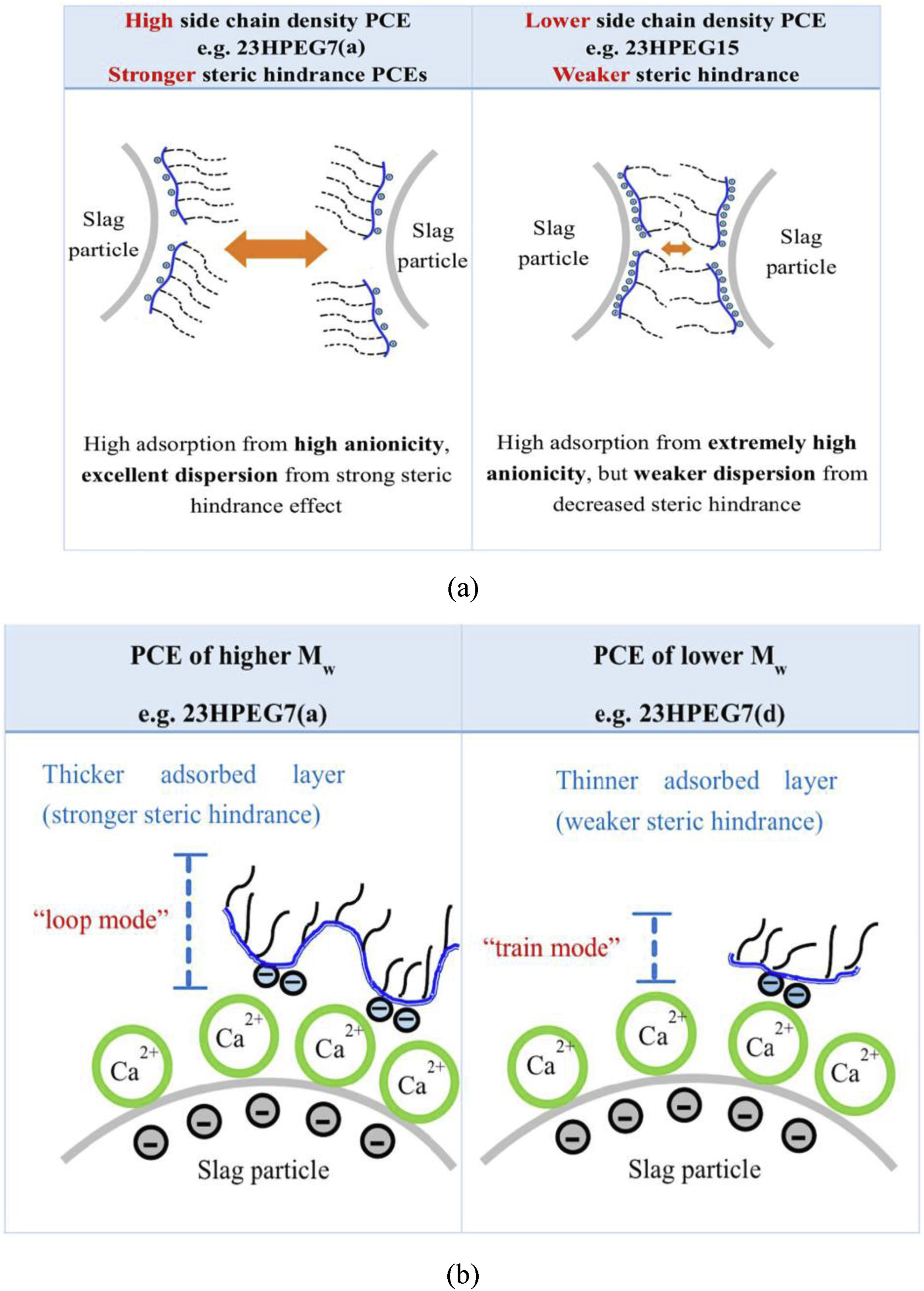
Fig. 32. Mechanism of the adsorption of HPEG-based polycarboxylate plasticizers (PCEs) with different molecular structures (a) illustration of the steric hindrance forces from PCEs with high and low side chain density; (b) illustration of the steric hindrance forces resulting from a thicker or thinner adsorbed PCE layer on the surface of slag particles.
Technology Overview
The effects of the admixtures on various properties of AAM in the past decades were summarized. The influences of different admixtures on the hydration and microstructure of AAM were discussed. The effects of admixtures especially plasticizers on surface/solution chemistry were analyzed. List relevant project cases to better understand the application of chemical admixtures in AAM. Provide useful suggestions and prospects for the development of AAM admixtures.
Applications & Benefits
The current research results broaden the insight and show two key issues affecting the effect of admixtures: (i) the effect of chemical composition of AAM raw materials, especially calcium content; (ii) the effect of complex liquid environment caused by activator. The change of calcium content in AAM raw materials directly results in the change of the type and structure of hydration products. A more in-depth study of the effects of different chemical admixtures on the structure and characteristics of the hydration products of AAMs at different stages is important for understanding the mechanism of different retarders and developing new retarders. The complex liquid environment caused by activator should make researchers pay more attention to the interaction between chemical admixture and activator, as well as the surface chemistry (e.g. chemical composition and charge properties) of particles in different AAM fresh pastes, which is helpful to improve the dispersion of nanoparticles and develop new plasticizers. Especially for the development of new plasticizers, it may be more critical and convenient to introduce the chemisorption groups or cationic groups into the molecules to improve the adsorption than to improve the molecular solubility.
Investigation on admixtures applied to alkali-activated materials: A review
Author:Liu Xiao, Li Shiyu, Ding Yungchin, Lu Zichen, Stephan Dietmar, Chen Yichen, Wang Ziming, Cui Suping
Year:2023
Source publication:Journal of Building Engineering Volume 64, 1 April 2023
Subfield Highest percentage:99% Architecture # 1 / 189
https://www.sciencedirect.com/science/article/pii/S2352710222017004