

Illuminating the Brain: Advances and Perspectives in Optoelectronics for Neural Activity Monitoring and Modulation
In this review, we evaluate recent efforts to use electrical, optical, and electrochemical modalities for neuromodulating and sensing, focusing on three main technical advancements: transparent intracortical probes, multifunctional optical fibers and microfluids, and micro-light-emitting diodes (µLEDs) integrated devices. The continued development and refinement of these implantable optoelectronics hold great promise for advancing our understanding of the brain and improving clinical outcomes for patients with neurological disorders.
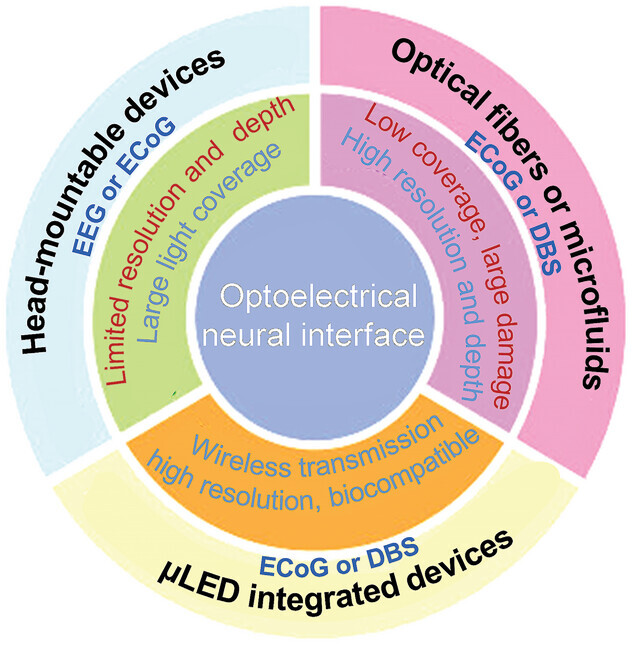
Figure 1. Summary of the advantages and disadvantages of three types of optoelectronics for optoelectrical neural interface monitoring and modulation.
Technology Overview
Implantable optoelectronics hold great promise for modulating and monitoring neural activity. With the ability to operate with cell type selectivity and address volumes of tissues using projected optics, optoelectrical neural interfaces represent a potent tool for compensating for the limitations of electrical methods in modulating and monitoring neural signals. Additionally, the use of transparent neuroelectrodes, optical neural fibers and microfluids, and µLEDs integrated devices can help address issues related to low light transmittance and data collection incompatibility between optical and electrical methods. Advances in materials engineering and biological considerations will also play a critical role in developing implantable optoelectronics that can operate with greater precision and reduce the risk of brain damage.
Applications & Benefits
Moving forward, the evolution of implantable hybrid optoelectrical devices should be adapted in a biocompatible and high-density manner that requires minimal damage and high resolution for nervous signal modulation. By reaching these objectives, basic brain research will improve significantly, and biomedical devices for clinical use will become possible. The future of implantable optogenetics is bright, and continued research and development in this area holds great promise for the future of neuroscience and clinical medicine. It is anticipated that wireless technology will become increasingly prevalent and sophisticated in the upcoming years, enabling neural signal modulation and data transmission to be performed with greater ease and flexibility. However, technical complexity, limited light penetration in optogenetics, and safety considerations need to be carefully addressed to fully harness the potential of these approaches. Magneto-optogenetic multimodalities face challenges related to optimizing the strength of magnetic forces and refining the technical aspects.
Abstract:
Optogenetic modulation of brain neural activity that combines optical and electrical modes in a unitary neural system has recently gained robust momentum. Controlling illumination spatial coverage, designing light-activated modulators, and developing wireless light delivery and data transmission are crucial for maximizing the use of optical neuromodulation. To this end, biocompatible electrodes with enhanced optoelectrical performance, device integration for multiplexed addressing, wireless transmission, and multimodal operation in soft systems have been developed. This review provides an outlook for uniformly illuminating large brain areas while spatiotemporally imaging the neural responses upon optoelectrical stimulation with little artifacts. Representative concepts and important breakthroughs, such as head-mounted illumination, multiple implanted optical fibers, and micro-light-delivery devices, are discussed. Examples of techniques that incorporate electrophysiological monitoring and optoelectrical stimulation are presented. Challenges and perspectives are posed for further research efforts toward high-density optoelectrical neural interface modulation, with the potential for nonpharmacological neurological disease treatments and wireless optoelectrical stimulation.
Illuminating the Brain: Advances and Perspectives in Optoelectronics for Neural Activity Monitoring and Modulation
Author:Xu Shumao, Momin Marzia, Ahmed Salahuddin, Hossain Arafat, Veeramuthu Loganathan, Pandiyan Archana, Kuo Chi-Ching, Zhou Tao
Year:2023
Source publication:Advanced Materials: Volume 35, Issue 42
Subfield Highest percentage:99% Mechanical Engineering # 3 / 672
https://advanced.onlinelibrary.wiley.com/doi/full/10.1002/adma.202303267