

Recent Advances in Rechargeable Metal-CO2 Batteries with Nonaqueous Electrolytes
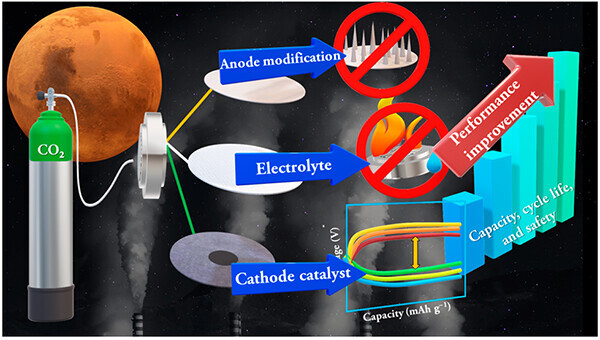
We have written the review article focusing on the contemporary developments in the nonaqueous secondary metal–CO2 batteries, based on Li, Na, Mg, Al, and K. The small voltage stability window (0–1.23 V vs standard hydrogen electrode (SHE)), hydrogen evolution reaction, high reactivity with the alkali metal anodes, severe anode corrosion by forming hydroxides, and increasing discharge voltage severely limit the usage of aqueous electrolytes. The cathode catalyst, electrolyte, and metal anode are the discerning components of a metal–CO2 battery. Therefore, we have reviewed recent electrolytes, cathode catalysts, and metal anode modifications in this review article. Besides we have also discussed how the presence of other gases/moisture in CO2 gas can influence the battery’s performance.
Technology Overview
In this review article, we have categorically reviewed the secondary Li–CO2, Na–CO2, K–CO2, Mg–CO2, and Al–CO2 batteries, mainly with aprotic electrolytes. We have tried sectionizing each metal–CO2 battery primarily into four sections─electrolytes, cathodes, modification of the anode (if any), and effect of other gases in CO2. We also have reported a few photoassisted cathodes for Li–CO2 batteries, which we contemplate having a tremendous prospect. Next, we have discussed a few instances where the research focused on modifying the metallic Li, Na, and K anodes to get rid of the corrosion and dendrite formation phenomena. The effective anode modification can not only suppress the dendrite formation for Li, Na, and K anode but also produce a stable SEI layer that abates the parasitic reactions and facilitates smooth ionic transfer─ thereby extending the battery life. In the subsequent section, we have briefly emphasized the effect of other gases in CO2 by reviewing some articles that inclusively discussed the matter.
Applications & Benefits
In conclusion, the development of rechargeable metal–CO2 batteries is still in its early stages, but there is great potential for these batteries as sustainable and low-cost energy storage solutions. The high theoretical energy density of metal–CO2 batteries makes them attractive for electric vehicles and other energy-intensive applications. However, significant challenges remain to overcome, including improving the efficiency and stability of the electrochemical reaction and developing suitable catalysts. Nevertheless, ongoing research in this area is promising, and metal–CO2 batteries might play a significant role in the future of energy storage.
Abstract:
This review article discusses the recent advances in rechargeable metal–CO2 batteries (MCBs), which include the Li, Na, K, Mg, and Al-based rechargeable CO2 batteries, mainly with nonaqueous electrolytes. MCBs capture CO2 during discharge by the CO2 reduction reaction and release it during charging by the CO2 evolution reaction. MCBs are recognized as one of the most sophisticated artificial modes for CO2 fixation by electrical energy generation. However, extensive research and substantial developments are required before MCBs appear as reliable, sustainable, and safe energy storage systems. The rechargeable MCBs suffer from the hindrances like huge charging–discharging overpotential and poor cyclability due to the incomplete decomposition and piling of the insulating and chemically stable compounds, mainly carbonates. Efficient cathode catalysts and a suitable architectural design of the cathode catalysts are essential to address this issue. Besides, electrolytes also play a vital role in safety, ionic transportation, stable solid-electrolyte interphase formation, gas dissolution, leakage, corrosion, operational voltage window, etc. The highly electrochemically active metals like Li, Na, and K anodes severely suffer from parasitic reactions and dendrite formation. Recent research works on the aforementioned secondary MCBs have been categorically reviewed here, portraying the latest findings on the key aspects governing secondary MCB performances.

Recent Advances in Rechargeable Metal-CO2 Batteries with Nonaqueous Electrolytes
Author:Ayan, Sarkar; Vasantan Rasupillai, Dharmaraj; Chia-Hui, Yi; Kevin, Iputera; Shang-Yang, Huang; Ren-Jei, Chung; Shu-Fen, Hu; Ru-Shi, Liu
Year:2023
Source publication:Chemical Reviews Volume 123, Issue 15 August 9, 2023
Subfield Highest percentage:99% General Chemistry # 1 / 407