

Effects of urban tree planting on thermal comfort and air quality in the street canyon in a subtropical climate
Therefore, the present research aimed to (i) build a relatively complete evaluation model, which can simulate trees' resistance, shading effect, and transpiration cooling effect on the surrounding built surfaces or air, (ii) investigate the potential contribution of urban trees to the overall environmental quality of a street canyon based on the thermal comfort and air quality at the same time; (iii) analyze how trees' morphological indicators (leaf area index (LAI), tree height (Htree), and crown spread (Scrown)), as well as the tree planting density (Ptree), influence how on-street trees impact the local air quality and thermal comfort in a subtropical climate; and (iv) explore the influence of these different parameters when the geometry of street canyons is changed, for instance, shorting the length of the street canyons (from long to short) and increasing the depth of the street canyons (from regular to deep).
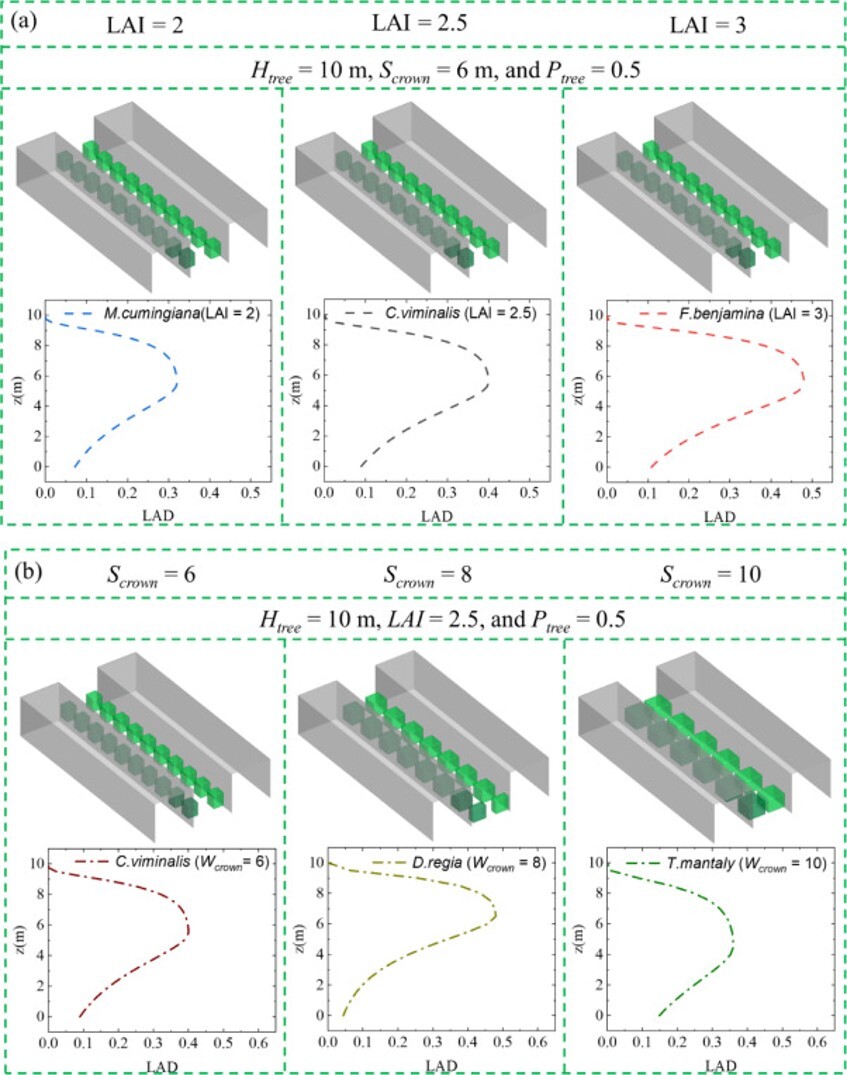
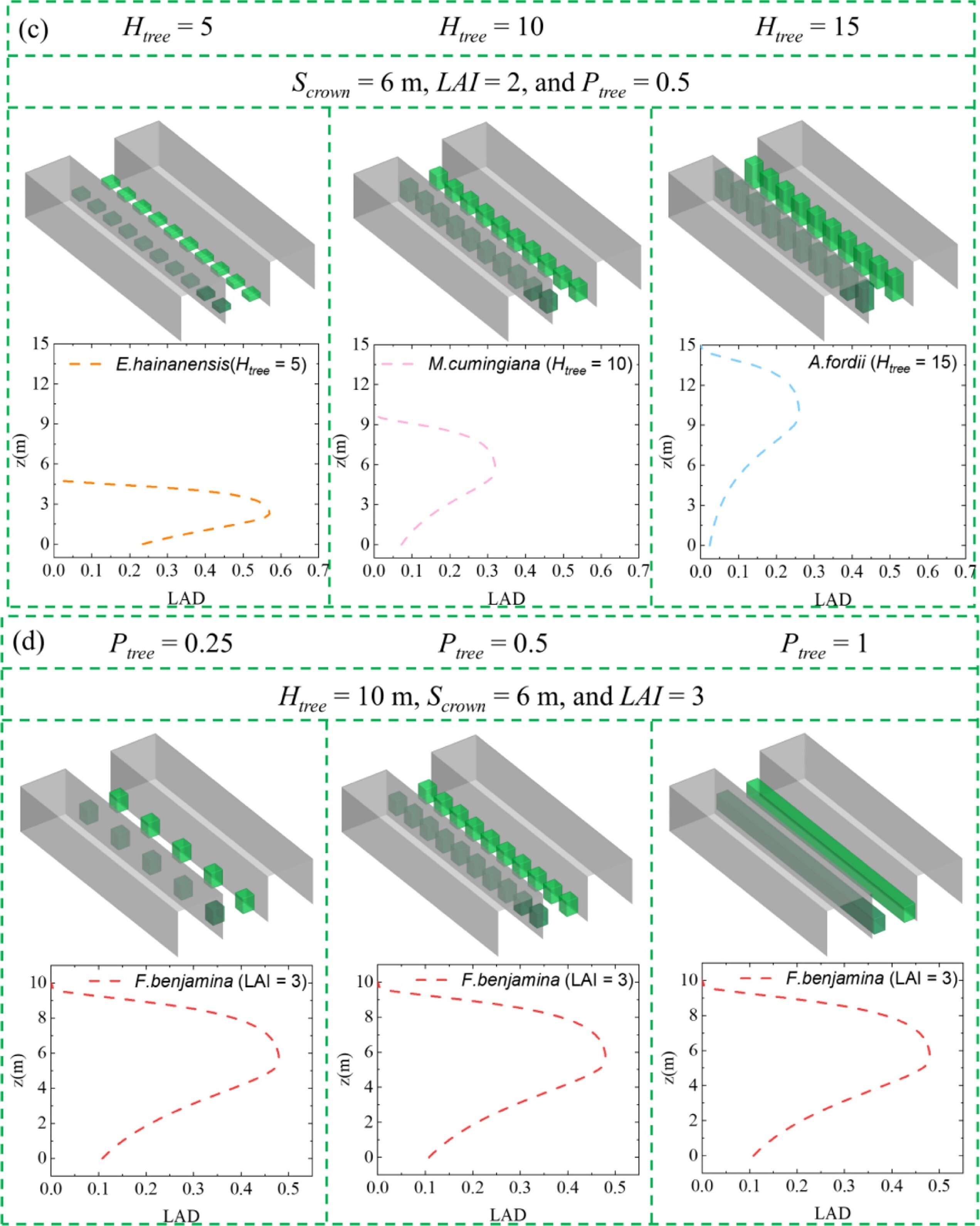
Fig. A1. Different configurations of trees inside the street canyon: (a) Different LAI, (b) Different crown spread, (c) Different tree height, and (d) Different tree planting density.
Technology Overview
Build an evaluation model of trees considering transpiration and shading effects. Study impact of trees to maximize environmental benefits in a subtropical climate. Higher trees with a lower near-ground LAD reduce PET and improve air quality. Windward larger or leeward smaller-crown trees minimize PET and enhance air quality. Increasing plant density and LAI can reduce PET while increasing concentration.
Applications & Benefits
For pedestrian-only streets, the influence of increasing tree LAI on thermal comfort is limited. For the heavily traveled commuter street, enormous traffic emissions are emitted, resulting in a considerable accumulation of pollutants. Therefore, urban planners should restrict the negative impact of tree planting on air quality as much as possible. For normal streets, pedestrians' thermal sensibility and traffic-related pollution issues must be simultaneously considered. it is as much as possible to significantly increase thermal comfort by tree planting while minimizing the detrimental effects on air quality. Therefore, planting trees with a lower LAI or taller trees with a lower LAD distribution around the ground on both walkways of a regular street canyon was recommended. Additionally, their planting density should be controlled, even though more trees will improve thermal comfort. Regarding the crown spread of trees, trees with larger crowns were more suited for the windward side, while trees with smaller crowns perform better on the leeward side.
Abstract:
Planting trees is considered to relieve the thermal load. However, trees may "pollute" the air quality. Tree net effects should receive more attention, but only a few studies have simultaneously addressed thermal comfort and air quality. By computational fluid dynamics (CFD) simulations, we created an evaluation model of trees and investigated the overall effects of tree planting inside street canyons. We considered the following four parameters by comparing seven common tree species in Hong Kong (subtropical climate): three tree morphological indicators (leaf area index (LAI), tree height (Htree), and crown spread (Scrown)) and tree planting density (Ptree). The results demonstrated that under a high ambient wind speed, higher trees with a lower near-ground leaf area density are better options, which more greatly reduces the physiological equivalent temperature (PET) by up to 1.1 K but causes the least pollutant accumulation. Bigger-crown trees on the windward side are advocated, while smaller ones are suitable for the leeward side. In such a way, there was at least a 0.7 K decrease in PET on the tree-planted side while maintaining better air quality. Thermal comfort can be improved by increasing LAI or Ptree, but a higher LAI or Ptree causes a greater accumulation of pollutants. Increasing Ptree can cause a 1.1 K reduction in PET, while the effect of changing LAI is relatively limited. When the length of a street is reduced, varying tree factors have a comparable effect. As canyon depth increases, the effect of trees is limited.
Effects of urban tree planting on thermal comfort and air quality in the street canyon in a subtropical climate
Author:Zhengtong Li, Hao Zhang, Yu-Hsuan Juan, Yee-Ting Lee, Chih-Yung Wen, An-Shik Yang
Year:2023
Source publication:Sustainable Cities and Society Volume 91, April 2023
Subfield Highest percentage:99% Civil and Structural Engineering #2/350
https://www.sciencedirect.com/science/article/pii/S2210670722006382