

Touchless Head-Control (THC): Head Gesture Recognition for Cursor and Orientation Control
In THC performance results, the system’s accuracy was not affected by darkroom lighting conditions and significant distance from the camera.
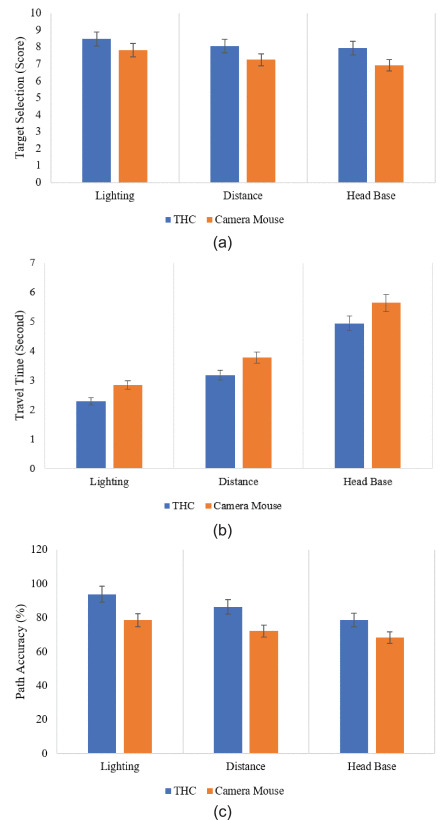
Performance comparison results of THC and Camera Mouse. (A) Target selection score, (B) Travel time, and (C) path accuracy.
Technology Overview
This paper proposes a Touchless Head-Control (THC) that uses head posture estimation and facial position to control the cursor on a PC and 3D objects in three DOFs (x -, y -, and z -axes). Our contribution is a new method to improve the performance of head pose predictions using deep convolutional neural networks (CNNs).
Applications & Benefits
We built an efficient CNN architecture that requires less pre-processing without keypoints and landmarks. The results indicated that the THC system was adequate for human-computer interaction and access control to assist disabled people with restricted motor skills.
Abstract:
The touchless techniques in human-computer interaction (HCI) can effectively expand computer access capabilities for disabled people. This paper presents Touchless Head-Control (THC), an assistive system method for computer cursor control based on head pose captured with an RGB camera. Our work aimed to replace the standard cursor control using a device on the user’s head. The convolutional neural networks with predicted fine-grained feature maps and binned classification were applied to estimate the head pose angles. The mouse pointer or cursor is moved to actual locations on the screen based on head movement (yaw and pitch) and the center position of the face. Head tilt to the right or left (roll) to control the mouse button. In addition, the proposed method can be used to simulate the movement of the robot or joystick using the head to control objects within three degrees of freedom (DOF). Various participants were involved in the interaction design evaluation, in which target selection accuracy, travel time, and path efficiency were measured. This technology allows people with limited motor skills to easily control a PC cursor and 3D object orientation without the use of additional equipment or sensors.
Touchless Head-Control (THC): Head Gesture Recognition for Cursor and Orientation Control
Author:Wahyu Rahmaniar, Alfian Ma’Arif, Ting-Lan Lin
Year:2022
Source publication:IEEE Transactions on Neural Systems and Rehabilitation Engineering, Volume 30, 2022
Subfield Highest percentage:99% Rehabilitation #1/129