

Hydrothermal carbonization of maize straw for hydrochar production and its injection for blast furnace
The aim of this paper was to investigate the characterized hydrochar of maize straw prepared via the hydrothermal carbonization (HTC) process as a solid fuel for blast furnace injection.
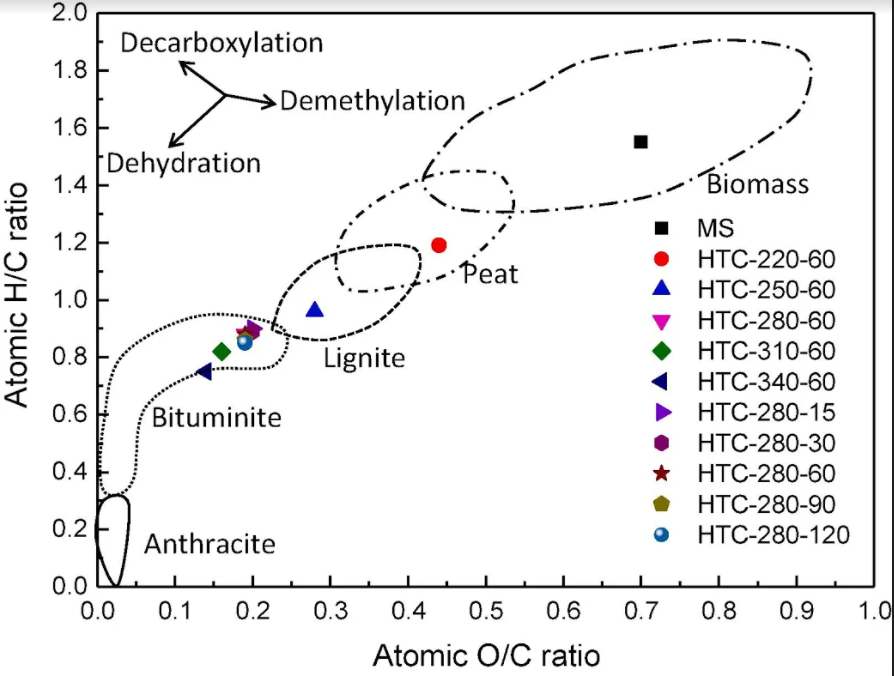
Van Krevelen diagram for LEA and hydrochars.
Technology Overview
Hydrothermal carbonization was employed to upgrade the maize straw for hydrochar. Physicochemical structures and combustion properties of hydrochars were studied. Maize straw hydrochar as clean solid fuel for blast furnace was first introduced. The optimal hydrothermal carbonization conditions were 280 °C and 60 min.
Applications & Benefits
The HTC process has proven to be an effective technology for the conversion of biomass into an alternative solid fuel for BF injection. However, more efforts are still needed to fully investigate the biomass hydrochar characteristics and explore effective application methods in BF.
Abstract:
The aim of this paper was to investigate the characterized hydrochar of maize straw prepared via the hydrothermal carbonization (HTC) process as a solid fuel for blast furnace injection. The effect of HTC conditions on the yield, physicochemical properties and combustion reactivity of hydrochar were evaluated by varying the HTC temperature over the range of 220–340 °C and the HTC time over the range of 15–120 min. The results showed that with the increase in HTC temperature and time, the yields, H/C and O/C values of hydrochar decreased, and the higher heating value increased. These characteristic changes in hydrochar are similar to those in bituminous coal because of dehydration and decarboxylation. The physicochemical properties and structure analyses showed that the specific surface area increased first and then decreased; meanwhile, the CC, CO and aromatic functional groups gradually increased. The carbonaceous structure of hydrochar became more compact, orderly and stable. Compared to the feedstock of maize straw, the combustion of hydrochar was expected to have higher ignition energy and become more stable with its higher ordering degree of the carbonaceous structure. HTC could be used as an effective method to convert maize straw biomass to a high quality solid injection fuel for the blast furnace.

Hydrothermal carbonization of maize straw for hydrochar production and its injection for blast furnace
Author:Wang, G., Zhang, J., Lee, J.-Y., (...), Teng, H., Wang, C.
Year:2020
Source publication:Applied Energy Volume 266, 15 May 2020, 114818
Subfield Highest percentage:99% Building and Construction #1/185
https://www.sciencedirect.com/science/article/pii/S0306261920303305