

Strategies for Designing Antithermal-Quenching Red Phosphors
We propose a novel strategy to develop red Eu3+, Mn4+-codoped Mg3Y2Ge3O12 (MYG) phosphor that possesses antithermal-quenching property as well as the color adjustability.
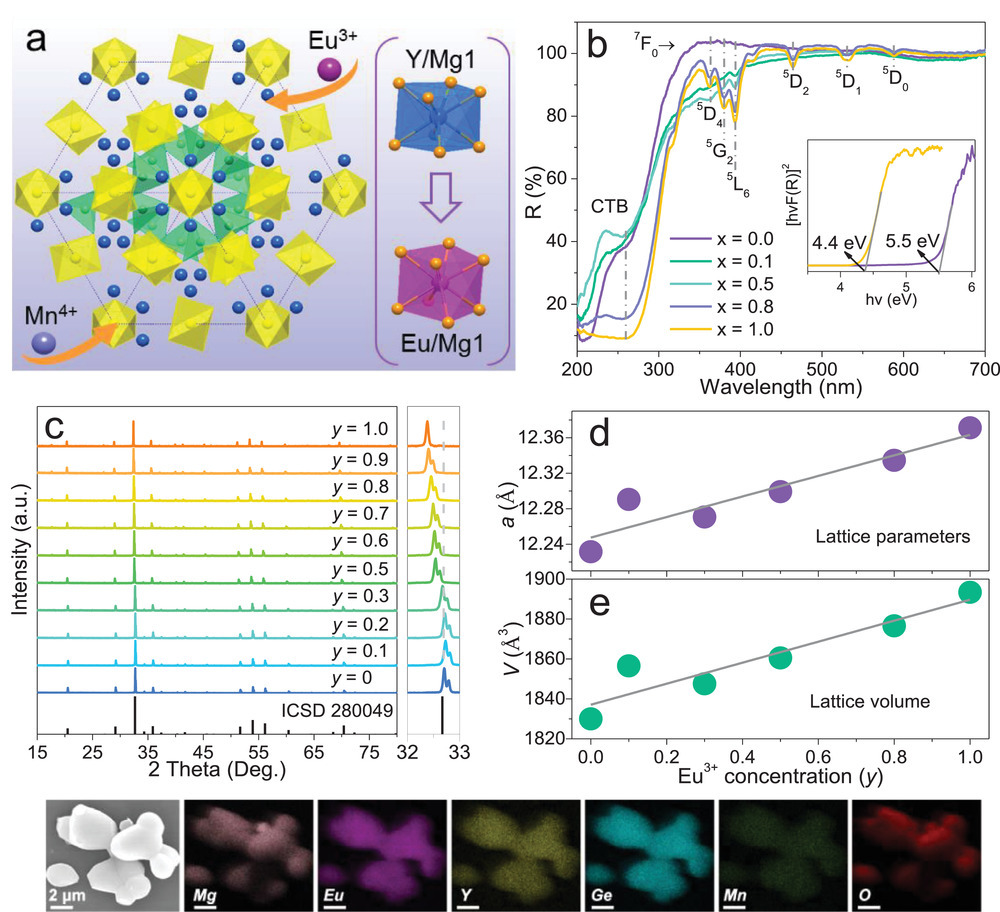
Figure 1:a) Crystal structure of MYG along [111] direction, where blue, violet, yellow, green, and orange spheres represent Y, Eu, Mg, Ge, O atoms respectively. b) Diffuse reflectance spectra of MYG:xEu3+ (0 ≤ x ≤ 1), the inset shows the optical bandgap values for MYG and MEG matrixes. c) XRD patterns of MYG:yEu3+, 0.01Mn4+ (0 ≤ y ≤ 1). d,e) Lattice parameter a and volume V versus Eu3+ concentration in MYG:yEu3+, 0.01Mn4+ (0 ≤ y ≤ 1). f) SEM images and elemental mapping analysis for MYG:0.6Eu3+, 0.01Mn4+ (The scalebar is 2 µm).
Technology Overview
This is the first time to report the antithermal-quenching behavior from the Eu3+ → Mn4+ energy transfer strategy, which opens a new gateway to obtain thermally stable luminescence materials. In addition, these phosphors can act as a superb red candidate in warm w-LEDs devices and optical thermometry sensors.
Applications & Benefits
These phosphors can act as a superb red candidate in warm w-LEDs devices and optical thermometry sensors. Therefore, this discovery opens a door to develop antithermal-quenching property and high luminescence efficiency in Mn4+-contained oxide phosphors.
Abstract:
Nowadays, red phosphor plays a key role in improving the lighting quality and color rendering index of phosphor-converted white light emitting diodes (w-LEDs). However, the development of thermally stable and highly efficient red phosphor is still a pivotal challenge. Herein, a new strategy to design antithermal-quenching red emission in Eu3+, Mn4+-codoped phosphors is proposed. The photoluminescence intensity of Mg3Y2(1−y)Ge3O12:yEu3+, Mn4+ (0 ≤ y ≤ 1) phosphors continuously enhances with rising temperature from 298 to 523 K based on Eu3+ → Mn4+ energy transfer. For Mg3Eu2Ge3O12:Mn4+ sample, the integrated intensity at 523 K remarkably reaches 120% of that at 298 K. Interestingly, through codoping Eu3+ and Mn4+ in Mg3Y2Ge3O12, the photoluminescence color is controllably tuned from orangish-red (610 nm) to deep-red (660 nm) light by changing Eu3+ concentration. The fabricated w-LEDs exhibit superior warm white light with low corrected color temperature (CCT = 4848 K) and high color rendering index (Ra = 96.2), indicating the promising red component for w-LED applications. Based on the abnormal increase in antistokes peaks of Mn4+ with temperatures, Mg3Eu2Ge3O12:Mn4+ phosphor also presents a potential application in optical thermometry sensors. This work initiates a new insight to construct thermally stable and spectra-tunable red phosphors for various optical applications.

Strategies for Designing Antithermal-Quenching Red Phosphors
Author:Wei Y., Yang H., Gao Z.a,Liu Y., Xing G., Dang P., Kheraif A.A.A., Li G., Lin J., Liu R.-S.
Year:2020
Source publication:Advanced Science Volume7, Issue8 1903060
Subfield Highest percentage:99% General Engineering #2/297
https://onlinelibrary.wiley.com/doi/full/10.1002/advs.201903060