

Impacts of urban morphology on improving urban wind energy potential for generic high-rise building arrays
The present study aims to address the above research gaps to complete a fundamental understanding of the influences of urban morphology in compact high-rise building arrays in a compact city on enhancing urban wind energy harvest for sustainable urban development.
Technology Overview
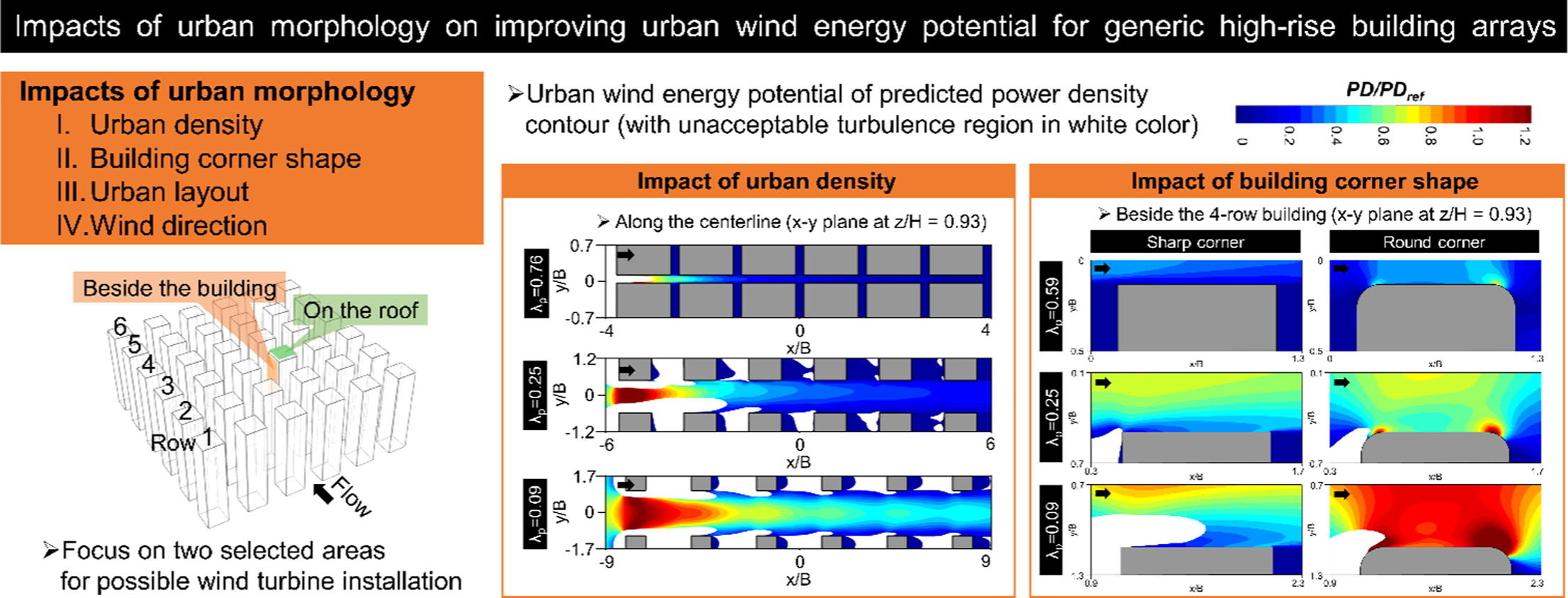
A comprehensive study of wind energy for compact high-rise buildings is explored. Power density and turbulence level are assessed for urban wind energy potential. Various urban densities, building corner shapes and staggered layouts are discussed. In-line arrangement shows a better wind power performance than staggered one. Improvement of wind power potential is achieved using the design of round corners.
Applications & Benefits
This study has revealed the effectiveness of appropriate modifications of urban morphology to significantly enhance wind power densities with reduced turbulence intensities for the high-rise building array.
Abstract:
Previous findings have indicated better performance attained by modified urban morphologies for wind energy utilization only in single and pair buildings, or medium-dense low-rise building arrays. Hence, the main purpose of this study is to address the research gaps to complete a fundamental understanding of the influences of urban morphology in compact high-rise urban areas on enhancing urban wind energy harvest for sustainable urban development. A comprehensive parametric study is conducted using the computational fluid dynamics tool to analyze the impacts of urban morphologies on the wind energy potential for a 6 × 6 array of generic high-rise buildings, including (i) urban density altered from compact to sparse urban layouts, (ii) building corner shapes of sharp and rounded corners, (iii) urban layouts of in-line and staggered patterns, and (iv) wind directions of 0° and 45°. This investigation implements the three-dimensional steady Reynolds-averaged Navier-Stokes equations with the Reynolds stress model to explore the distributions of wind speed, power density, and turbulence intensity over the building array. The results indicate that decreasing urban plan area density reduces the unacceptable turbulence areas with relatively higher wind power density on the roof. Besides, round corners can produce elevated power densities up to 201% greater than sharp corners beside the building. Even under the oblique wind direction of 45°, the rounded corner still shows better wind energy potentials than the sharp corner. The in-line urban layout demonstrates more significant areas with higher power densities and low turbulence intensities than the staggered urban layout.

Impacts of urban morphology on improving urban wind energy potential for generic high-rise building arrays
Author:Juan Y.-H., Wen C.-Y., Li Z., Yang A.-S.
Year:2021
Source publication:Applied Energy Volume 299, 1 October 2021, 117304
Subfield Highest percentage:99% Building and Construction #1/185
https://www.sciencedirect.com/science/article/pii/S0306261921007169