

Super Tough and Spontaneous Water-Assisted Autonomous Self-Healing Elastomer for Underwater Wearable Electronics
We combined dynamic covalent imine bonds with crosslinked H-bonds to design a highly stretchable and universally autonomous supramolecular polymeric self-healing network.
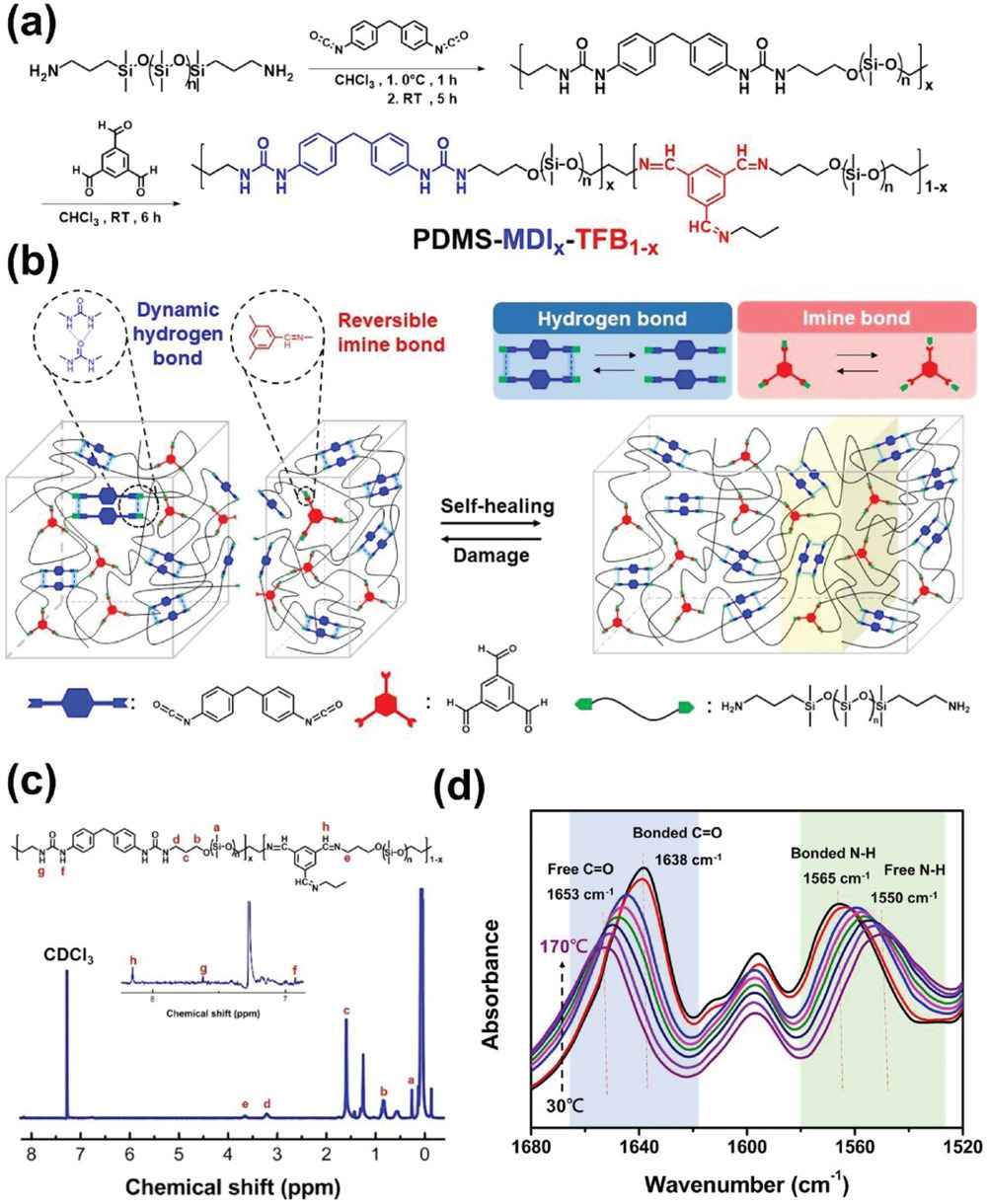
Molecular architecture of PDMS-MDIx-TFB1−x elastomer with eco-friendly, high toughness, stretchability, and autonomous self-healing property. a) Synthetic route to prepare PDMS-MDIx-TFB1−x self-healing elastomer. b) Schematic illustration of ideal structure of PDMS-MDIx-TFB1−x based on the synergistic effect of reversible weaker imine bonds and stronger hydrogen bonds. c) 1H NMR spectrum of PDMS-MDI0.4-TFB0.6 elastomer. d) In situ ATR-FTIR spectra of PDMS-MDI0.4-TFB0.6 upon heating from 30 to 170 °C. 1660–1620 cm−1 (left), 1600–1520 cm−1 (right).
Technology Overview
The water-assisted reversible dissociation–association of noncovalent bonds provides our PDMS-MPI-TFB film with excellent self-healing properties, including rapid self-healing kinetic behavior, as well as high stretchability. Moreover, upon damage under mechanical stress, the pristine room-temperature SHP has a short self-healing time (4 h) and high stretchability (4250%), self-healing efficiency (90%), and toughness (26.8 MJ m−3). Notably, our WASHP had a self-healing time of only 1 h as well as excellent overall performance, including a tensile strain of 9050%, self-healing efficiency of 95%, and toughness of 144.2 MJ m−3.
Applications & Benefits
Our WASHP-QD composite effectively suppresses Pb leakage (0.1 ppm), resulting in high long-term stability, including in boiling water over a one-year period. As a proof of concept, a unique prototype of a WASHP-QD white LED backlight was fabricated through the integration of a blue LED chip and the WASHP-QD composite. Our multifunctional WASHP has extensive potential applications in wearable electronic devices and flexible displays.
Abstract:
Self-healing soft electronic material composition is crucial to sustain the device long-term durability. The fabrication of self-healing soft electronics exposed to high moisture environment is a significant challenge that has yet to be fully achieved. This paper presents the novel concept of a water-assisted room-temperature autonomous self-healing mechanism based on synergistically dynamic covalent Schiff-based imine bonds with hydrogen bonds. The supramolecular water-assisted self-healing polymer (WASHP) films possess rapid self-healing kinetic behavior and high stretchability due to a reversible dissociation–association process. In comparison with the pristine room-temperature self-healing polymer, the WASHP demonstrates favorable mechanical performance at room temperature and a short self-healing time of 1 h; furthermore, it achieves a tensile strain of 9050%, self-healing efficiency of 95%, and toughness of 144.2 MJ m−3. As a proof of concept, a versatile WASHP-based light-emitting touch-responsive device (WASHP-LETD) and perovskite quantum dot (PeQD)-based white LED backlight are designed. The WASHP-LETD has favorable mechanical deformation performance under pressure, bending, and strain, whereas the WASHP-PeQDs exhibit outstanding long-term stability even over a period exceeding one year in a boiling water environment. This paper provides a mechanically robust approach for producing eco-friendly, economical, and waterproof e-skin device components.
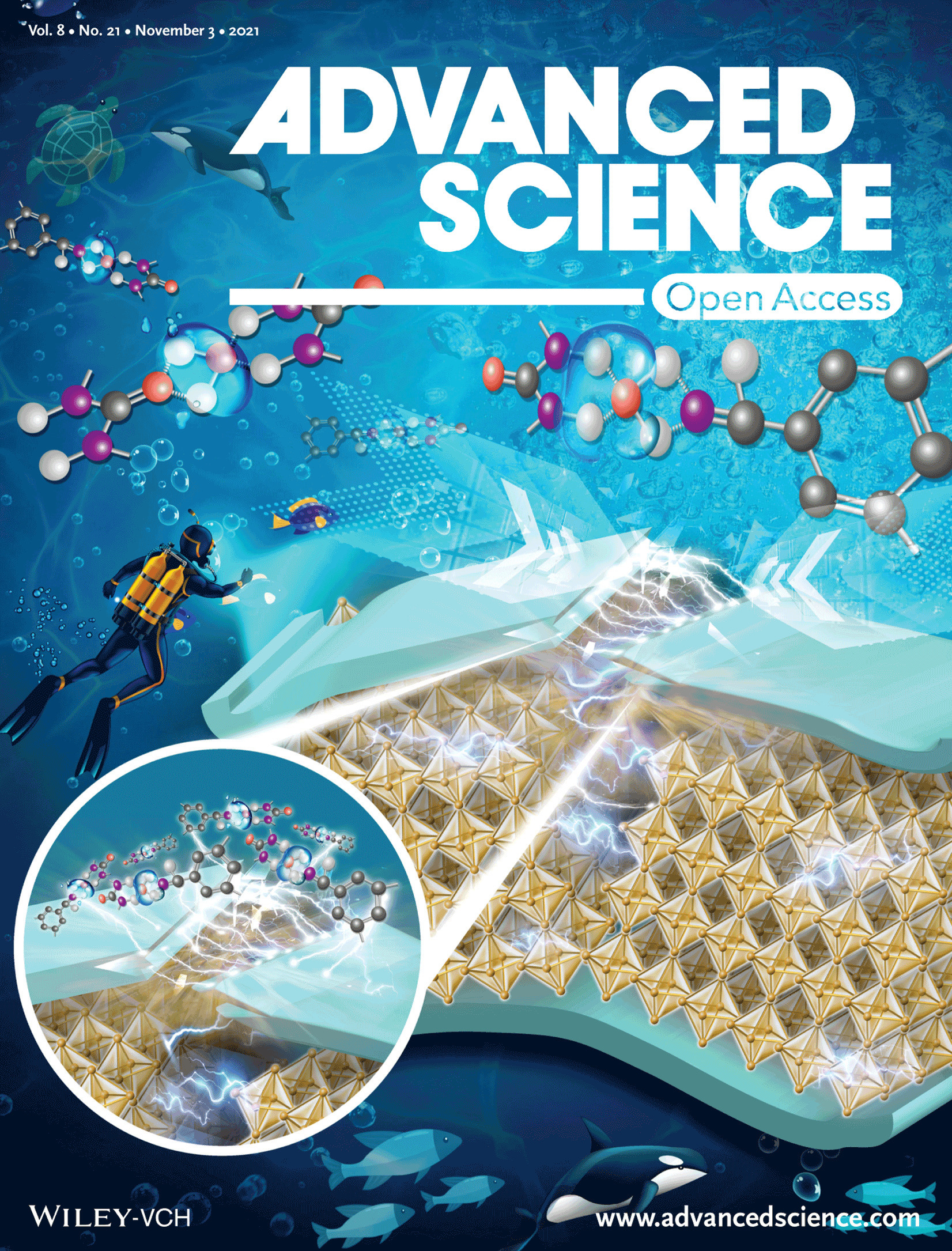
Super Tough and Spontaneous Water-Assisted Autonomous Self-Healing Elastomer for Underwater Wearable Electronics
Author:He C.-L., Liang F.-C., Veeramuthu L., Cho C.-J., Benas J.-S., Tzeng Y.-R., Tseng Y.-L., Chen W.-C., Rwei A., Kuo C.-C.
Year:2021
Source publication:Advanced Science Volume 8 Issue 21
Subfield Highest percentage:99% General Engineering #2/297
https://onlinelibrary.wiley.com/doi/full/10.1002/advs.202102275