

Kirigami-Based Light-Induced Shape-Morphing and Locomotion
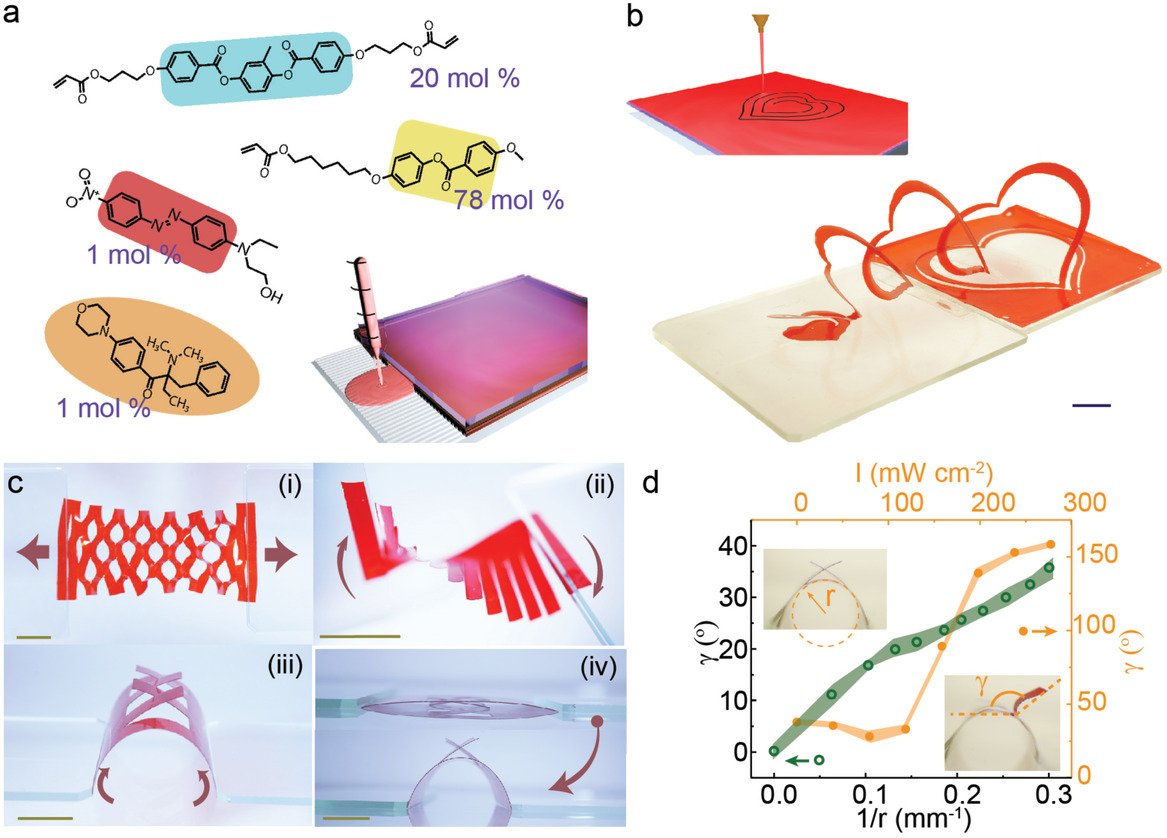
Figure1:The kirigami concept in stimuli-responsive LCN films. a) Chemical composition of the LC monomer mixture and schematic drawing of the cell infiltration process. b) Photograph of the 2D-to-3D shape-morphing of a kirigami LCN film upon an external stress field. Inset: schematic drawing of laser engraving of corresponding kirigami pattern on the actuating film. c) Three basic deformation modes in LCN kirigami films: stretching (i), twisting (ii), and rolling (iii). iv) The side-view photograph of a cut film upon a rolling deformation. d) Deformation strains upon different stress fields (rolling mode) and illuminating intensities. Error bars indicate standard deviation for n = 3 measurements. Insets indicate the bending curvature upon an external force, 1/r, and the bending angle γ upon light illumination. All scale bars are 5 mm.
Technology Overview
We demonstrate light-controlled actuation in the kirigami structures and fabricate a kirigami rolling robot with multiple photomechanical petals. The robot is able to perform multigait rolling movement in both forward and backward direction, with capabilities that are unreachable by conventional light driven rolling devices. The robot can be steered with light along predesigned 2D trajectories, and it can climb up a slope up to 6°. Kirigami serves as an efficient technique to obtain 2D-to-3D shape-morphing in generally flat materials like films and sheets. Although easy to process, the obtained architectures are passive. Photomechanical materials contain intrinsic features of active deformability upon light stimuli, but obtaining 3D constructions of such materials prior to actuation stage is still challenging.
Applications & Benefits
The results presented in this work are an attempt to cross boundaries by combining kirigami technique and photomechanical materials, suggesting a facile technique to fabricate complex geometries in responsive films, and may provide unforeseen inspiration for both kirigami devices and soft microrobotics.
Abstract:
The development of stimuli-responsive soft actuators, a task largely undertaken by material scientists, has become a major driving force in pushing the frontiers of microrobotics. Devices made of soft active materials are oftentimes small in size, remotely and wirelessly powered/controlled, and capable of adapting themselves to unexpected hurdles. However, nowadays most soft microscale robots are rather simple in terms of design and architecture, and it remains a challenge to create complex 3D soft robots with stimuli-responsive properties. Here, it is suggested that kirigami-based techniques can be useful for fabricating complex 3D robotic structures that can be activated with light. External stress fields introduce out-of-plane deformation of kirigami film actuators made of liquid crystal networks. Such 2D-to-3D structural transformations can give rise to mechanical actuation upon light illumination, thus allowing the realization of kirigami-based light-fuelled robotics. A kirigami rolling robot is demonstrated, where a light beam controls the multigait motion and steers the moving direction in 2D. The device is able to navigate along different routes and moves up a ramp with a slope of 6°. The results demonstrate a facile technique to realize complex and flexible 3D structures with light-activated robotic functions.

Kirigami-Based Light-Induced Shape-Morphing and Locomotion
Author:Cheng Y.-C., Lu H.-C., Lee X., Zeng H., Priimagi A.
Year:2020
Source publication:Advanced Materials Volume32, Issue7 February 20, 2020 1906233
Subfield Highest percentage:99% Mechanical Engineering #2/596
https://onlinelibrary.wiley.com/doi/full/10.1002/adma.201906233