

Virtual characters, real emotions: Avatar identification and psychological transformation across esports and K-pop fandoms
This study investigates how fans form deep psychological connections with virtual idols within transmedia entertainment ecosystems. Focusing on K/DA—a virtual girl group bridging the League of Legends universe and K-pop culture—the researchers examine avatar identification through social cognitive and self-expansion theories. By categorizing participants into esports players, K-pop fans, and dual fans, the paper constructs a psychological transformation model. The empirical findings reveal distinct pathways of dynamic engagement and self-expansion across these heterogeneous groups. Ultimately, it illuminates the mechanisms through which virtual character designs successfully translate into genuine emotional resonance, media consumption, and continuous brand loyalty.
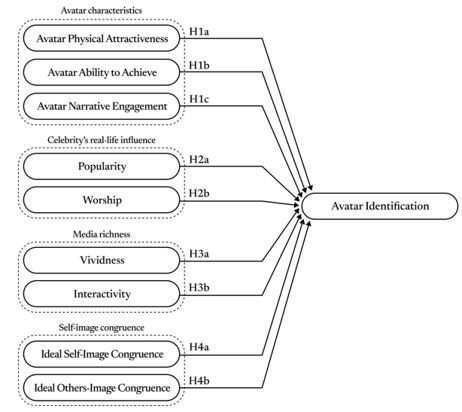
Fig. 1. Structural model.
Technology Overview
The study employs a cross-sectional survey design and structural equation modeling (SEM) to validate its psychological transformation framework. Methodologically, it utilizes multi-group analysis to compare structural coefficients among three distinct fan segments. The mathematical model quantitatively analyzes the relationships between transmedia storytelling engagement, multi-dimensional avatar identification, self-expansion, and long-term behavioral intentions.
Applications & Benefits
This research directly benefits virtual idol marketing, game character design, transmedia storytelling industries, and fan psychology studies. It provides valuable strategic insights for developers to design highly resonant virtual characters that transcend single-media boundaries. Ultimately, it optimizes cross-industry marketing strategies, maximizes intellectual property (IP) value, and fosters deep, sustainable emotional engagement among diverse consumer segments.
Abstract:
The goal of this paper is to propose an optimization scheme for enhancing power dispatch and load scheduling for residential fuel cell-based combined heat and power systems (FC-CHPS) using mixed integer linear programming (MILP), considering the lifetime degradation of both the fuel cell system (FCS) and battery energy storage systems (BESS). The scheme is applied in the home energy management system that oversees the electric and thermal power of residential FC-CHPS. First, the nonlinearity in the relationship between the natural gas consumption and output electric power, and between the residual thermal power and output electric power of the fuel cell system (FCS) in the FC-CHPS is approximated using piecewise linearization. Then, the piecewise linearization is integrated with MILP to derive optimal power dispatch and load scheduling solutions, while accounting for the nonlinearity of the FCS. Next, cost functions representing the lifetime degradation of FCS and BESS are formulated. These cost functions result in nonlinear optimization constraints. Therefore, innovative methods are proposed to linearize these constraints, allowing the continued use of MILP as the optimization method and factoring in the lifetime degradation of FCS and BESS. Compared to the mixed-integer non-linear programming (MINLP) method that does not linearize the non-linearity in the FCS or the lifetime degradation of the FCS and BESS, the proposed MILP scheme achieves the identical objective function value. Furthermore, the computation time for the proposed MILP scheme is 99.94 % lower than that required by the MINLP method. The proposed scheme provides accurate results in short computation times.

Virtual characters, real emotions: Avatar identification and psychological transformation across esports and K-pop fandoms
Author:Huang Yi-Ting, Huang Yu-Chiao, Lin En-Chia
Year:2026
Source publication: Computers in Human Behavior, Volume 179, June 2026, 108951
Subfield Highest percentage: 99% Arts and Humanities #1/692