

Caffeic Acid-Driven Green Synthesis of Rhenium Nanoparticles Embedded in Self-Templating Double-Shelled ZnMn2O4Hollow Microspheres for Ultrasensitive Epinephrine Detection in Biofluids
Epinephrine (EP) is a vital neurotransmitter and hormone that regulates cardiovascular function, metabolism, and stress responses. Abnormal EP levels are closely linked to conditions like adrenal tumors, while it serves as a critical agent in emergency medicine for cardiac arrest and anaphylactic shock. Therefore, precise quantification of EP in biofluids is highly essential for clinical diagnostics. Traditional analytical methods, however, suffer from complex sample preparation, high costs, and long analysis times. To overcome these challenges, developing highly sensitive, specific, and real-time electrochemical biosensors is heavily demanded to achieve accurate clinical monitoring.
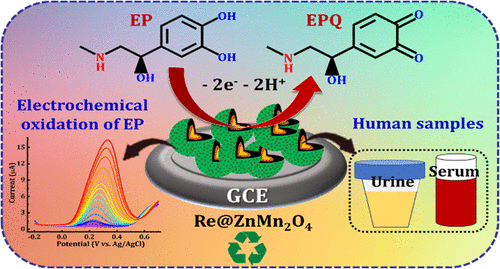
Graphical abstract.
Technology Overview
The technology features an electrochemical sensor utilizing rhenium (Re) nanoparticles embedded within a double-shelled ZnMn2O4 hollow microsphere structure. The material is synthesized via coprecipitation and annealing, followed by a green, caffeic acid-assisted chemical reduction. This hollow architecture offers high conductivity, a large surface area, and abundant active sites to accelerate diffusion-controlled electro-oxidation of EP.
Applications & Benefits
This sensor delivers excellent sensitivity, a broad linear range, a low detection limit, and outstanding anti-interference capabilities. It can successfully perform accurate real-time EP quantification in complex human serum and urine samples. Consequently, this technology provides significant benefits for practical clinical diagnostics, point-of-care testing, and biomedical monitoring.
Abstract:
In the present work, we report an electrochemical sensor based on rhenium (Re) nanoparticles embedded within a double-shelled ZnMn2O4 hollow microsphere (Re@ZnMn2O4) for ultrasensitive detection of epinephrine (EP) in biofluids. The Re@ZnMn2O4 material was synthesized via a coprecipitation and annealing route, followed by a green, caffeic acid (CA)-assisted chemical reduction. Structural and morphological analyses, including spectrophotometry, confirmed the high purity, crystallinity, and integrity of the material. Electrochemical performance was evaluated using voltammetry and impedance spectroscopy. The Re@ZnMn2O4-modified electrode exhibited superior electrochemical activity attributed to its high conductivity, large surface area, abundant active sites, and efficient charge transfer enabled by the hollow architecture. EP oxidation followed a diffusion-controlled 2e–/2H+ transfer mechanism. The sensor demonstrated a broad linear detection range (0.5–1951.3 μM), a low detection limit (0.21 μM), and good sensitivity (0.282 μA μM–1 cm–2). Furthermore, it showed remarkable reproducibility, long-term stability, and strong resistance to common interferents. Its practical potential was validated by accurate EP quantification in human serum and urine, highlighting its applicability in clinical diagnostics and biomedical monitoring.
Caffeic Acid-Driven Green Synthesis of Rhenium Nanoparticles Embedded in Self-Templating Double-Shelled ZnMn2O4Hollow Microspheres for Ultrasensitive Epinephrine Detection in Biofluids
Author:Sakthivel Rajalakshmi, Chen Bo-Yuan, Kubendhiran Subbiramaniyan, Lin Lu-Yin, Ramaraj Sayee Kannan, Lin Yu-Chien, Liu Xinke, Gong Cihun-Siyong, Chung Ren-Jei
Year:2026
Source publication: ACS Sensors, Vol 11, Issue 1, January 2026
Subfield Highest percentage: 99% Fluid Flow and Transfer Processes #1/99