

Tracing the evolution of Particle Swarm Optimization in scheduling: A systematic review using main path analysis
Nature-inspired intelligence forms the foundation of metaheuristic algorithms widely employed to solve real-world problems. Particle Swarm Optimization (PSO) is a prominent example, mimicking the positional updates and velocity adjustments of bird flocks to balance global and local search strategies. In production and logistics, scheduling provides crucial decision support for short-term planning under resource constraints. As mathematical models become high-dimensional and complex, exact solvers suffer from long computation times. Consequently, a systematic literature review tracing PSO's evolutionary trajectories across scheduling applications provides critical insights into algorithmic innovations and future computational trends.
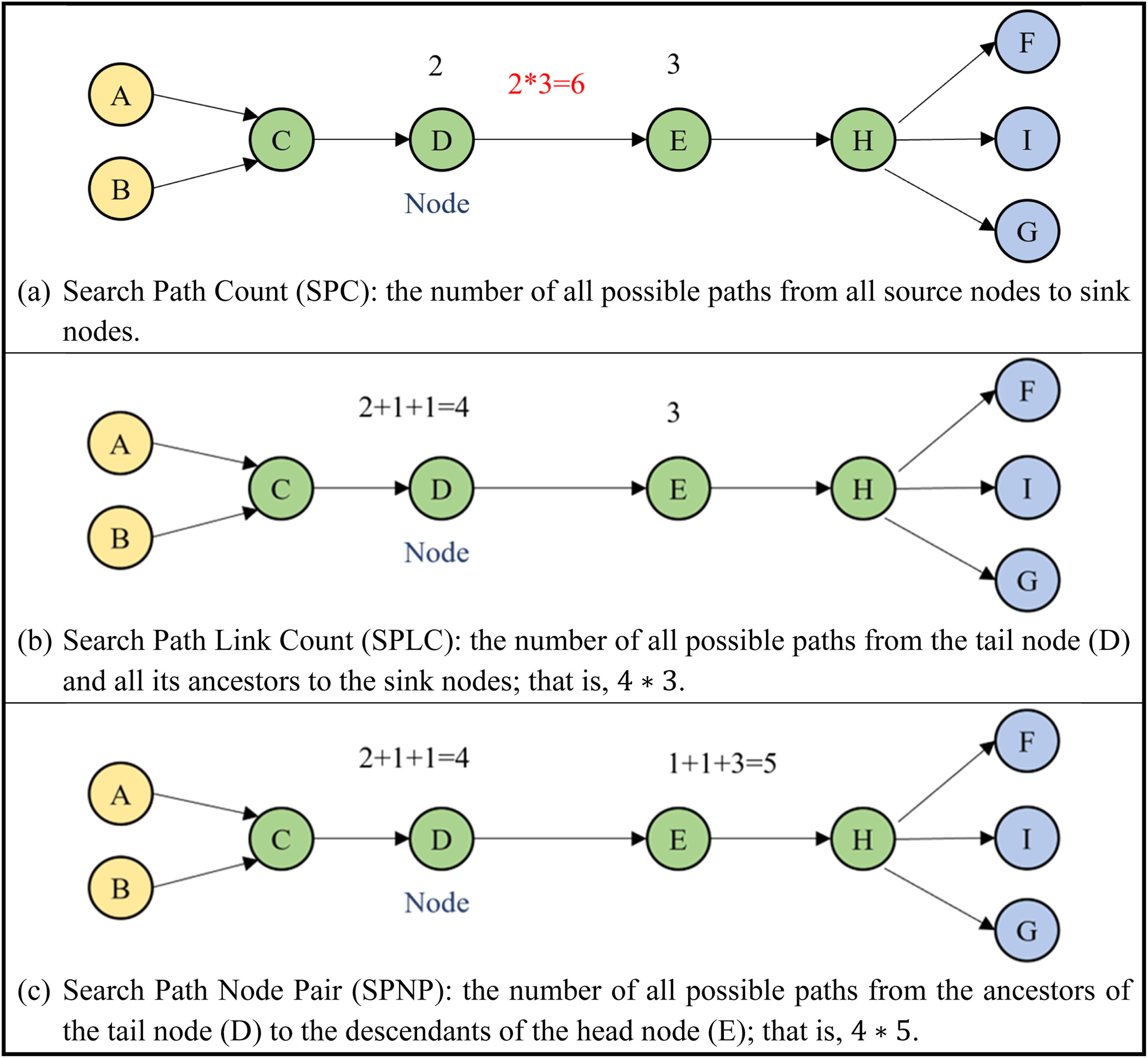
Fig. 1. Weight calculation methods in the citation network.
Technology Overview
PSO is a population-based, stochastic metaheuristic algorithm designed for optimization problems. It manages multi-objective trade-offs using continuous position vectors or discrete mechanisms, such as permutation-based encoding and Smallest Position Value (SPV) rules. Advanced adaptations integrate hybridized search strategies, adaptive parameter controls (like dynamic inertia weights), and local search heuristics to prevent premature convergence and accelerate solution efficiency.
Applications & Benefits
PSO offers exceptional robustness and distributed capabilities for complex combinatorial tasks. Its main scheduling applications have shifted from traditional manufacturing—such as flow-shop and job-shop operations—to advanced computing, load balancing, and energy management. By resolving complex dimensional constraints, it effectively lowers production or fuel costs, reduces makespan, minimizes energy consumption, and improves overall system throughput.
Abstract:
This study analyzes the literature and reviews the trends and development trajectories of Particle Swarm Optimization (PSO)-based scheduling. Main Path and Cluster Analysis identify the seminal features introduced to improve PSO, and the major application areas. This serves as the basis for discussing computational advancements. The findings suggest that PSO is most developed in flow-shop scheduling, with its evolution progressing from single- to multi-objective optimization. The main application has shifted from production to advanced computing and energy management, indicating the growing influence of AI, renewables and energy storage. The shift towards mass customization explains the projected growth of flexible job-shop scheduling.

Tracing the evolution of Particle Swarm Optimization in scheduling: A systematic review using main path analysis
Author:Ying Kuo-Ching, Pourhejazy Pourya, Huang Kuan-Lun
Year:2026
Source publication: Swarm and Evolutionary Computation, Volume 100, January 2026, 102239
Subfield Highest percentage: 99% General Mathematics #3/414