

Enhancing furniture production and process management knowledge in woodworking students using VR CAVE technology and collaborative task allocation strategy
This study addresses the pedagogical challenges in vocational woodworking education, where traditional instruction often fails to efficiently convey complex furniture production and quality process management workflows. To bridge this gap, the researchers developed an immersive virtual reality system using Cave Automatic Virtual Environment (VR CAVE) technology. Combined with a structured collaborative task allocation strategy, the system provides an interactive, simulated factory environment for students. The empirical results demonstrate that this integrated approach significantly enhances students' theoretical knowledge, practical process comprehension, and team coordination, offering a highly effective, safe, and engaging alternative to conventional classroom-based training methodologies.
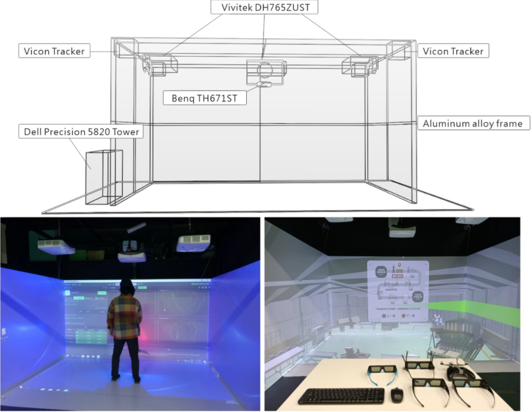
FIGURE 3. The VR CAVE environment equipment and setup.
Technology Overview
The technology integrates a multi-screen projection-based VR CAVE system with immersive simulation software replicating a real-world furniture manufacturing pipeline. Methodologically, it pairs this hardware with a collaborative task allocation framework. This setup allows student teams to simultaneously experience various factory roles, interact with virtual woodworking machinery, manage dynamic production workflows, and execute quality control protocols in real time within a synchronized digital environment.
Applications & Benefits
The technology integrates a multi-screen projection-based VR CAVE system with immersive simulation software replicating a real-world furniture manufacturing pipeline. Methodologically, it pairs this hardware with a collaborative task allocation framework. This setup allows student teams to simultaneously experience various factory roles, interact with virtual woodworking machinery, manage dynamic production workflows, and execute quality control protocols in real time within a synchronized digital environment.
Abstract:
Furniture production is a complex process, requiring manufacturers to possess the knowledge and skills needed for effective production and process management. In Taiwan, most schools are unable to provide hands-on training for students to acquire furniture production skills due to limited space and facilities. To address this issue, the present study employed a VR CAVE system for task allocation and furniture production simulation. The training was conducted in groups to strengthen students’ understanding of furniture production and process management. This study recruited 40 freshmen majoring in furniture design to participate in the training. They were divided into two groups: an experimental group (20 students receiving VR CAVE training) and a control group (20 students receiving traditional training). The training covered various aspects, including personnel, equipment, and production line operations aligned with the furniture production process. The effectiveness of this training was evaluated through a combination of tests and observations. The results revealed that students who underwent VR CAVE training and actively engaged in furniture production within a collaborative, task-oriented environment showed significant improvements in their knowledge of furniture production and process management. This innovative approach could effectively address the teaching challenges encountered by traditional furniture vocational schools.

Enhancing furniture production and process management knowledge in woodworking students using VR CAVE technology and collaborative task allocation strategy
Author:Lee I-Jui, Wan Nai-Chin
Year:2026
Source publication: Interactive Learning Environments, Volume 34, Issue 1, Feb 2026
Subfield Highest percentage: 99% Education #16 / 1698