

Spin-Selective Oxygen Evolution in Chiral Molecule-Intercalated Layered Double Hydroxides
This study demonstrates that intercalating chiral phenylalanine (Phe) molecules into CoFe layered double hydroxide (CoFe-LDH) expands the interlayer spacing and triggers the chiral-induced spin selectivity (CISS) effect. The resulting hybrid chiral-inorganic interface enables intrinsic spin-filtering without magnetic fields, steering the oxygen evolution reaction (OER) along a lower-energy pathway to produce triplet O2. Compared to achiral counterparts, chiral CoFe-LDHs achieve superior catalytic efficiency with a lower overpotential of 245 mV at 10 mA cm−2 and faster reaction kinetics. Operando spectroscopic analyses confirm that chirality-induced spin polarization modulates spin-selective charge transfer, offering a robust design strategy for oxide-based electrocatalysts.
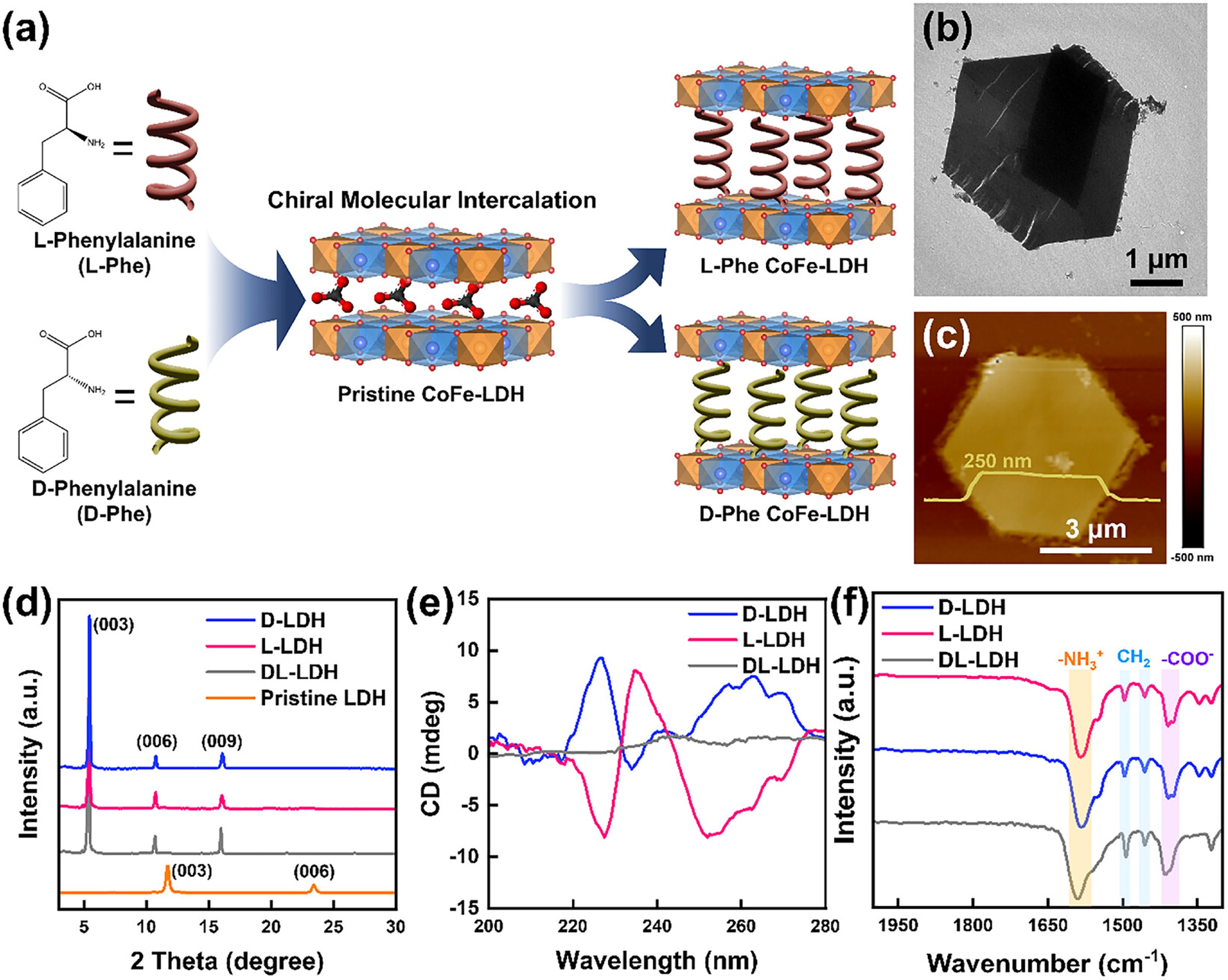
FIGURE 1(a) Scheme diagram of chiral molecular intercalation from pristine CoFe‐LDH to chiral CoFe‐LDH. (b) TEM image and (c) AFM image of DL‐LDH. (d) XRD patterns of pristine, DL‐, D‐, and L‐LDH. (e) CD spectra and (f) FTIR spectra of DL‐, D‐, and L‐LDH.
Technology Overview
Chiral Phe molecules (D- and L-forms) are intercalated into CoFe-LDH layers via co-precipitation, expanding the d-spacing to 1.64 nm. By leveraging the CISS effect, the hybrid interface functions as a spin filter that regulates electron spin orientation during charge transfer. In situ XANES, in situ Raman, and nanoscale SECCM confirm cobalt active site oxidation and lower O–O coupling energetic barriers.
Applications & Benefits
This technology applies to sustainable green hydrogen production via water splitting and spin-engineered electrocatalysis. By integrating CISS-driven spin filtering into stable oxide architectures, it lowers the OER overpotential to 245 mV, significantly accelerates charge-transfer kinetics, suppresses undesirable singlet H2O2 side reactions, and retains outstanding long-term durability in harsh alkaline environments.
Abstract:
The chiral-induced spin selectivity (CISS) effect offers a novel paradigm for designing high-performance catalysts for spin-dependent oxygen evolution reactions (OER). Layered double hydroxides (LDHs), are widely used for oxygen evolution reaction (OER) due to their superior electrocatalytic activity and stability in alkaline environments. Here, we demonstrate that intercalating chiral phenylalanine molecules into CoFe-LDH induces spin-polarized OER via the CISS effect, while simultaneously expanding the interlayer spacing. The resulting chiral–inorganic hybrid interface directs the reaction along a lower-energy pathway, promoting the formation of triplet O2, and exhibits outstanding OER performance with a lower overpotential of 245 mV at 10 mA cm−2, as well as faster charge-transfer kinetics compared to its achiral counterpart. Using in situ XANES, in situ Raman spectroscopy, and nanoscale scanning electrochemical cell microscopy (SECCM), we further uncover the fundamental origin of this chiral-induced spin-selective behavior. This study establishes a general strategy for designing advanced, stable oxide-based electrocatalysts, where intercalated chiral molecules manipulate spin dynamics to improve reaction kinetics and selectivity.
Spin-Selective Oxygen Evolution in Chiral Molecule-Intercalated Layered Double Hydroxides
Author:Huang Chih-Ying, Wu Cheng-Rong, Lu Yang-Sheng, Chang Yu-Ying, Chang Chia-Che, Liu Tsung-Hsin, Lee Che-Lun, Shiue Jessie, Lin Yu-Chang, Chuang Wei-Tsung, Tsai Huang-Ming, Ho Ya-Lun, Chiou Jau-Wern, Hsu Hua-Shu, Li Shao-Sian, Chen Chia-Chun, Pong Way-Faung, Chen Chun-Wei
Year:2026
Source publication: Advanced Science, Early View, 2026
Subfield Highest percentage: 99% Biochemistry, Genetics and Molecular Biology #1/144