

DFA-Net: A Domain Flow Adaptation Network for Diverse Hazy-Image Generation
This study addresses the scarcity of high-quality, diverse hazy image datasets required for training deep-learning-based computer vision applications. To overcome data collection difficulties in inclement weather conditions, the researchers present a novel Domain Flow Adaptation Network (DFA-Net). Unlike traditional methods, DFA-Net integrates a density variable to precisely control haze intensity and generate realistic, highly diverse hazy images. By learning the mapping between clear and hazy image domains, this framework successfully synthesizes high-fidelity datasets from plentiful clear-weather images, thereby establishing a scalable approach to boosting the performance and robustness of subsequent defogging and vision algorithms.
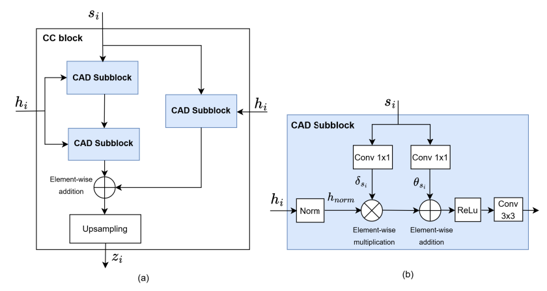
Fig. 3. (a) Overall architecture of the content conveyance (CC) block. (b) Characteristic adaptive denormalization (CAD) subblock in the CC block.
Technology Overview
The DFA-Net architecture comprises four innovative modules: semantic extraction (SE), haze extraction (HE), image production (IP), and image assessment (IS). The SE and HE modules extract structural semantics and weather-style representations from inputs, respectively. Utilizing a density variable as guidance, the IP module refines synthesized images in a coarse-to-fine fashion, while the IS module ensures realism via strict adversarial verification.
Applications & Benefits
This technology is highly valuable for autonomous driving systems, outdoor surveillance networks, image dehazing research, and computer vision training dataset augmentation. It delivers immense benefits by eliminating the high costs and physical constraints of capturing real-world weather data. Ultimately, it enhances the safety and accuracy of intelligent vehicles and object recognition systems operating in adverse environments.
Abstract:
Large and diverse image datasets have facilitated the recent advances in deep-learning-based computer vision applications. Whereas datasets with images depicting normal-weather scenes are plentiful, datasets with images depicting inclement weather conditions, such as haze, remain scarce due to collection difficulties. In response to this problem, we present a novel domain flow adaptation network (DFA-Net) that can control the haze density and facilitate the generation of realistic and diverse hazy images. DFA-Net employs a density variable to direct the network to learn and yield the desired images and is composed of four modules: a semantic extraction (SE) module, a haze extraction (HE) module, an image production (IP) module, and an image assessment (IS) module. The SE and HE modules are used to capture the semantic structure and style representation of clear and hazy images, respectively, and provide them to the IP module for refining the output images. The IP module is adopted to yield hazy images in a coarse-to-fine fashion, while the IS module is responsible for examining the realism of the synthesized results. Experiments on multiple benchmark datasets confirm the effectiveness of the proposed DFA-Net, which outperforms competing approaches by achieving improvements of up to 147% in quality, 237% in fidelity, and 354% in the diversity of generated images.
DFA-Net: A Domain Flow Adaptation Network for Diverse Hazy-Image Generation
Author:Le Trung-Hieu, Huang Shih-Chia
Year:2026
Source publication:IEEE Transactions on Circuits and Systems for Video Technology, VOL. 36, NO. 5, MAY 2026
Subfield Highest percentage: 99% Media Technology #1/83