

Supercritical-CO2 mediated preparation of porous carbon from Araucaria heterophylla biomass: A proficient nanomolar detection platform for phenolic water pollu
This study developed a sustainable electrochemical sensor using porous activated carbon derived from Araucaria heterophylla biomass through supercritical CO₂-assisted chemical activation. The resulting porous carbon exhibited enhanced surface area, abundant oxygen-containing functional groups, and improved electron-transfer capability. A screen-printed carbon electrode modified with the activated carbon enabled highly sensitive detection of 4-aminophenol (AP), a hazardous phenolic pollutant. The sensor achieved a wide linear detection range (0.01–582.5 μM), an ultralow detection limit of 2 nM, excellent selectivity, long-term stability, and high recovery in environmental water samples, demonstrating its potential for rapid and reliable real-time pollutant monitoring.
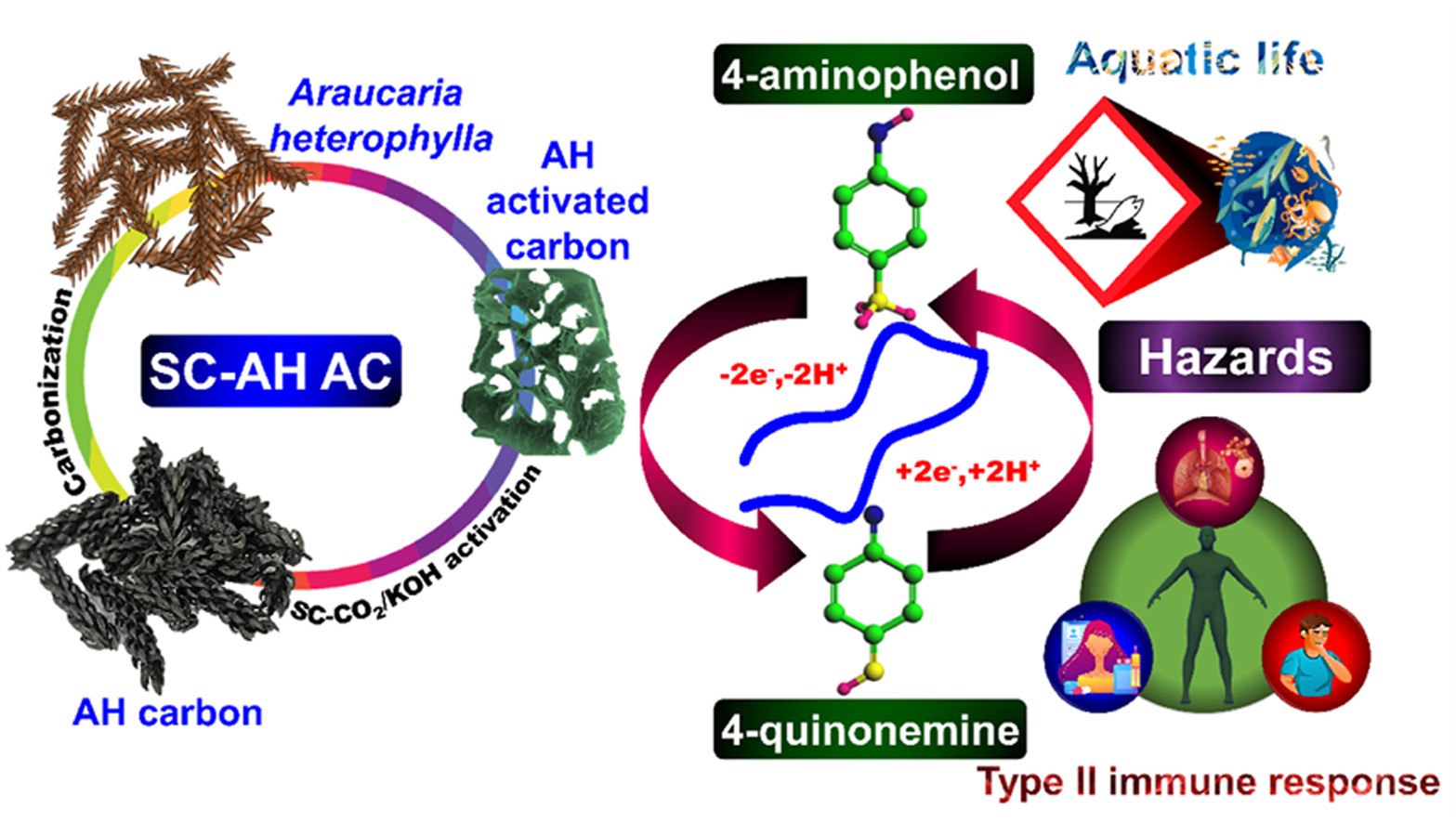
Graphical abstract.
Technology Overview
Supercritical CO₂-assisted activation converted Araucaria heterophylla biomass into highly porous activated carbon for a screen-printed electrochemical sensor. The material's enlarged surface area and oxygen-rich functional groups enhanced electron transfer, enabling ultrasensitive, selective, and stable detection of 4-aminophenol in aqueous environments.
Applications & Benefits
The technology is applicable to environmental water quality monitoring, pharmaceutical analysis, and pollution control. Using renewable biomass as a precursor offers a low-cost and eco-friendly sensing platform with high sensitivity, excellent stability, rapid response, and reliable real-sample performance for real-time detection of phenolic contaminants.
Abstract:
4-aminophenol (AP), an aromatic phenolic compound, is commonly found in commercial products that eventually enter and pollute environmental water sources. The precise detection and quantification of AP in environmental samples are critical for comprehensively assessing contamination levels, safeguarding public health, and formulating effective remediation strategies. In the shed of light, this work proposes an electrochemical sensing platform for detecting and quantifying AP using Araucaria heterophylla biomass-derived activated carbon (AH-AC) prepared via the SC-CO2 pathway. To evaluate the significance of SC–CO2–mediated chemical activation (SC-AHAC), a comparative study with conventional activation methods (C-AHAC) was also conducted. The physical characterizations such as structural, morphological, optical, and elemental analysis demonstrate the greater ID/IG value and enhanced surface functionalities of SC-AHAC than C-AHAC. The obtained lower empirical factor (R) value of 1.89 for SC-AHAC suggests increased disorder and a higher presence of single-layer amorphous carbon compared to C-AHAC (2.03). In the electrochemical analysis, the active surface area of the SC-AHAC modified electrode (0.069 cm2) is higher than that of the C-AHAC modified electrode (0.061 cm2), demonstrating the significance of SC-CO2 activation. Further, the quantitative analysis on SC-AHAC@SPCE resulted in a sensitivity of 3.225 μA μM−1 cm−2 with the detection limit and quantification limit of 2.13 and 7.11 nM L−1, respectively, in the linear range of 0.01–582.5 μM L−1 at the oxidation potential of 0.13V. This suggests that the prepared SC-AHAC could be a promising electrocatalyst for AP detection in the environmental and healthcare sectors.
Supercritical-CO2 mediated preparation of porous carbon from Araucaria heterophylla biomass: A proficient nanomolar detection platform for phenolic water pollutant
Author:Manickaraj Shobana Sebastin Mary, Pandiyarajan Sabarison, Liao Ai-Ho, Ramanathan Subramanian, Baskaran Gopinath, Selvaraj Manickam, A. Assiri Mohammed, Chuang Ho-Chiao
Year:2024
Source publication: Chemosphere, Volume 364, September 2024, 143050
Subfield Highest percentage: 99% Public Health, Environmental and Occupational Health #7/687