

2D sheet structure of zinc molybdate decorated on MXene for highly selective and sensitive electrochemical detection of the arsenic drug Roxarsone in water samples
This study developed a ZnMoO₄/MXene nanocomposite-based electrochemical sensor for the highly selective and sensitive detection of Roxarsone (ROX), an arsenic-containing veterinary drug, in water samples. The nanocomposite was synthesized through hydrothermal and sonication methods and exhibited excellent electrical conductivity and electrocatalytic activity. The fabricated sensor achieved a wide linear detection range (0.025–605.65 μM), an ultralow detection limit of 0.0081 μM, and high sensitivity. It also demonstrated outstanding selectivity, reproducibility, storage stability, and anti-interference performance. Successful validation in real water samples confirmed its feasibility as a rapid, reliable, and practical environmental monitoring platform.
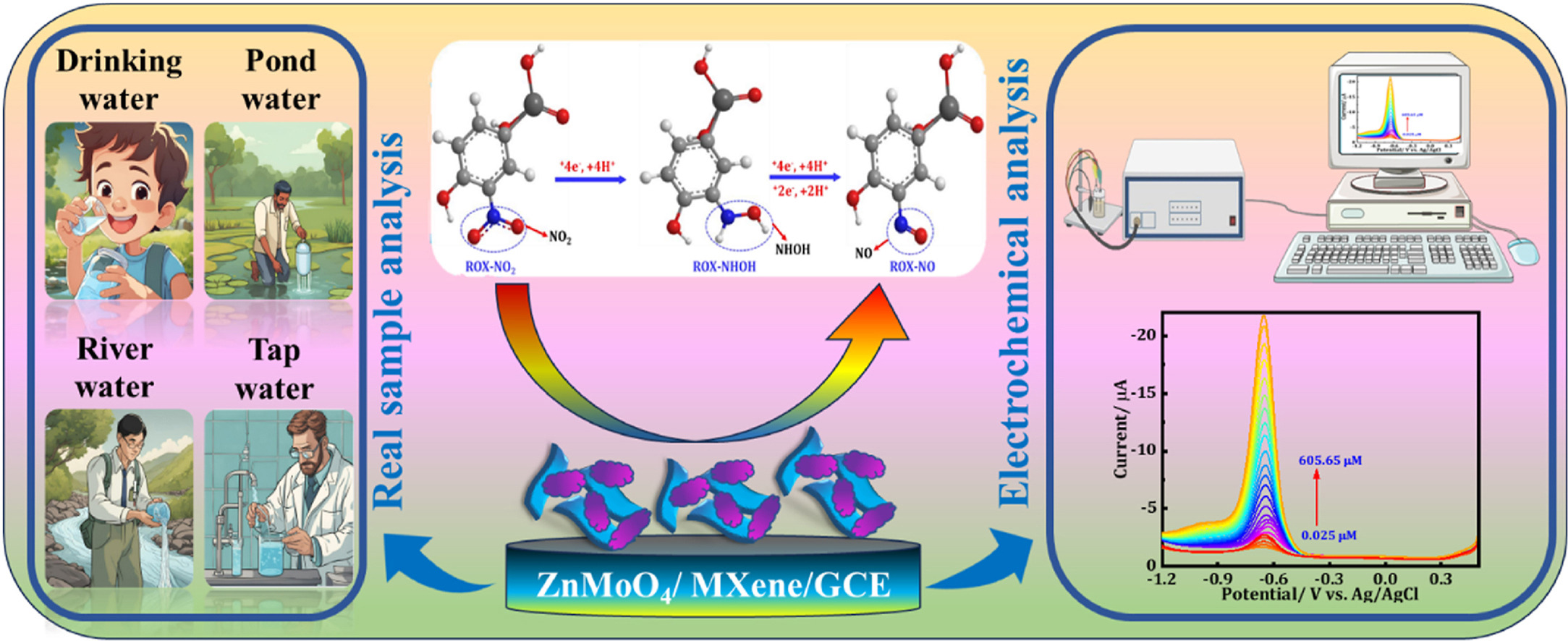
Graphical abstract.
Technology Overview
A ZnMoO₄/MXene nanocomposite-modified glassy carbon electrode was fabricated for electrochemical Roxarsone detection. Combining hydrothermal synthesis with sonication enhanced electron transfer, electrical conductivity, and catalytic activity, enabling highly sensitive, selective, and stable detection through differential pulse voltammetry.
Applications & Benefits
The sensor is suitable for monitoring Roxarsone contamination in environmental water sources, including tap, river, drinking, and pond water. Its rapid response, low detection limit, excellent stability, and strong anti-interference capability make it a promising tool for environmental monitoring, food safety, and water quality assessment.
Abstract:
Water contamination is a serious environmental issue posing a significant global challenge. Roxarsone (ROX), a widely used anticoccidial drug is excreted in urine and feces, potentially disrupting natural habitats. Therefore, rapid and cost-effective ROX detection is essential. In this study, we developed a 2D sheet structure of zinc molybdate decorated on MXene (ZnMoO4/MXene) for detecting ROX using electrochemical methods. The materials were characterized using appropriate spectrophotometric and voltammetric techniques. The ZnMoO4/MXene hybrid exhibited excellent electrocatalytic performance due to its rapid electron transfer rate and higher electrical conductivity. The ZnMoO4/MXene-modified GCE (ZnMoO4/MXene/GCE) showed a broad linear range with high sensitivity (10.413 μA μМ−1 cm−2) and appreciable limit of detection (LOD) as low as 0.0081 μM. It also demonstrated significant anti-interference capabilities, excellent storage stability, and remarkable reproducibility. Furthermore, the feasibility of utilizing ZnMoO4/MXene/GCE for monitoring ROX in water samples was confirmed, achieving satisfactory recoveries.

2D sheet structure of zinc molybdate decorated on MXene for highly selective and sensitive electrochemical detection of the arsenic drug Roxarsone in water samples
Author:Baskaran Nareshkumar, Prasanna Sanjay Ballur, Jeyaram Kanimozhi, Lin Yu-Chien, Govindasamy Mani, Wei Yang, Chung Ren-Jei
Year:2024
Source publication: Chemosphere, Volume 364, September 2024, 143188
Subfield Highest percentage: 99% Public Health, Environmental and Occupational Health #7/687