

Aerothermal performance of cavity tip with flow structure effects in a transonic high-pressure turbine blade
This study investigates the aerothermal performance of cavity-tip designs in transonic high-pressure turbine blades through computational fluid dynamics (CFD). It examines how squealer height, width, and tip gap influence leakage flow, vortex structures, and heat transfer characteristics. The results show that suction-side cavity and scraping vortices play key roles in reducing leakage flow and controlling heat load distribution. A feedforward neural network combined with the NSGA-II optimization algorithm identifies optimal geometric parameters that minimize leakage flow and heat transfer simultaneously. The findings provide practical design strategies for improving turbine efficiency, durability, and thermal performance in advanced gas turbine systems.
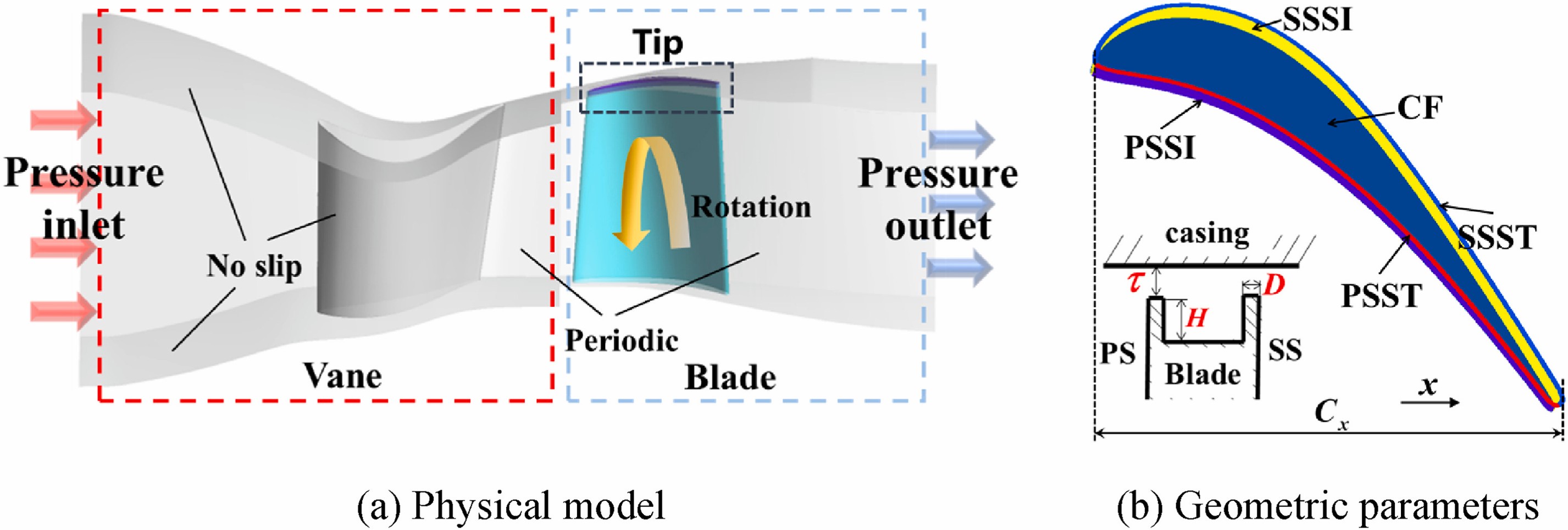
Fig. 1. Physical model and geometric parameters of cavity tip.
Technology Overview
A CFD-based aerothermal analysis integrated with neural-network-assisted multi-objective optimization was developed to evaluate cavity-tip turbine blades. The method reveals vortex-flow mechanisms and optimizes blade-tip geometry to reduce leakage flow and heat transfer while improving turbine aerodynamic efficiency.
Applications & Benefits
The proposed approach supports the design of high-performance gas turbines used in aviation and power generation. By reducing leakage losses and thermal loads, it enhances turbine efficiency, extends blade service life, improves operational reliability, and provides optimized geometric guidelines for next-generation turbine blade development.
Abstract:
Understanding the mechanisms of leakage flow control and heat load distribution is important in optimizing the structure of cavity tips in gas turbines. This paper investigates the aerothermal performance of cavity tip in a transonic high-pressure turbine stage. By analyzing flow structure, the effects of squealer height, squealer width and gap height on aerothermal performance are explained. It has been found that both the leakage flow and heat load distribution are influenced by the structure of vortices in the cavity. The leakage flow is controlled by the suction-side cavity vortex and the scraping vortex. The heat load distribution relates to the “M-shaped” leakage flow induced by the scraping vortex. The geometric parameters can affect the structure of vortices, which then impacts the aerothermal performance of cavity tip. As the squealer height is 2.5τ0, both the leakage flow rate and average heat transfer coefficient decrease by 0.64 % and 6.6 %, respectively. A multi-objective optimization with a feedforward neural network prediction is conducted to determine the distribution characteristics of optimal design parameters. The optimal values are approximately 2.34 for the expansion ratio, 0.5τ0 for the squealer width and 0.5τ0 for the gap height. The optimal squealer height ranges from 1.5τ0 to 2.5τ0.

Aerothermal performance of cavity tip with flow structure effects in a transonic high-pressure turbine blade
Author:Qin Tao-Jie, Tong Zi-Xiang, Li Dong, He Ya-Ling, Hung Tzu-Chen
Year:2024
Source publication: Energy, Volume 291, 15 March 2024, 130411
Subfield Highest percentage: 99% Modeling and Simulation #2/361