

Fluorinated photoreduced graphene oxide with semi-ionic C–F bonds: An effective carbon based photocatalyst for the removal of volatile organic compounds
This paper investigates a metal-free, fluorine-doped photoreduced graphene oxide (FPRGO) photocatalyst for volatile organic compound (VOC) removal. Fabricated via a novel, facile, and room-temperature photoirradiation method using a trifluoroacetic acid (TFA) precursor, the resulting FPRGO possesses unique semi-ionic C-F bonds. These bonds induce a 7-fold increase in hole carrier density, effectively suppressing electron-hole recombination. The optimal catalyst (FPRGO-0.5) exhibits outstanding efficiency, achieving a methanol photodegradation rate 14 times higher than pristine graphene oxide (GO), highlighting its potential as a highly stable and effective metal-free photocatalyst for indoor air purification.
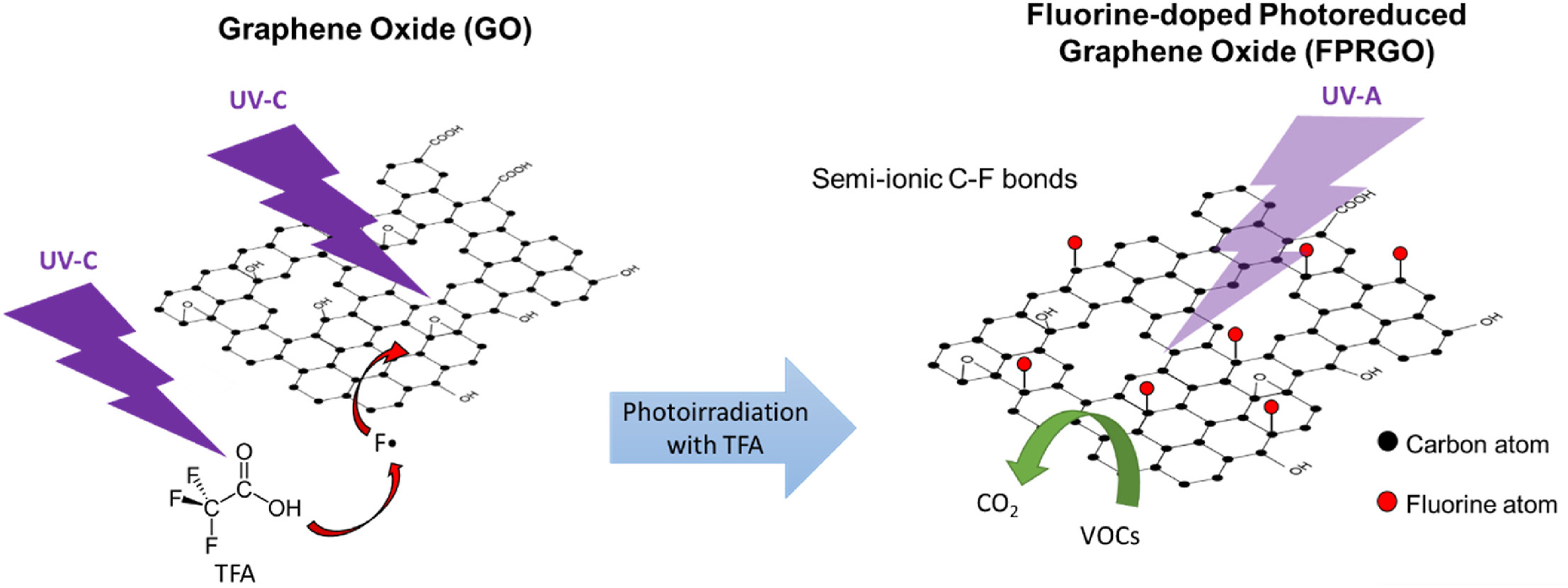
Graphical abstract.
Technology Overview
Synthesis of the FPRGO photocatalyst is achieved through a facile, solution-based UV-C photoirradiation of GO in a water/isopropanol mixture containing a low concentration of TFA. This process successfully reduces GO while introducing surface-transfer fluorine dopants exclusively in a highly polar, semi-ionic C-F bond configuration. This specific bonding scheme significantly minimizes charge carrier transport resistance and accelerates charge separation.
Applications & Benefits
The primary application is indoor air purification through the photocatalytic oxidation (PCO) of hazardous VOCs, including methanol, acetone, and formaldehyde. The primary benefits include high degradation efficiency (93.5% methanol removal), exceptional mineralization (91.7% converted to harmless CO2), and excellent catalytic stability and reusability over multiple operating cycles.
Abstract:
There is much interest in developing metal-free halogenated graphene such as fluorinated graphene for various catalytic applications. In this work, a fluorine-doped graphene oxide photocatalyst was investigated for photocatalytic oxidation (PCO) of a volatile organic compound (VOC), namely gaseous methanol. The fluorination process of graphene oxide (GO) was carried out via a novel and facile solution-based photoirradiation method. The fluorine atoms were doped on the surface of the GO in a semi-ionic C–F bond configuration. This presence of the semi-ionic C–F bonds induced a dramatic 7-fold increment of the hole charge carrier density of the photocatalyst. The fluorinated GO photocatalyst exhibited excellent photodegradation up to 93.5% or 0.493 h−1 according pseudo-first order kinetics for methanol. In addition, 91.7% of methanol was mineralized into harmless carbon dioxide (CO2) under UV-A irradiation. Furthermore, the photocatalyst demonstrated good stability in five cycles of methanol PCO. Besides methanol, other VOCs such as acetone and formaldehyde were also photodegraded. This work reveals the potential of fluorination in producing effective graphene-based photocatalyst for VOC removal.

Fluorinated photoreduced graphene oxide with semi-ionic C–F bonds: An effective carbon based photocatalyst for the removal of volatile organic compounds
Author:Tai Xin Hong, Hung Wei-Song, Yang Thomas Chung Kuang, Lai Chin Wei, Lee Kian Mun, Chen Chia-Yun, Juan Joon Ching
Year:2024
Source publication: Chemosphere, Volume 349, February 2024, 140890
Subfield Highest percentage: 99% Public Health, Environmental and Occupational Health #7/687