

Synergistic activation of lamellar bismuth selenide anchored functionalized carbon nanofiber for detecting hazardous carbendazim in environmental water samples
This paper presents a novel electrochemical sensing platform for the sensitive and selective detection of carbendazim (CBZ), a toxic and persistent fungicide that threatens aquatic ecosystems. To address the limitations of conventional analytical methods, the authors developed a nano-engineered composite comprising lamellar bismuth selenide (Bi2Se3)anchored onto acid-functionalized carbon nanofibers (f-CNF). This Bi2Se3/f-CNF nanocomposite exhibits synergistic electrocatalytic properties, a high electroactive surface area, and excellent electron transportation kinetics. When modified onto a glassy carbon electrode, it provides a highly reliable, stable, and rapid tool for environmental safety monitoring.
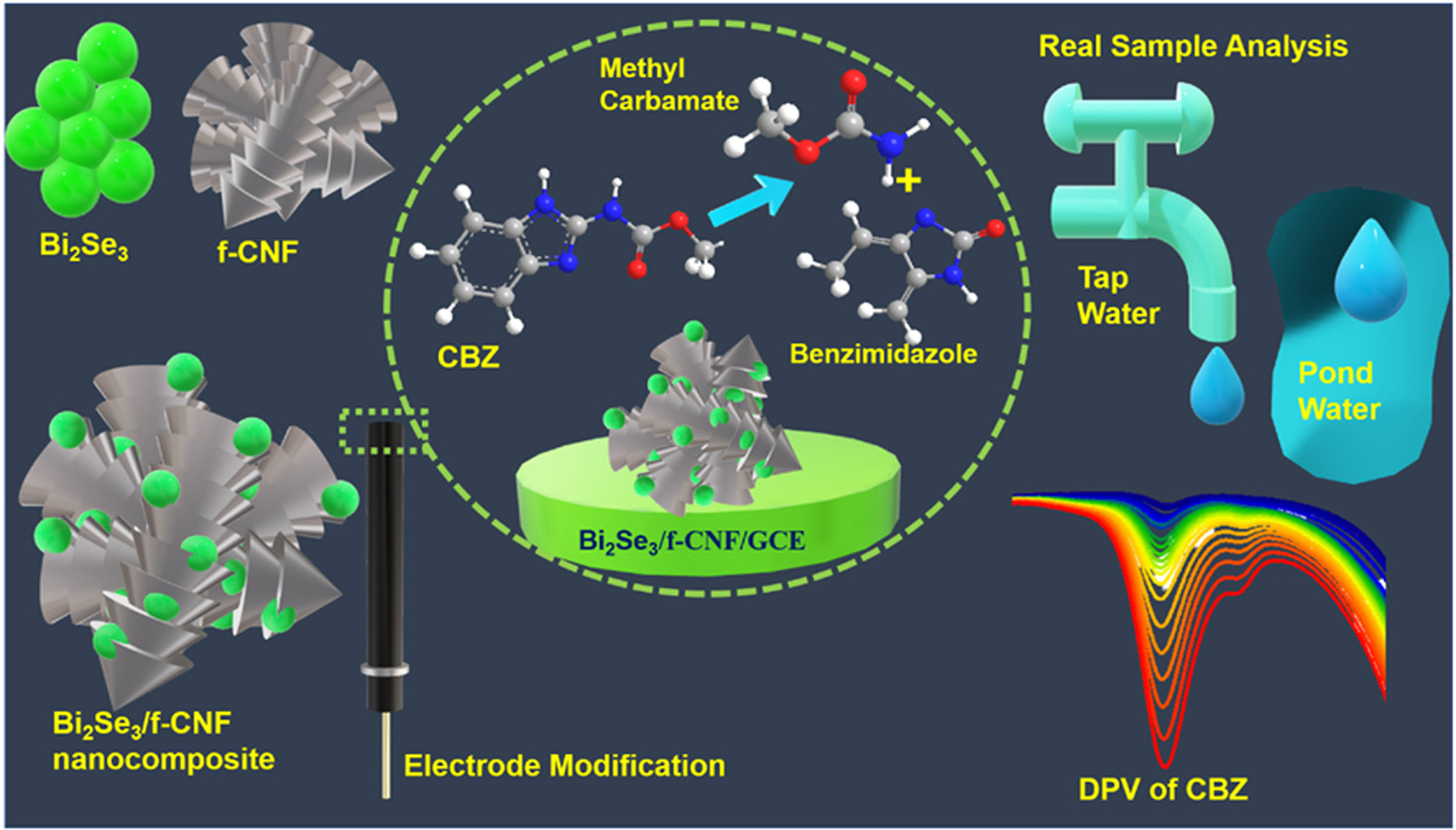
Graphical abstract.
Technology Overview
The sensor utilizes a Bi2Se3/f-CNF nanocomposite synthesized via a hydrothermal route followed by sonication. Bi2Se3 contributes abundant catalytic sites, while f-CNF enhances electrical conductivity and prevents electrode fouling. The modified electrode facilitates the quasi-reversible electro-oxidation of CBZ, exhibiting a low charge-transfer resistance (Rct = 35.93 Ω) and high electroactive surface area (0.082 cm2).
Applications & Benefits
The primary application lies in monitoring trace CBZ residues in environmental water. It delivers significant benefits, including an exceptionally low detection limit of 1.04nM, a broad linear range and strong anti-interference capabilities. Demonstrating excellent recovery in tap and pond water, this technology offers a low-cost, portable alternative for real-time ecological protection.
Abstract:
Pesticides pollute natural water reservoirs through persistent accumulation. Therefore, their toxicity and degradability are serious issues. Carbendazim (CBZ) is a pesticide used against fungal infections in agricultural crops, and its overexploitation detrimentally affects aquatic ecosystems and organisms. It is necessary to design a logical, efficient, and field-deployable method for monitoring the amount of CBZ in environmental samples. Herein, a nano-engineered bismuth selenide (Bi2Se3)/functionalized carbon nanofiber (f-CNF) nanocomposite was utilized as an electrocatalyst to fabricate an electrochemical sensing platform for CBZ. Bi2Se3/f-CNF exhibited a substantial electroactive surface area, high electrocatalytic activity, and high conductivity owing to the synergistic interaction of Bi2Se3 with f-CNF. The structural chemical compositions and morphology of the Bi2Se3/f-CNF nanocomposite were confirmed by X-ray diffraction (XRD), X-ray photoelectron spectroscopy (XPS), and field-emission scanning electron microscopy (FESEM). Electrochemical analysis was carried out using cyclic voltammetry (CV), electrochemical impedance spectroscopy (EIS), and differential pulse voltammetry (DPV). The voltammetry and impedance experiments exposed that the Bi2Se3/f–CNF–modified GCE has attained adequate electrocatalytic function with amended features of electron transportation (Rct = 35.93 Ω) and improved reaction sites (0.082 cm2) accessible by CBZ moiety along with exemplary electrochemical stability (98.92%). The Bi2Se3/f-CNF nanocomposite exhibited higher sensitivity of 0.2974 μA μM−1cm−2 and a remarkably low limit of detection (LOD) of 1.04 nM at a broad linera range 0.001–100 μM. The practicability of the nanocomposite was tested in environmental (tap and pond water) samples, which supports excellent signal amplification with satisfactory recoveries. Hence, the Bi2Se3/f-CNF nanocomposite is a promising electrode modifier for detecting CBZ.
Synergistic activation of lamellar bismuth selenide anchored functionalized carbon nanofiber for detecting hazardous carbendazim in environmental water samples
Author:Jayapaul Abishek, Lin Yu-Chien, Lin Lu-Yin, Dhawan Udesh, Duann Yeh-Fang, Lee Yi-Hsuan, Liu Ting-Yu, Sakthivel Rajalakshmi, Chung Ren-Jei
Year:2024
Source publication: Chemosphere, Volume 355, May 2024, 141744
Subfield Highest percentage: 99% Public Health, Environmental and Occupational Health #7/687