

A Ce2MgMoO6 double perovskite decorated on a functionalized carbon nanofiber nanocomposite for quantification of ciprofloxacin in milk and honey samples: Density functional theory interpretation
This study presents a novel electrochemical sensor fabricated by decorating a rare-earth cerium magnesium molybdite double perovskite Ce2MgMoO6 on acid-functionalized carbon nanofibers (f-CNFs). This advanced nanocomposite serves as an electrocatalyst for the highly sensitive and selective determination of ciprofloxacin (CFX), a widely used antibiotic. Density functional theory (DFT) is employed to theoretically evaluate the electronic properties and explain the electrochemical reaction pathways of CFX oxidation on the electrode. The fabricated sensor exhibits exceptional electroanalytical performance, including high stability, excellent repeatability, and reliable durability.
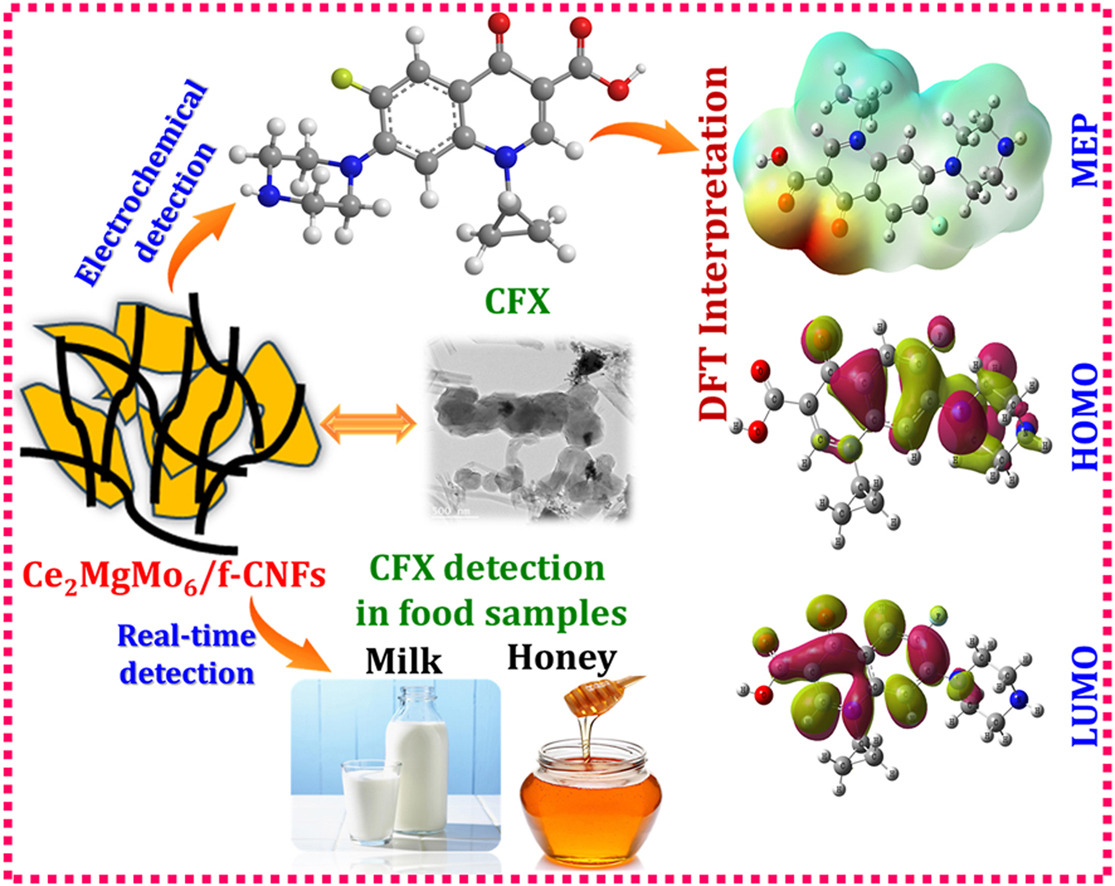
Graphical abstract.
Technology Overview
The electrode is developed by synthesizing Ce2MgMoO6 flakes hydrothermally and anchoring them onto tube-like f-CNFs via sonication. This nanocomposite provides a large surface area and high electrical conductivity, accelerating electron transfer kinetics. Additionally, DFT calculations utilizing the B3LYP method reveal the specific molecular electrostatic potentials and orbital distributions (HOMO/LUMO) governing the electrooxidation mechanism.
Applications & Benefits
This sensor is applied to quantify CFX in milk and honey samples, showing impressive recoveries comparable to GC-MS. Benefits include a low detection limit (0.127 μM) high sensitivity (0.807μA μM−1 cm−2), and wide linear ranges (0.005–7.71 μM and 9.75–77.71 μM). It offers a rapid, low-cost, eco-friendly, and selective alternative for food safety monitoring.
Abstract:
In this study, a novel Ce2MgMoO6/CNFs (cerium magnesium molybdite double perovskite decorated on carbon nanofibers) nanocomposite was developed for selective and ultra-sensitive detection of ciprofloxacin (CFX). Physical characterization and analytical techniques were used to explore the morphology, structure, and electrocatalytic characteristics of the Ce2MgMoO6/CNFs nanocomposite. The sensor has a wide linear range (0.005–7.71 μM and 9.75–77.71 μM), a low limit of detection (0.012 μM), high sensitivity (0.807 μA μM−1 cm−2 nM), remarkable repeatability, and an appreciable storage stability. Here, we used density functional theory to investigate CFX and oxidized CFX as well as the locations of the energy levels and electron transfer sites. Furthermore, the Ce2MgMoO6/CNFs-modified electrode was successfully tested in food samples (milk and honey), indicating an acceptable response with a recovery percentage and relative standard deviation of less than 4%, which is comparable to that of GC-MS. Finally, the developed sensor exhibited high selectivity and stability for CFX detection.

A Ce2MgMoO6 double perovskite decorated on a functionalized carbon nanofiber nanocomposite for quantification of ciprofloxacin in milk and honey samples: Density functional theory interpretation
Author:Jagtap Akash Ashokrao, Prasanna Sanjay Ballur, Kumar Gagankumar Sakaleshpur, Lin Yu-Chien, Dhawan Udesh, Lu Yu-Chun, Sakthivel Rajalakshmi, Tung Ching-Wei, Chung Ren-Jei
Year:2024
Source publication: Chemosphere, Volume 358, June 2024, 142237
Subfield Highest percentage: 99% Public Health, Environmental and Occupational Health #7/687