

Comprehensive evaluation of the nephrotoxicity of carbon quantum dots: Effects of the surface charge
This study offers a comprehensive safety and health risk evaluation of carbon quantum dots (CQDs) with different surface modifications, addressing a key research gap. It investigates three CQD types—diammonium citrate-based (CQDs-A), spermidine trihydrochloride-based (CQDs-S), and their combination (CQDs-A/S)—by analyzing their cytotoxicity, oxidative stress, and nephrotoxicity both in vitro and in vivo. The results reveal that while positively charged CQDs-S and CQDs-A/S exhibit significant cellular cytotoxicity and induce oxidative stress in HEK293 cells, they do not trigger severe inflammatory responses or compromise renal barrier integrity, demonstrating a reassuring biomedical safety profile.
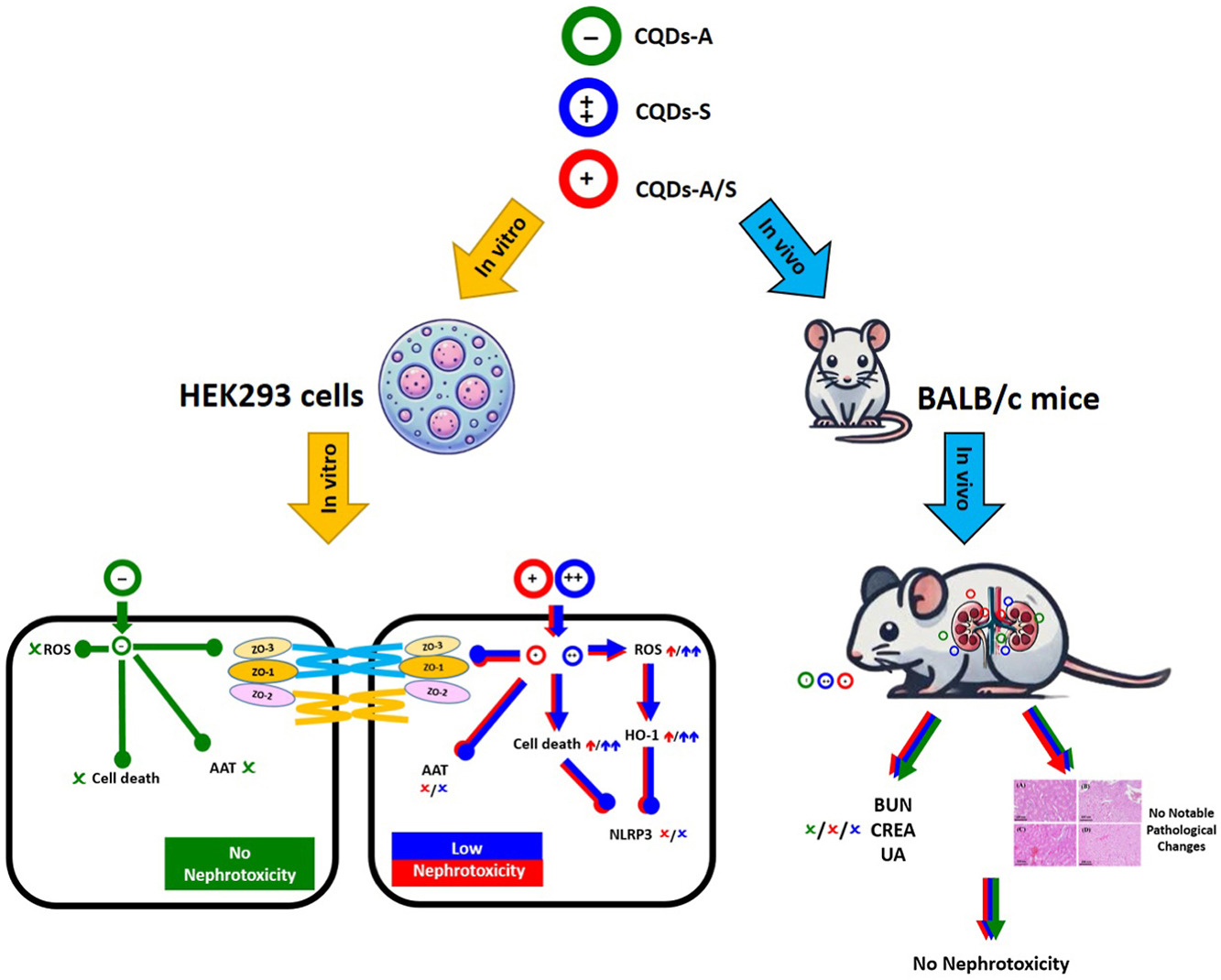
Graphical abstract.
Technology Overview
The CQDs were synthesized via a one-step carbonization method by heating specific chemical precursors at $180^\circ\text{C}$. Advanced characterization techniques, including FE-TEM, DLS, FTIR, and XRD, confirmed well-defined amorphous nanostructures under 10 nm with distinct surface charges. Biological pathways were technically assessed using CCK-8 assays for cell viability, fluorescence spectrometry for ROS levels, and Western blotting for protein expressions.
Applications & Benefits
This research directly benefits fields like bioimaging, biosensing, and targeted drug delivery by clarifying nanoparticle safety. By establishing a clear link between CQD surface charges and cytotoxicity, the study provides crucial guidelines for molecular engineering, enabling the design of safer, highly biocompatible carbon-based nanomaterials with minimized health risks in future clinical applications.
Abstract:
Carbon quantum dots (CQDs) are garnering attention for their broad applications. This study offers a detailed evaluation of the biomedical safety and health risks of carbon quantum dots (CQDs) with different surface modifications, addressing a key gap in their safe application. It focuses on three CQD types: diammonium citrate-based (CQDs-A), spermidine trihydrochloride-based (CQDs-S), and a combination (CQDs-A/S), analyzing their physicochemical properties, cytotoxicity, oxidative stress, inflammatory responses, and nephrotoxicity. While all CQDs were under 10 nm, their biological impacts varied. Positively charged CQDs-S and CQDs-A/S showed significant cytotoxicity in HEK293 cells, inducing oxidative stress but not activating NLRP3 inflammasome, indicating a limited inflammatory response. Renal integrity remained unaffected, with stable zonula occludens 2 expression and unaltered renal markers. In vivo studies in BALB/c mice further supported the safety of CQDs, showing no organ damage or kidney pathology at high doses. The findings underscore the potential for safe biomedical use of CQDs, particularly when their retention time is minimized. This research makes a novel contribution by linking CQDs' surface charge to cytotoxic effects and oxidative stress, providing key insights into their safe use in biomedicine and filling a critical gap in nanoparticle toxicity studies.
Comprehensive evaluation of the nephrotoxicity of carbon quantum dots: Effects of the surface charge
Author:Jiang Pei-Luen, Hong Yan-Yu, Yang Lingyan, Lin Han-Jia, Huang Chih-Ching, Chen Yan-Hua, Lin Chia-Hua, Chen Yi-Chun
Year:2024
Source publication: Chemosphere, Volume 367, November 2024, 143604
Subfield Highest percentage: 99% Public Health, Environmental and Occupational Health #7/687