

Comment on “Towards improved USLE-based soil erosion modelling in India: A review of prevalent pitfalls and implementation of exemplar methods” by Majhi et al. (2021), Earth-Science Reviews 221, 103786
This paper is a commentary discussing the evaluation of USLE-based soil erosion modeling in India by Majhi et al. (2021). The authors commend the original review for identifying errors across 100 studies but point out that Majhi et al. committed their own error regarding the rainfall and runoff factor (R) equations derived from the Modified Fournier Index (MFI). Specifically, they clarify a typographical misinterpretation of the original Arnoldus (1977) equation, proving that the equation represents a log-log relationship with an exponent rather than a standard multiplication.
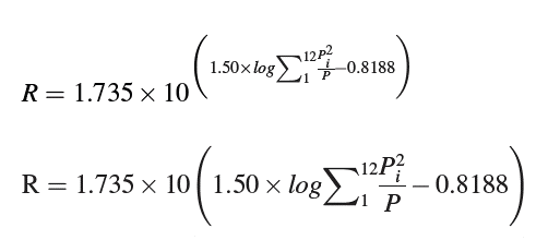
The correction of the equation.
Technology Overview
This study thoroughly analyzes the mathematical structure of the empirical rainfall erosivity R-factor equation based on the Modified Fournier Index (MFI). By verifying the historical context and cross-referencing rainfall data from contour maps in Morocco, the authors demonstrate that the equation inherently represents a log-log relationship that requires an exponential form rather than basic multiplication, thereby correcting a long-standing typographic misinterpretation originating from early typewriter limitations. Furthermore, the technical critique identifies an intrinsic unit conversion error within the formula, asserting that the coefficient 1.735 must be substituted with 17.02 to accurately satisfy metric unit standards for soil erosion modeling.
Applications & Benefits
This corrective framework is directly applicable to hydrological modeling, watershed management, and large-scale soil erosion risk assessments that utilize the USLE/RUSLE models. In terms of practical benefits, it successfully prevents the widespread misclassification and incorrect citation of rainfall erosivity equations across academic and engineering sectors. By addressing the mathematical and unit conversion flaws that previously caused significant underestimations of soil loss, this refinement drastically improves the precision, reliability, and safety of environmental impact assessments and soil conservation engineering designs.
Abstract:
We found the study of Majhi et al. (2021) very interesting. The authors did an excellent job of evaluating the 100 USLE-based soil erosion studies undertaken in India and outlining the problems and errors encountered while estimating the USLE erosion factors in these studies. According to the authors, practically every study of the 100 research examined either overestimated or underestimated at least one of the five factors. We appreciate the excellent work of Majhi et al. (2021). Their research demonstrating the flaws in previous studies that employed USLE-based models to estimate soil erosion is precisely the type of work we need. However, we fear that Majhi et al. (2021) also made an error while evaluating the rainfall and runoff factor (R) equations that were based on the Modified Fournier Index. We highlighted the details in this discussion.

Comment on “Towards improved USLE-based soil erosion modelling in India: A review of prevalent pitfalls and implementation of exemplar methods” by Majhi et al. (2021), Earth-Science Reviews 221, 103786
Author:Chen Walter, Bezak Nejc
Year:2022
Source publication: Earth-Science Reviews, Volume 231, August 2022, 104095
Subfield Highest percentage: 99% Earth and Planetary Sciences #2/192