

Crystal orientation and insulating ligand of quasi-two dimensional perovskite optimized through silver ion doping for realizing efficient light emitting diodes
This study investigates the optimization of quasi-two-dimensional (Q-2D) lead halide perovskites for efficient light-emitting diodes (LEDs). Q-2Ds possess exceptional optoelectronic properties but suffer from disorderly crystal orientation and insulating ligands that impair device performance. To address these challenges, the authors developed a silver ion (Ag+) doping method to manipulate crystallization kinetics, enhance ionic balance, and passivate surface defects. With an appropriate Ag+ doping ratio (2.5%), the optimized Q-2D LEDs achieved superior carrier mobility, suppressed nonradiative recombination, and remarkably high performance compared to pristine devices.
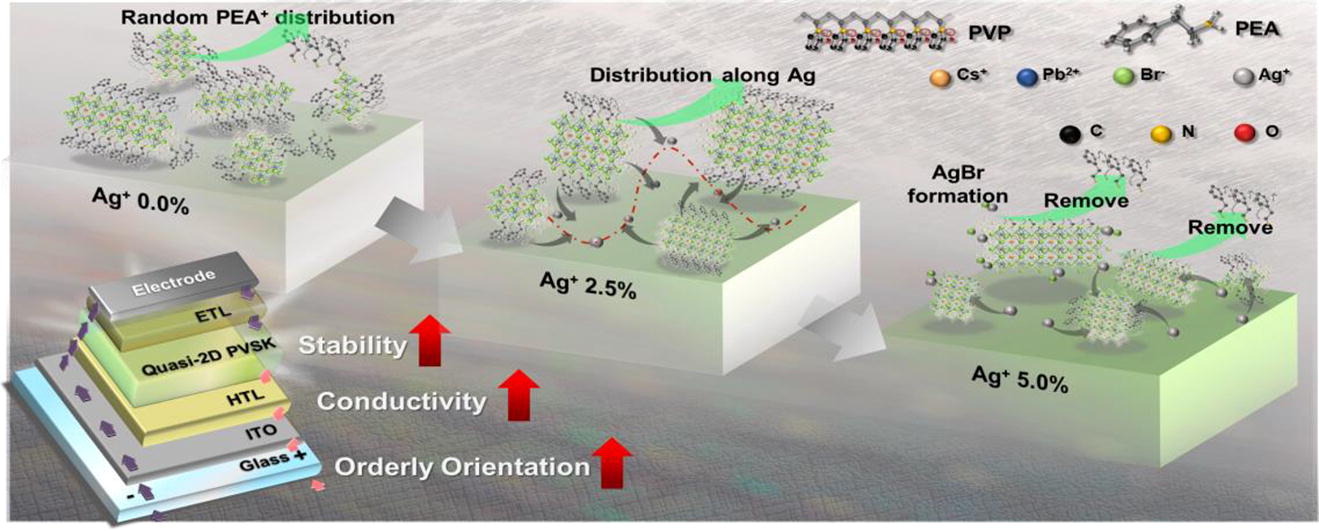
Graphical abstract.
Technology Overview
The technology introduces an optimal 2.5% silver ion doping into the quasi-two-dimensional perovskite structure via a solution process. The strong electronic affinity between silver and bromide ions inhibits disorderly crystal orientation, promoting a highly organized crystalline phase. Additionally, the hole-transport layer is modified with silver nanoparticles to reduce hole injection barriers and utilize localized surface plasmon resonance to significantly enhance radiative recombination.
Applications & Benefits
This technology is primarily applied to high-efficiency optoelectronic devices, specifically green perovskite light-emitting diodes (LEDs). Benefiting from defect passivation and improved carrier balance, the optimized 2.5% Ag+ -doped LED delivers a maximum luminance of 9,507 cd/m2 and an external quantum efficiency (EQE) of 10.80%. These values represent a significant improvement—being 2 times and 10 times higher in luminance and EQE, respectively, than those of pristine Q-2D LEDs.
Abstract:
Quasi-two-dimensional lead halide perovskites (Q-2Ds) have outstanding optoelectronic properties and solution processability, and they have been widely studied as promising candidates for the development of low-cost and efficient LEDs. However, the disorderly crystal orientation and insulating ligand impair the performance of Q-2D-based photoelectronic devices. Thus, a method based on silver (Ag) ion doping is formulated that provides a high dielectric constant, controls the crystal orientation, improves ionic balance, and successfully elevates the LED characteristics of these materials. With the addition of an appropriate amount of Ag+, the disorderly crystal orientation is inhibited, and defect passivation is achieved owing to improvements in photoluminescence quantum yield (PLQY) and carrier mobility. By contrast, the addition of excess Ag+ increases the possibility of the formation of AgBr during crystal growth, which aggravates the disorderly crystal orientation due to the destruction of ionic balance, which can be attributed to the strong affinity between Ag+ and Br−. Additionally, the hole-transport layer is modified upon Ag nanoparticle doping, which reduces luminescence quenching and hole injection barriers. Consequently, the luminance and external quantum efficiency of the optimized Ag+-doped Q-2D LED are 2 and 10 times higher, respectively, than those of the Q-2D LED without Ag+ doping.
Crystal orientation and insulating ligand of quasi-two dimensional perovskite optimized through silver ion doping for realizing efficient light emitting diodes
Author:Chen Wei-Cheng, Hung Chung-Wei, Chang Cheng-Hao, Liang Fang-Cheng, Benas Jean-Sebastien, Yan Zhen-Li, Lin Bi-Hsuan, Lin Ja-Hon, Kuo Chi-Ching
Year:2022
Source publication: Chemical Engineering Journal, Volume 443, September 2022, 136496
Subfield Highest percentage: 99% Industrial and Manufacturing Engineering #3/355