

Heterostructures of mixed metal oxides (ZnMnO3/ZnO) synthesized by a wet-chemical approach and their application for the electrochemical detection of the drug chlorpromazine
This paper reports a highly efficient, label-free electrochemical sensor designed for the precise detection of the antipsychotic drug chlorpromazine (CPMZ). The researchers successfully fabricated a novel heterostructure consisting of cubic ZnMnO3 and hexagonal zinc oxide nanoparticles (ZMO/ZnO NPs), synthesized via a simple co-precipitation method followed by thermal calcination. This nanohybrid modified electrode overcomes the limitations of conventional analytical methods. It exhibits outstanding electrocatalytic activity and high sensitivity toward CPMZ oxidation , providing a rapid, user-friendly, and cost-effective platform for clinical monitoring and pharmaceutical analysis.
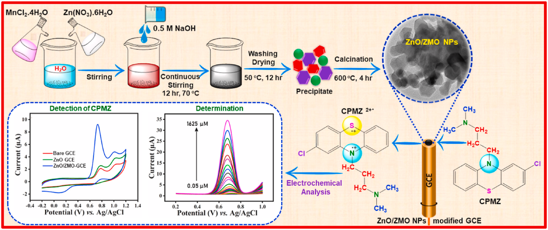
Graphical abstract.
Technology Overview
The technology utilizes a ZMO/ZnO NP-modified glassy carbon electrode (GCE). The synergetic effect between the mixed oxides and the high oxidation state of manganese Mn4+ significantly enhances electron transfer and catalytic activity. Analyzed via DPV, the sensor delivers two wide linear ranges (0.05–125.55 μM and 185.55–1625 μM) and an ultra-low detection limit of 0.019 μM .
Applications & Benefits
This sensor is primarily applied in clinical medical diagnostics, forensic analysis, and therapeutic drug monitoring. By offering a portable and low-cost alternative to HPLC or GC , it accurately determines CPMZ levels in real human blood serum and urine with excellent recovery rates 96–100%, effectively preventing health risks from excessive drug consumption.
Abstract:
Materials development using heterostructures is generally considered an efficient method for developing electrocatalysts. However, it still faces many challenges, such as instability and accurate phase mixing ratio of metals. On the other hand, the excessive consumption of drugs such as chlorpromazine (CPMZ) leads to several serious human diseases. Therefore, the accurate detection and determination of CPMZ is essential. In this view, a highly efficient electrochemical sensor based on a heterostructure of ZnMnO3/ZnO NPs/GCE was fabricated to detect the psychotic drug CPMZ. The heterostructure of cubic ZnMnO3 (ZMO) and hexagonal zinc oxide nanoparticles (ZMO/ZnO NPs) was synthesized by a simple co-precipitation method followed by thermal calcination. The as-prepared material crystallinity and average crystal size (26 nm) were analyzed by p-XRD. The morphology of the ZMO/ZnO NPs was analyzed by SEM and HR-TEM, which revealed the formation of non-uniform spherical and hexagonal nanoparticles with a size of ∼10-30 nm. FT-IR and XPS were used to investigate the functional groups and oxidation states of the ZMO/ZnO NPs. The electrochemical properties of the ZMO/ZnO NPs/GCE were analyzed by EIS, CV, and DPV methods. ZMO/ZnO/GCE has improved electrochemical activity for detecting CPMZ. In addition, the ZMO/ZnO/GCE electrochemical probe has two linear ranges (0.05–125.55 μM and 185.55–1625 μM) and good sensitivity (0.760 μA μM−1 cm−2) with a low detection limit of 0.019 μM. Analysis of real samples was performed in human blood serum and urine, and the recoveries of CPMZ were 96–100% and 98–100%, respectively.

Heterostructures of mixed metal oxides (ZnMnO3/ZnO) synthesized by a wet-chemical approach and their application for the electrochemical detection of the drug chlorpromazine
Author:Balamurugan Karuppaiah, Karthik Raj, Chen Shen-Ming, Sukanya Ramaraj, Thasma Subramanian Bhuvaneswari, Biju Valsala Madhavan Nair, Shim Jae-Jin, Breslin Carmel B.
Year:2022
Source publication: Composites Part B Engineering, Volume 236, 1 May 2022, 109822
Subfield Highest percentage: 99% Engineering #2/355