

Experimental and numerical study on heat and mass transfer of a membrane dehumidifier with various materials
This study investigates the heat and mass transfer performance of a membrane dehumidifier using three membrane materials: Nafion 212, Nafion 117, and Carboxyl polyimide (PI). Experimental tests and CFD simulations were conducted under different temperatures, humidity levels, and airflow rates. The results show that higher temperature and humidity enhance moisture removal by increasing vapor pressure differences. Nafion 212 achieved the highest dehumidification capacity, while Nafion 117 provided better thermal stability and lower pressure loss. The study demonstrates the potential of membrane dehumidification as an energy-efficient alternative for HVAC and humidity control applications.
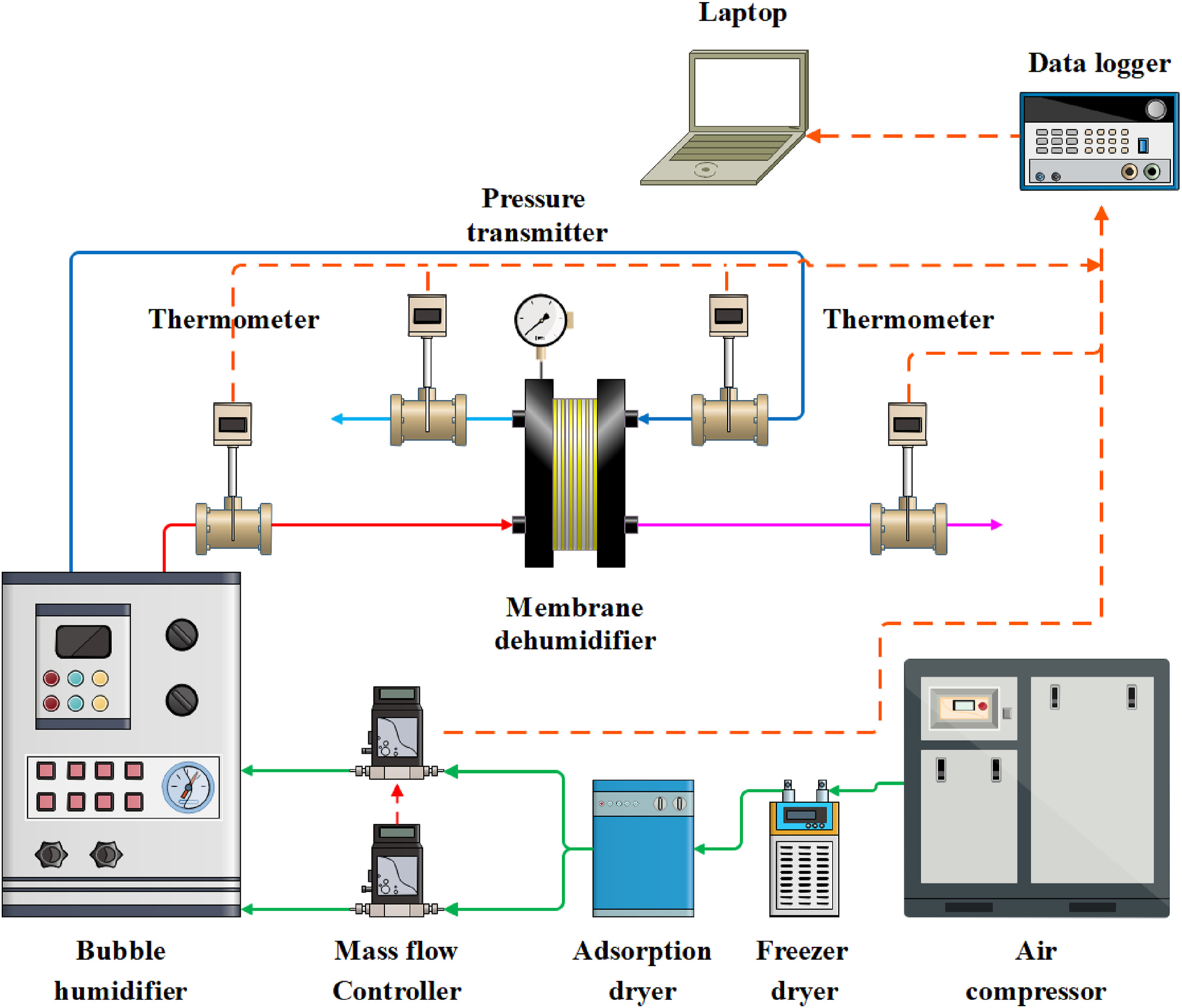
Fig. 5. The schematic of the experimental system for the thermally driven membrane dehumidification.
Technology Overview
A thermo-mass transfer membrane dehumidifier was developed using Nafion 212, Nafion 117, and Carboxyl PI membranes. Moisture transfer occurs through temperature and humidity gradients under atmospheric pressure. Experimental measurements and CFD simulations were combined to evaluate heat transfer, moisture removal, and airflow characteristics.
Applications & Benefits
The technology can be applied in HVAC systems, indoor air quality control, industrial drying, and medical environments. It offers lower energy consumption than conventional dehumidification methods while improving humidity control, reducing latent heat loads, and enhancing overall energy efficiency.
Abstract:
Efficient humidity control is essential for maintaining indoor air quality and optimizing energy consumption in heating, ventilation, and air conditioning (HVAC) systems, industrial processes, and medical environments. Conventional dehumidification methods are often energy-intensive, necessitating the development of more efficient alternatives. This study evaluates the performance of a heat and mass transfer membrane dehumidifier utilizing three membrane materials—Nafion 212, Nafion 117, and Carboxyl polyimide (PI). Experimental and numerical analyses were conducted under varying wet-side conditions, with air temperatures ranging from 35 °C to 50 °C, relative humidity levels from 50 %RH to 80 %RH, and flow rates between 20 L/min and 50 L/min. Results indicate that increasing wet-side temperature and humidity enhances dehumidification rates by increasing vapor pressure and driving force across the membrane. Nafion 212 achieved the highest dehumidification rate, removing 2.35 g/min of moisture at 50 °C and 80 %RH, with the greatest enthalpy difference, making it the most effective for high-performance applications. Nafion 117 demonstrated superior thermal stability, achieving the highest approach temperature of 13.5 °C and the lowest pressure drop, making it more efficient in maintaining airflow stability. The Carboxyl PI membrane exhibited the lowest overall dehumidification efficiency due to its higher mass transfer resistance. These findings provide valuable insights for optimizing membrane-based dehumidification systems, offering an energy-efficient alternative for diverse environmental applications.
Experimental and numerical study on heat and mass transfer of a membrane dehumidifier with various materials
Author:Li Chun-Han, Yan Wei-Mon
Year:2025
Source publication: Journal of Building Engineering, Volume 106, 112573
Subfield Highest percentage: 99% Architecture #2/210