

Probing interfacial chemistry of functionalized ceramic nanoparticles to optimize Li+ pathways in polymer electrolytes for solid-state lithium metal batteries
This study investigates the surface functionalization of LLZTO garnet nanoparticles using different silane coupling agents to improve interfacial compatibility in composite polymer electrolytes for solid-state lithium metal batteries. Experimental analyses, DFT calculations, and Li-NMR studies reveal that amino-functionalized LLZTO significantly enhances Li⁺ transport pathways and interfacial interactions. The optimized composite electrolyte achieves an ionic conductivity of 2.7 × 10⁻⁴ S cm⁻¹ at room temperature and excellent electrochemical stability up to 5 V, leading to improved battery cycling performance and safer solid-state battery operation.
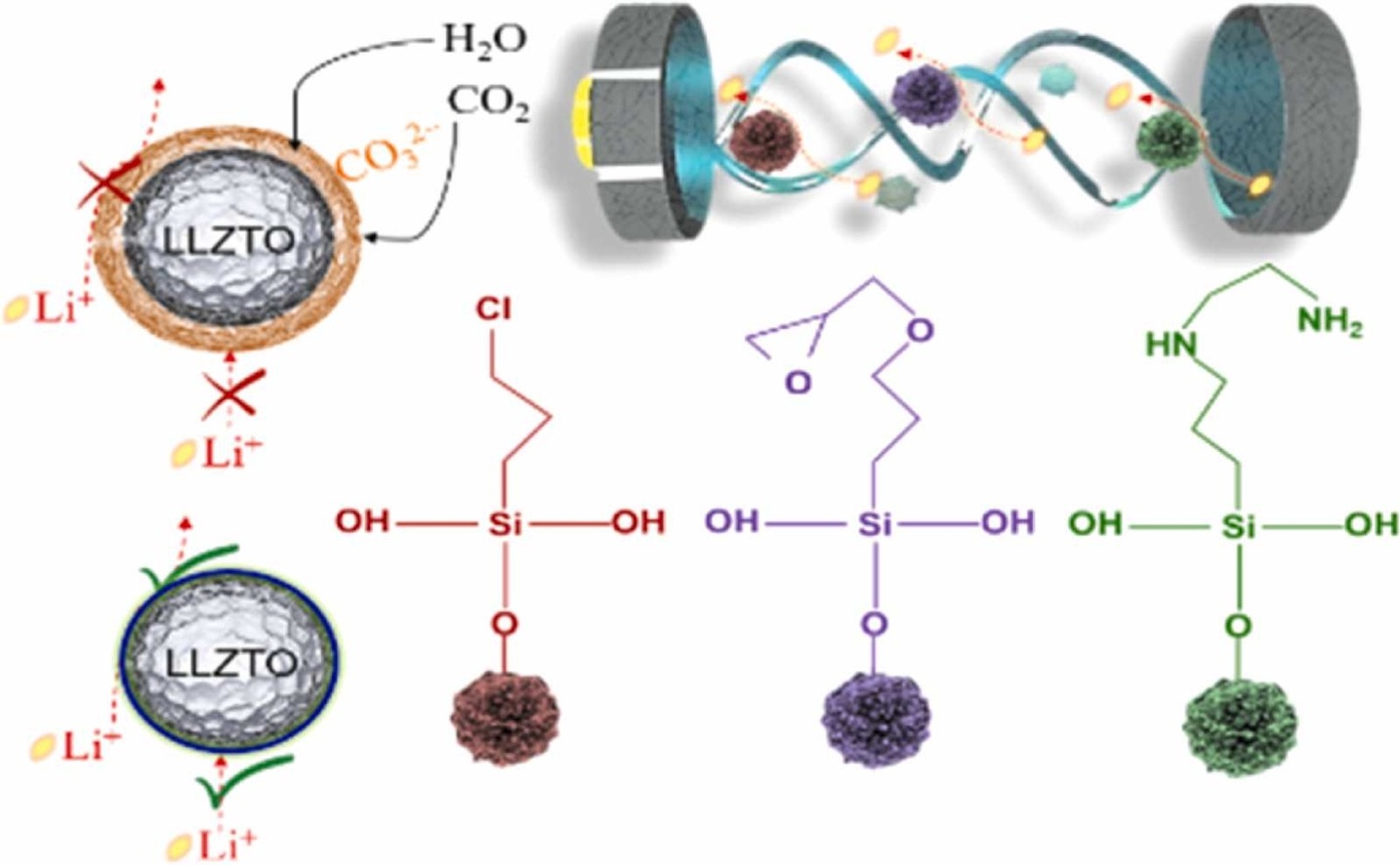
Fig. 1. Graphical Abstract.
Technology Overview
Silane-functionalized LLZTO ceramic nanoparticles were incorporated into PEO-based composite polymer electrolytes. Surface modification improves filler dispersion, polymer–ceramic compatibility, and Li⁺ transport pathways. Combined experimental characterization, DFT simulations, and Li-NMR analyses were used to understand interfacial chemistry and optimize solid-state electrolyte performance.
Applications & Benefits
The developed composite electrolytes are suitable for solid-state lithium metal batteries used in electric vehicles and energy storage systems. Enhanced ionic conductivity, wider electrochemical stability, improved Li⁺ transport, and better dendrite suppression contribute to safer batteries with higher energy density and longer cycling life.
Abstract:
The surface functionalization of garnet-type Li6.75La3Zr1.75Ta0.25O12 (LLZTO) solid-state electrolytes (SSEs) is a promising strategy to enhance interfacial compatibility between LLZTO fillers and the polymer matrix in composite polymer electrolytes (CPEs). Silane coupling reagents are increasingly explored for this purpose; however, the optimal choice of silane remains unclear. Herein, a systematic study of three distinct silane reagents, integrating experimental analyses and computational modeling to elucidate the influence of terminal functional groups on LLZTO functionalization, is demonstrated. Incorporating silane-modified LLZTO into a polymer matrix significantly improves key performance metrics, with the optimized CPE exhibiting a 30-fold increase in ionic conductivity of 2.7 × 10⁻⁴ S cm–1 at 25 °C compared to pristine LLZTO-based CPE. The optimized CPE could demonstrate a high ionic conductivity of 2.7 mS cm–1 at 55 °C. The electrochemical window demonstrated stability extending up to 5 V, while the evaluations of electrochemical performance further underscore the efficacy of surface functionalization in enhancing battery performance. Density Functional Theory (DFT) calculations and solid-state magic angle spinning Li-nuclear magnetic resonance (ss-MAS Li-NMR) studies provide molecular-level insights into the interfacial interactions between LLZTO fillers and the polymer matrix. This study offers a strategic approach for modifying inorganic fillers, facilitating the design of high-performance CPEs for next-generation solid-state lithium metal batteries (SSLMBs).
Probing interfacial chemistry of functionalized ceramic nanoparticles to optimize Li+ pathways in polymer electrolytes for solid-state lithium metal batteries
Author:Srivastava Pavitra, Bazri Behrouz, Hung Yuan-Ting, Verma Hemant, Cheng Chih-Yang, Huang Shun-Ming, Wu Yi-Tso, Wei Da-Hua, Kaun Chao-Cheng, Liu Ru-Shi
Year:2025
Source publication: Nano Energy, Volume 146, December 2025
Subfield Highest percentage: 99% Electrical and Electronic Engineering #9/1030