

Aggregated scheduling of household and public loads with different characteristics in a single-building energy community
This paper proposes an aggregated scheduling framework for household and public loads in a single-building energy community (SBEC). The method coordinates residential loads, public facilities, shared solar power systems, and battery energy storage systems to reduce electricity costs. A distributed optimization approach based on the Alternating Direction Method of Multipliers (ADMM) is adopted to preserve residents’ privacy and improve computational efficiency. Convex relaxation, cover inequalities, and iterative threshold rounding are introduced to accelerate convergence and ensure feasible solutions. Simulation results demonstrate that the proposed method outperforms conventional non-aggregated scheduling approaches in reducing energy costs.
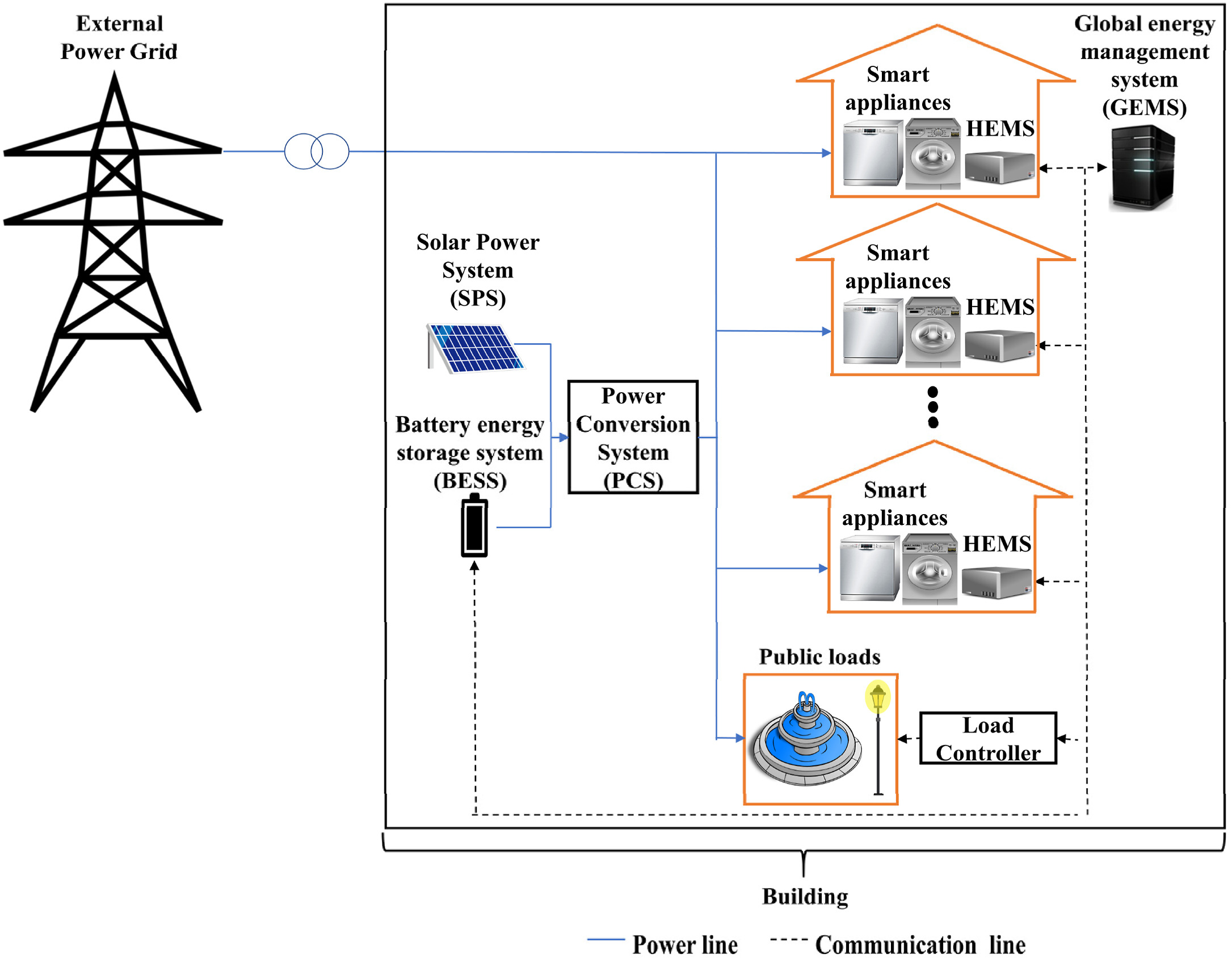
Fig. 1. System architecture of SBEC.
Technology Overview
The study employs ADMM-based distributed optimization for energy management in a single-building energy community. Convex relaxation, cover inequalities, and iterative threshold rounding are integrated to improve convergence and solution feasibility while coordinating household loads, public loads, shared solar generation, and battery storage.
Applications & Benefits
The proposed method enables efficient energy scheduling in apartment buildings and energy communities. It lowers electricity costs, protects residents’ privacy, improves computational efficiency, and enhances the utilization of shared renewable energy resources and battery storage systems.
Abstract:
This paper proposes an optimization scheme for aggregated scheduling of household and public loads with different characteristics in a single-building energy community (SBEC). SBEC refers to a group of residential households within the same building that use the shared energy resources within the building on a shared basis. Additionally, the SBEC includes public loads with varying characteristics, which are used collectively by all residents in SBEC. To ensure reasonable computation times while preserving residents' privacy, the Alternating Direction Method of Multipliers (ADMM) is used to solve the aggregated scheduling problem in a distributed manner. At each iteration of the ADMM iterative process, the home energy management system (HEMS) of every household first determines its household load scheduling. Then, the global energy management system (GEMS) determines the public load scheduling. To expedite the convergence of the ADMM iterative process, a convex relaxation scheme coupled with cover inequalities is proposed to assist each HEMS and GEMS in reaching mutual agreement on household load profiles. Iterative threshold rounding is proposed to refine the solution obtained from the ADMM iterative process, thereby enhancing the solution's feasibility. Results show that the proposed aggregated scheduling and ADMM iterative process are more effective at reducing electricity cost compared to the previously published non-aggregated scheduling method.
Aggregated scheduling of household and public loads with different characteristics in a single-building energy community
Author:Teo J.C., Yao Leehter
Year:2025
Source publication: Journal of Building Engineering, Volume 109, September 2025, 113032
Subfield Highest percentage: 99% Architecture #2/210