

Bridging the gap: integrating AR and VR production line training to enhance furniture carpentry students’ understanding of production processes
This study investigates the integration of Augmented Reality (AR) and Virtual Reality (VR) in furniture carpentry education. AR was used to create a miniature production line in a school workshop, while VR simulated large-scale furniture factories in Vietnam. Thirty students participated in the experiment, comparing AR/VR training with traditional instruction. Results showed significant improvements in production knowledge, production scheduling ability, and reduced cognitive load. The proposed approach helps students understand different manufacturing environments and enhances their adaptability to various furniture production processes and industrial conditions.
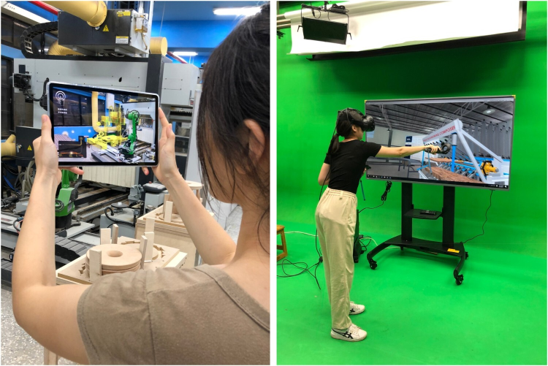
Figure 5. Two distinct training frameworks: AR on the left, tailored for the school’s small-batch production environment, and VR on the right, designed for large-scale production environments in Vietnam.
Technology Overview
The study combines AR and VR technologies developed with Unity. AR overlays virtual machinery and production guidance onto school workshops, while VR simulates overseas large-scale furniture factories. Together, these technologies provide immersive and interactive training experiences for furniture production education.
Applications & Benefits
The AR–VR training system improves students’ production knowledge, scheduling ability, and understanding of manufacturing processes. It reduces cognitive load and enables learners to adapt to different production environments, offering an effective solution for vocational and industrial training.
Abstract:
Large-scale furniture production involves complex manufacturing processes and methods. However, Taiwanese schools face limitations in terms of space and equipment, restricting students from engaging in furniture prototype creation or small-batch production. As a result, students often struggle to grasp practical aspects of large-scale furniture production, leading to a partial understanding of manufacturing processes and methods. To bridge this gap, this study introduces Augmented Reality (AR) technology and miniaturized furniture production lines in a school’s woodshop. AR can be used to guide students through miniaturized production stages, emphasizing semi-automated furniture production features. Additionally, Virtual Reality (VR) technology is combined to provide an immersive experience of real-world, large-scale furniture production, allowing students to understand processing scenarios and conditions in facilities of other countries. In an experiment involving 30 first-year students, an experimental group (15 participants) received mixed AR and VR instruction, while a control group (15 participants) received traditional teaching methods. Findings reveal that AR and VR integration enhanced students’ comprehension of differences between the school workshop and overseas large-scale furniture production facilities. This strategy improved their furniture production knowledge, and fostered adaptability to various production conditions and methods.
Bridging the gap: integrating AR and VR production line training to enhance furniture carpentry students’ understanding of production processes
Author:Lee I-Jui, Lin Yu-Ting
Year:2025
Source publication: Interactive Learning Environments, Volume 33, Issue 1, February 2025, 557–578
Subfield Highest percentage: 99% Education #16/1698