

The roles of cooperative attitude, personal innovativeness, and anxiety in AI adoption within the design community
This study investigates designers’ intentions to adopt AI technologies in the design process. Based on the UTAUT framework, the proposed model incorporates cooperative attitude, personal innovativeness, and AI anxiety to explain AI acceptance. Using structural equation modeling with 292 designers, the results reveal that performance expectancy is the strongest predictor of AI adoption. Cooperative attitudes and personal innovativeness positively influence AI acceptance, while AI anxiety mainly affects perceived ease of use. The findings provide insights for developing AI-integrated design education and professional training programs.
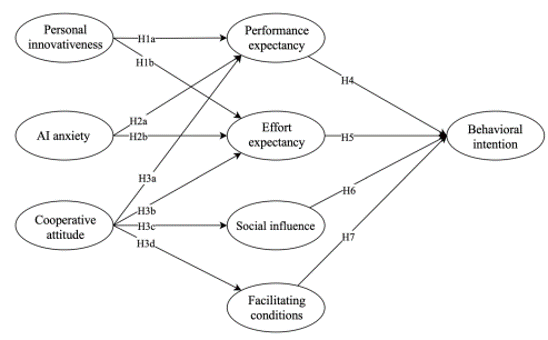
Fig. 1. Research model and hypotheses.
Technology Overview
The study employs the UTAUT framework and Structural Equation Modeling (SEM) to examine AI adoption among designers. It analyzes relationships among performance expectancy, effort expectancy, social influence, facilitating conditions, personal innovativeness, cooperative attitude, and AI anxiety.
Applications & Benefits
The findings support the development of AI-assisted design education and workplace training. Encouraging collaboration and personal innovativeness can improve AI adoption, enhance design efficiency, and promote effective human–AI collaboration in creative industries.
Abstract:
The integration of AI technology into design practices has sparked debate within the design community, particularly regarding its behavioral and process-oriented impacts. While existing studies predominantly rely on qualitative methods such as interviews and observations, these approaches may fall short in uncovering the intricate, cross-disciplinary relationships essential for a holistic understanding of AI’s societal implications. This study introduces an acceptance model tailored to designers, based on the Unified Theory of Acceptance and Use of Technology (UTAUT). The proposed model emphasizes the increasing role of online cooperation and affective drivers, including personal innovativeness and anxiety toward AI-integrated design tools. By analyzing 292 valid responses through structural equation modeling, we found that social influence and facilitating conditions are strongly correlated with positive attitudes toward cooperation, while performance expectancy emerged as the key driver for AI adoption in design. Notably, experienced professionals reported greater access to support and resources for AI integration. Although AI-induced anxiety affects certain aspects of technology adoption, it does not significantly diminish performance expectancy. In addition, the study discusses gender differences in technology acceptance and the influence of underlying geographic factors. These insights contribute to the broader discourse on the societal implications of AI, offering practical guidance for the development of AI-integrated design programs in educational and professional contexts.
The roles of cooperative attitude, personal innovativeness, and anxiety in AI adoption within the design community
Author:Kuo Jo-Yu, Wang Tzu-Hsuan
Year:2025
Source publication: AI and Society, Volume 40, pages 6339–6355
Subfield Highest percentage: 99% Philosophy #2/891