

An analysis of Metaverse literacy and college teachers’ need for learning: the need for a cognition perspective
This study investigates college teachers’ Metaverse literacy and their professional learning needs from a cognition perspective. A Metaverse literacy scale was developed to evaluate teachers’ current competencies and future learning demands. Using Importance–Performance Analysis, the study identified areas requiring professional development. Results showed that most teachers possess only moderate Metaverse literacy and demonstrate limited readiness to apply Metaverse technologies in education. The findings suggest that targeted training programs are necessary to improve teachers’ abilities in immersive technologies, instructional strategies, and educational applications of the Metaverse.
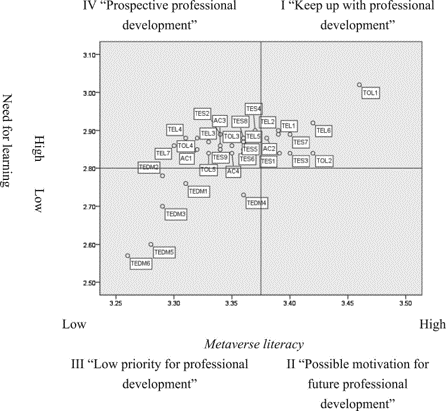
Fig. 1. Quadrant analysis of Metaverse literacy and need for learning.
Technology Overview
The study employs a Metaverse literacy assessment framework and Importance–Performance Analysis (IPA) to evaluate teachers’ competencies and learning needs. The framework covers immersive technologies such as AR, VR, MR, XR, digital platforms, and virtual learning environments for educational applications.
Applications & Benefits
The framework helps identify teachers’ training priorities and supports the design of professional development programs. Enhancing Metaverse literacy can improve immersive teaching, personalized learning, student engagement, and the effective integration of emerging technologies into higher education.
Abstract:
The concept of the Metaverse has increased in realizability with the rapid development of emerging technology, and this has led to the need for cognition of how to create a Metaverse world in educational settings. However, there is still little discussion in the existing research on teachers’ understanding of Metaverse literacy and their need for learning. In order to expand the understanding of this issue, in this study we developed a Metaverse literacy scale to assess teachers’ understanding of Metaverse literacy and their need for learning about the Metaverse. Adapting the importance-performance quadrant analysis approach, we integrated four quadrants: Keep up with professional development, possible motivation for future professional development, low priority for professional development, and prospective professional development. Results indicated that the need for learning to use Metaverse technology in the educational field is low, as most of the questions fell into the “Prospective professional development” quadrant. The attributes located in this quadrant can threaten teaching practices designed to attract students to face the Metaverse age. The results imply that Metaverse-related technologies can be used by college teachers to develop their students’ Metaverse literacy and to promote teachers’ and students’ Metaverse literacy competence.
An analysis of Metaverse literacy and college teachers’ need for learning: the need for a cognition perspective
Author:Hong Jon-Chao, Ye Jian-Hong, He Zhen, Ye Jhen-Ni
Year:2025
Source publication: Interactive Learning Environments, VOL. 33, NO. 4, June 2025, 2808–2823
Subfield Highest percentage: 99% Education #16/1698