

Self-referenced Digital Spectral Chromatic Local Surface Plasmon Resonance in Ultrasensitive Severe Sepsis Interleukin-6 Detection
This study presents a self-referenced chromatic digital nanoplasmon-metry (cDiNM) platform for ultrasensitive and label-free detection of interleukin-6 (IL-6), a critical biomarker for severe sepsis. By combining localized surface plasmon resonance, gold nanoparticles, and digital spectral image analysis, the system enables rapid IL-6 detection in human plasma within 45 minutes. The method achieves extremely low detection limits while minimizing matrix interference and simplifying instrumentation. The proposed platform demonstrates high accuracy, excellent recovery, and strong potential for clinical monitoring and early diagnosis of sepsis.
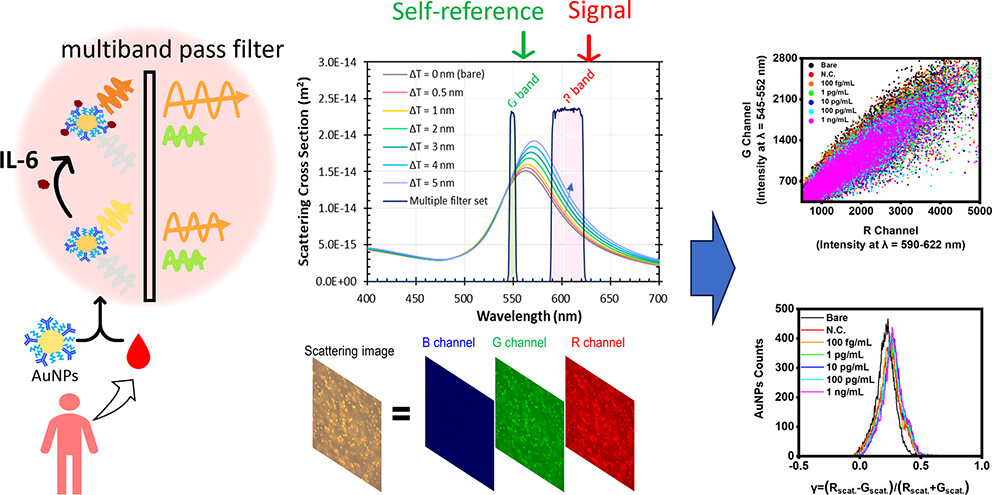
Fig. 1. Graphical Abstract.
Technology Overview
The cDiNM platform integrates gold nanoparticle-based LSPR sensing, dual-wavelength spectral imaging, and a color sCMOS camera. A self-referenced analysis compares red and green scattering signals from individual nanoparticles, enabling highly sensitive, label-free detection of IL-6 with reduced noise and matrix effects.
Applications & Benefits
The technology enables rapid sepsis diagnosis and real-time IL-6 monitoring in blood plasma. It offers ultrahigh sensitivity, low sample consumption, label-free operation, reduced matrix interference, and excellent recovery, making it suitable for clinical biomarker monitoring and early intervention in critical care.
Abstract:
Clinical monitoring of cytokines, such as interleukin-6 (IL-6), enables a timely diagnosis and can significantly improve patient prognosis. In this study, we developed a rapid, label-free, ultrasensitive, and low matrix-effect method called chromatic digital nanoplasmon-metry (cDiNM) to detect IL-6 in human blood plasma. Utilizing a multiple filter configuration, two nonadjacent specific transmission wavelength bands are extracted. One is centered within the full-width-at-half-maximum (fwhm) range where the local surface plasmon resonance (LSPR) response of the 80 nm gold nanoparticles (AuNPs) is strongest, while the other band is narrowed and blue-shifted from the peak to a region with minor intensity change. Scattering images of AuNPs passing through these two bands are then captured simultaneously and independently via the red and green channels of a color scientific complementary metal-oxide-semiconductor (sCMOS) camera. This configuration allows every AuNPs’ spectral chromatic image contrast to be a self-referenced subtractive analysis LSPR and facilitates evaluation of their changes induced by the IL-6 binding across numerous individual AuNPs. This method achieves IL-6 detection in blood plasma within 45 min, requiring only 0.5 mL of a 10-fold diluted, label-free sample, with a limit of detection and quantification (LOD and LOQ) of less than 19.2 and 87.8 fg/mL, respectively, and a recovery rate of 96%. In summary, cDiNM provides rapid and accurate IL-6 monitoring with promising potential for clinical application in sepsis patient care.
Self-referenced Digital Spectral Chromatic Local Surface Plasmon Resonance in Ultrasensitive Severe Sepsis Interleukin-6 Detection
Author:Chang Ting-Wei, Chuang Ting-Hao, Wang Sheng-Hann, Yeung Wing Kiu, Wei Pei-Kuen
Year:2025
Source publication: ACS Sensors, Vol 10, Issue 2, Feburary 2025, 1178-1186
Subfield Highest percentage: 99% Fluid Flow and Transfer Processes #1/99