

From Lab to Body: Advanced Electrochemical Biosensors for Illicit Drug Detection via Nanomaterials, AI, and Wearable Tech
This review explores recent advances in electrochemical biosensors for illicit drug detection. By integrating nanomaterials, artificial intelligence, and wearable technologies, these sensors enable rapid, sensitive, and portable monitoring of opioids, stimulants, cannabinoids, and date rape drugs. The paper discusses novel biorecognition elements, signal transduction strategies, and wearable sensing platforms while addressing challenges such as fouling, signal interference, and regulatory issues. It highlights the transition from laboratory-based analysis to real-time, on-body drug monitoring systems for forensic, clinical, and public health applications.
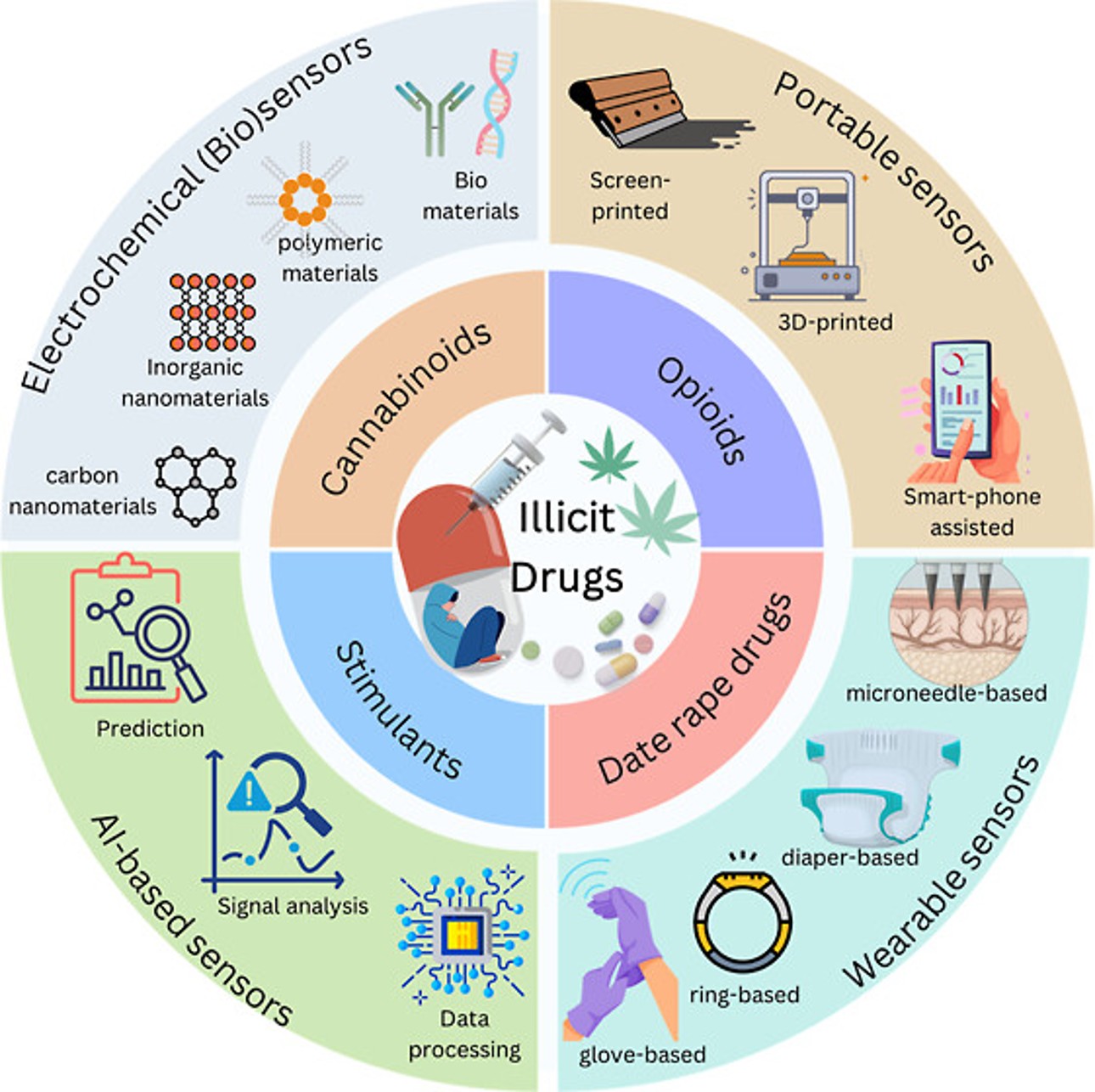
Scheme 1. Schematic Illustration for the Integrated Sensing Strategies for Illicit Drug Detection Combining Electrochemical Biosensors, Portable Formats, Wearable Interfaces, and AI-Based Analytics.
Technology Overview
Advanced electrochemical biosensors combine nanomaterials, aptamers, molecularly imprinted polymers, and AI-assisted analysis to detect illicit drugs with high sensitivity. Integrated with wearable and portable devices, these systems provide rapid, real-time monitoring in biological fluids such as saliva, sweat, blood, and urine.
Applications & Benefits
These biosensors support forensic investigations, clinical toxicology, roadside screening, and public health surveillance. Their portability, rapid response, low cost, and real-time monitoring capabilities enable early drug detection, personalized monitoring, and decentralized testing outside conventional laboratories.
Abstract:
Illicit drug detection is entering a transformative era, driven by the convergence of electrochemical sensing, nanomaterials engineering, and artificial intelligence. Traditional analytical approaches, despite their precision, are increasingly misaligned with the demands of real-time, on-site, and personalized monitoring. In recent years, electrochemical biosensors have emerged as a disruptive class of technologies capable of bridging this gap, offering miniaturized platforms that combine molecular specificity, rapid response, and adaptability to diverse biological matrices. This review captures the current momentum in the development of advanced electrochemical systems tailored for the detection of psychoactive substances, with a particular focus on opioids, stimulants, cannabinoids, and date rape drugs. We highlight how the integration of high-surface-area nanomaterials (e.g., MXenes, carbon nanostructures, metal organic frameworks) and programmable biorecognition interfaces (e.g., aptamers, synthetic polymers) has redefined the sensitivity, selectivity, and stability of drug sensors. Beyond material innovation, we explore how modern transduction strategies are being repurposed into flexible, wearable formats and seamlessly coupled with AI-driven data analytics to enable intelligent, autonomous sensing. Key technical challenges, including signal interference, fouling, multianalyte discrimination, and regulatory translation, are critically assessed alongside emerging solutions such as antifouling coatings, multiplexed recognition chemistries, and artificial intelligence (AI)-assisted calibration. Looking ahead, we outline a paradigm shift toward decentralized, user-adaptable drug sensing platforms that could radically improve forensic readiness, clinical toxicology, and public health surveillance. The path forward lies in translating these innovations into robust, field-deployable devices capable of meeting the complex demands of modern drug monitoring ecosystems.
From Lab to Body: Advanced Electrochemical Biosensors for Illicit Drug Detection via Nanomaterials, AI, and Wearable Tech
Author:Ganesan Muthusankar, Devi Ramadhass Keerthika, Wang Chih-Lung, Lin Yung-Chang, Lin Wan-Ching, Lin Shu-Fen, Lin Chun Che, Chang-Chien Guo-Ping
Year:2025
Source publication: ACS Sensors, Vol 10, Issue 12, 9153-9182
Subfield Highest percentage: 99% Fluid Flow and Transfer Processes #1/99