

Multi-faceted procurement with mixed integer linear programming for corporate 100 % renewable energy goal
This study develops a diversified renewable energy procurement model to help corporations achieve RE100 targets while minimizing electricity procurement costs. Using a Mixed-Integer Linear Programming (MILP) framework with 15-minute time intervals, the model optimizes the integration of solar power, wind power, renewable energy certificates (T-RECs), and energy storage systems. A case study of Taiwan’s banking sector demonstrates that the proposed approach improves renewable energy utilization, reduces reliance on certificates, and lowers overall procurement costs through flexible energy allocation strategies.
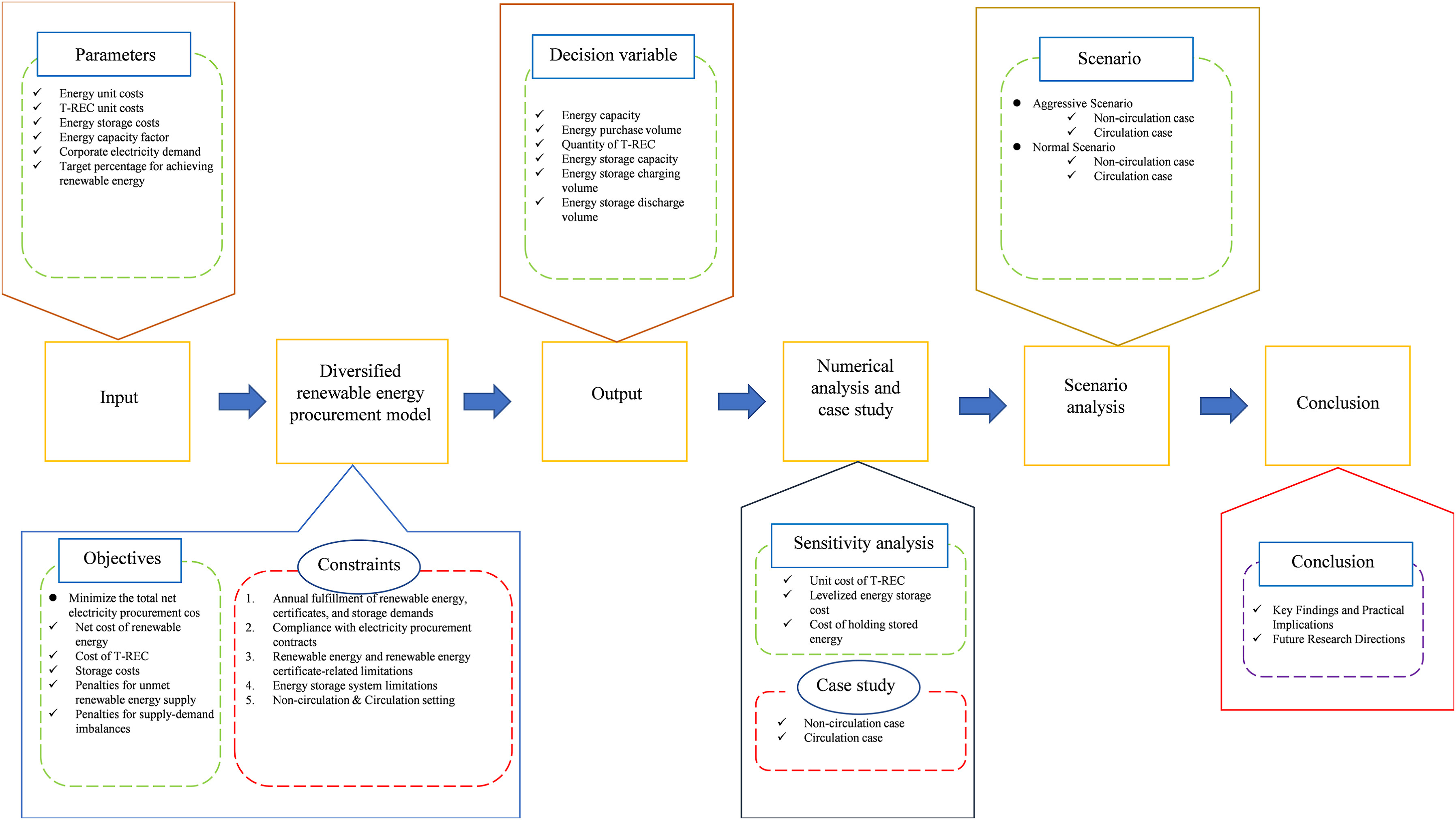
Fig. 1. Diagram of diversified renewable energy procurement model.
Technology Overview
A MILP-based renewable energy planning model optimizes the procurement of solar, wind, energy storage, and T-RECs under RE100 requirements. By using 15-minute demand-resolution data and circulation mechanisms, the framework minimizes costs while ensuring renewable energy targets and system stability.
Applications & Benefits
The model supports corporate RE100 planning, renewable energy procurement, and carbon reduction strategies. It enhances energy utilization efficiency, lowers procurement costs, reduces dependence on renewable certificates, and provides practical decision-making guidance for sustainable energy transitions.
Abstract:
To achieve net-zero emissions, wind and solar power are projected to provide over half of global electricity by 2050. These sources, along with storage systems and Renewable Energy Certificates, are crucial for companies aiming for carbon neutrality. This study applies a mixed integer linear programming model to minimize procurement costs, considering regional cost differences and capacity factors. It focuses on the corporate sector, examining two cases based on different Renewable Energy 100 % Initiative accounting methods: the “Non-Circulation Case” and the “Circulation Case.” Each case includes “Aggressive” and “Normal” scenarios based on progress, outlining strategies, including capacity, electricity, storage, and cost. Key findings reveal that in the “Non-Circulation Case with Aggressive Scenario,” relying solely on a single energy source proves insufficient, necessitating investment in diverse sources such as secondary renewables (like wind), storage systems, and Renewable Energy Certificates. This strategy enhances system resilience but may pose financial challenges for smaller companies. In the “Non-Circulation Case with Normal Scenario,” companies can gradually invest in solar photovoltaics, supported by storage systems and Renewable Energy Certificates, to balance flexibility, efficiency, and affordability. The most significant contribution is demonstrated in the “Circulation Case with Aggressive Scenario,” where the model identifies a solar-dominated system emerges as the optimal strategy for achieving corporate 100 % renewable goals, driven by solar energy's superior cost-effectiveness and capacity factor in southern regions. In the “Circulation Case with Normal Scenario,” companies shift towards a solar-only energy system to leverage the high capacity factor in southern regions, ensuring a streamlined, scalable procurement strategy.

Multi-faceted procurement with mixed integer linear programming for corporate 100 % renewable energy goal
Author:Hsu Hsin-Wei, Fan, Zhi-Wei
Year:2025
Source publication: Energy, Volume 320, 1 April 2025, 135144
Subfield Highest percentage: 99% Modeling and Simulation #4/397