

Flexible Mechanical Response Device With Optical Logic Emission Enabled by Synergistic Crystallization Engineering of Ester Polymer and Perovskite
This study presents a flexible mechanical response device (FMRD) based on a stretchable perovskite light-emitting diode. By introducing a highly crystalline ester polymer into the perovskite system, a synergistic crystallization strategy was developed to regulate crystal growth, enhance exciton transfer efficiency, and improve luminescence performance. The device exhibits optical logic emission under mechanical deformation, including bending and stretching, enabling dynamic signal generation. The FMRD demonstrates strong potential for motion capture, mechanical stress sensing, and next-generation flexible optoelectronic applications.
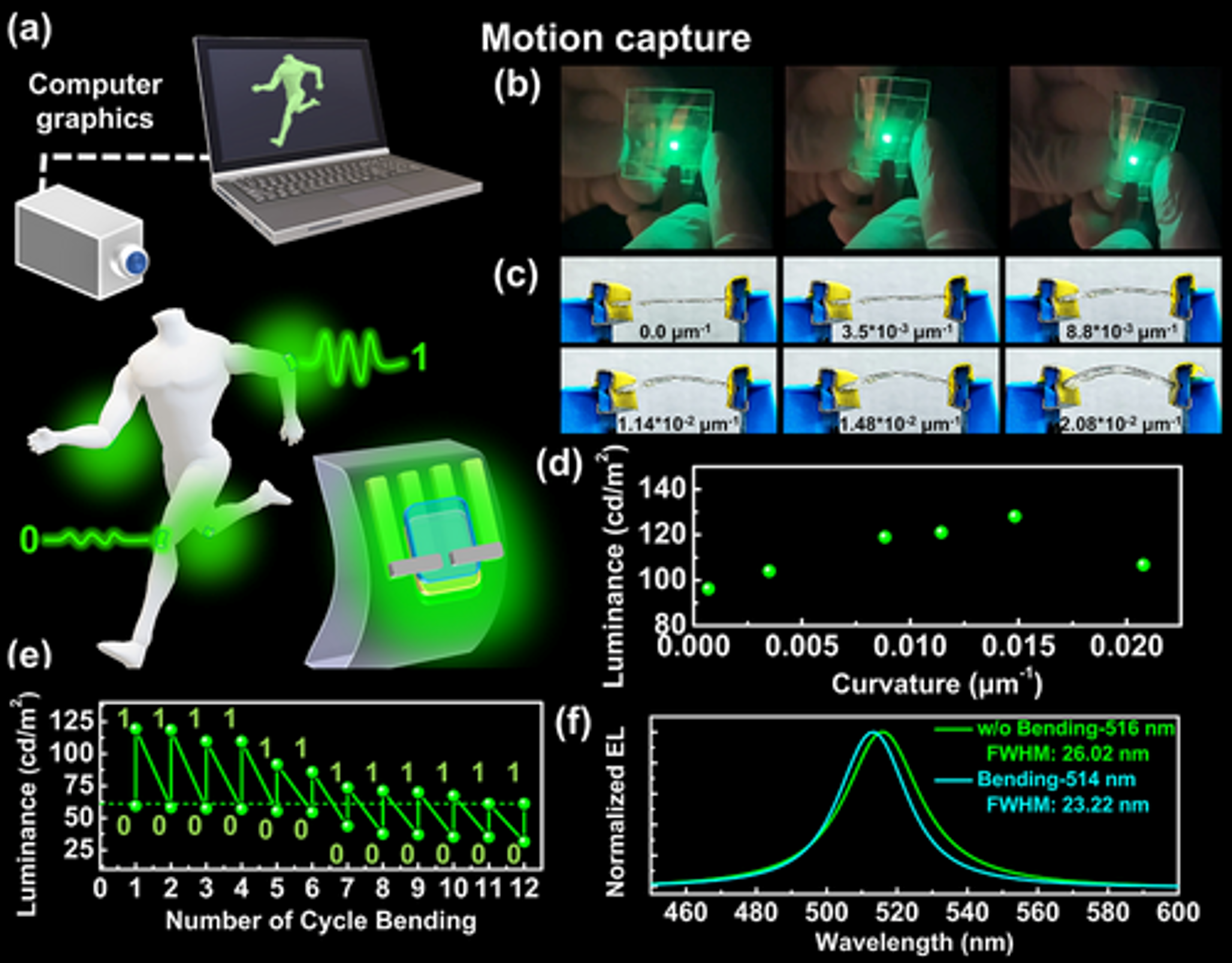
Fig. 1. Application of ester-based polymer-perovskite composite in FMRD with logical emission signal for motion capture.
Technology Overview
A synergistic crystallization engineering approach combines highly crystalline ester polymers with perovskites to create flexible light-emitting devices. The resulting FMRD generates distinct optical signals under bending or stretching by enhancing crystal confinement, exciton transfer, and luminescence efficiency.
Applications & Benefits
The technology enables flexible optical logic devices for motion capture, wearable electronics, and mechanical stress sensing. It offers enhanced brightness, reversible spectral response, improved energy transfer efficiency, and reliable signal recognition, supporting advanced human–machine interaction and intelligent sensing systems.
Abstract:
The flexible mechanical response device (FMRD) is developed using a stretchable perovskite light-emitting diode. The FMRD achieves optical logic light-emitting properties through a synergetic crystallization strategy involving a highly crystalline ester-based polymer (hc-ester) and perovskite. Research indicates that hc-ester polymer influences the crystal growth of perovskite via ion-dipole interaction, resulting in “crystallized space confinement.” Perovskite space confinement further optimizes perovskite's sub-dimensional crystal phase ratio, enhancing exciton transmission efficiency and luminescence performance. Additionally, hc-ester enhances the surface morphology of perovskite films and lowers the electron trap density, demonstrating significant potential for use in optoelectronic devices. Regarding its application, FMRD can generate optical logic signals through external force deformation, such as bending and stretching, making it useful for motion capture and mechanical stress sensing. In the bent state, FMRD shows an increase in luminance, a blue shift in emission, and improved external quantum efficiency, making it suitable for dynamic analog signal source output. At the same time, its reversible spectral changes and consistent variations in luminescence make it exceptional for mechanical stress sensing applications. This research presents an innovative, flexible optoelectronic device technology solution and paves the way for new applications of perovskite composite materials in optical logic devices and intelligent sensing.
Flexible Mechanical Response Device With Optical Logic Emission Enabled by Synergistic Crystallization Engineering of Ester Polymer and Perovskite
Author:Yan Zhen-Li, Hsu Tzu-Ming, Wu Chien-Hsin, Benas Jean-Sebastien, Huang Ying-Chi, Chen Wei-Cheng, Lin Bi-Hsuan, Chen Mei-Hsin, Lin Ja-Hon, Tsai Hsinhan, Chueh Chu-Chen, Adachi Chihaya, Jeng Ru-Jong, Kuo Chi-Ching
Year:2025
Source publication: Advanced Science, Volume 12, Issue 43, Nov 2025, e08812
Subfield Highest percentage: 99% Biochemistry, Genetics and Molecular Biology #1/144