

Effect of integrating gamified teaching activities on learning emotions of design students with different learning styles
This study investigates the impact of gamified teaching activities on the learning emotions of design students with different learning styles. Based on Self-Determination Theory (SDT), the researchers integrated the Classcraft platform, incorporating points, badges, leaderboards, collaborative activities, and industry-academic teaching into a storytelling course. Through a semester-long quasi-experimental study involving 47 design students, the results showed that gamification significantly increased positive emotions such as enjoyment, pride, and hope while reducing negative emotions, especially anxiety and hopelessness. The findings highlight the value of gamified learning in enhancing student engagement and emotional well-being.
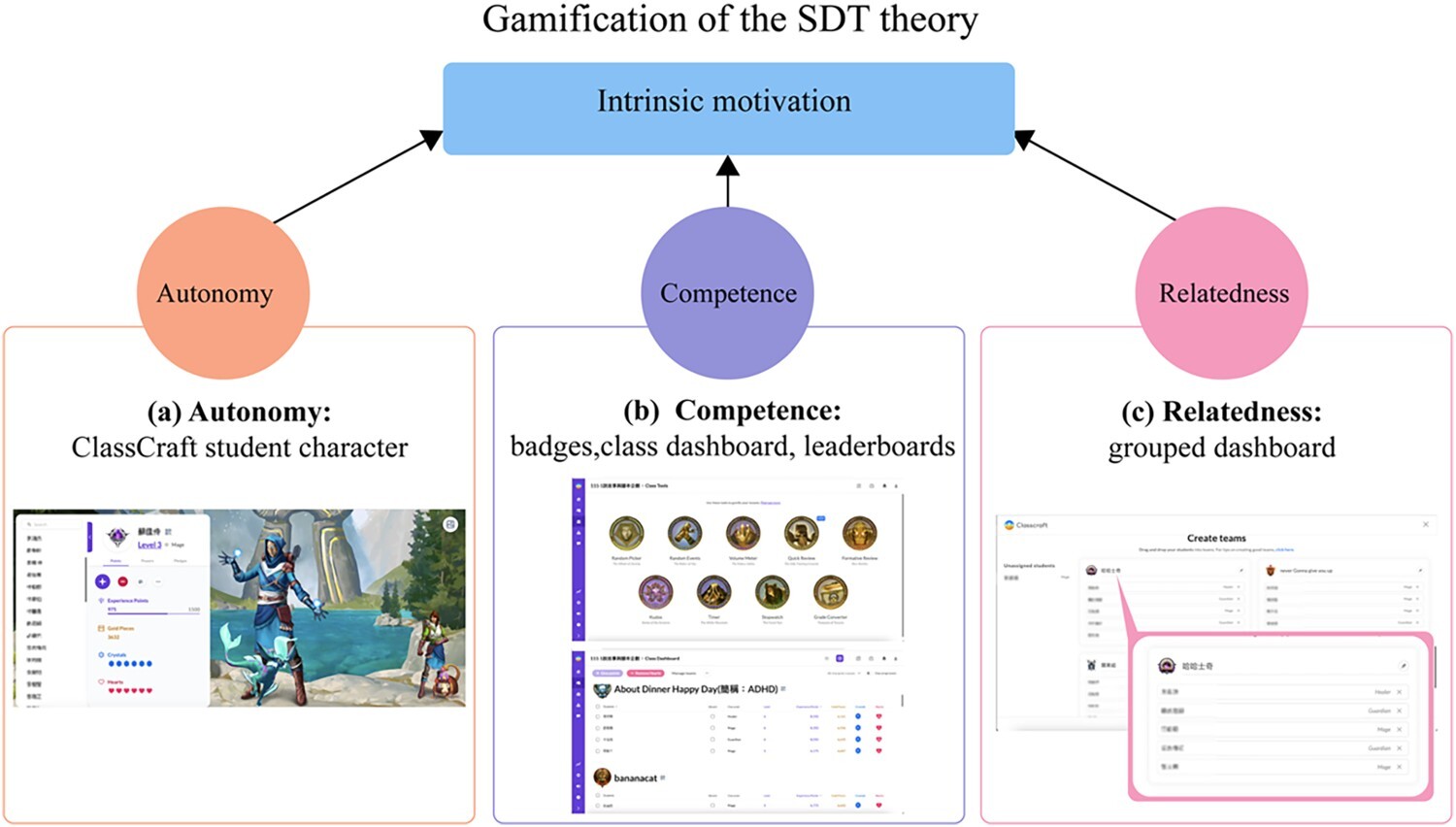
Fig. 1. Diagram of relationships between gamification of ClassCraft and SDT.
Technology Overview
Energy management system for residential fuel cell-based combined heat and power. Minimizing energy cost while preserving the lifespan of fuel cell and battery. The nonlinearity in fuel cell is approximated using piecewise linearization. Nonlinearity brought about by the fuel cell and battery lifespan is linearized. Employing mixed integer linear programming to solve the energy management problem.
Applications & Benefits
A gamified learning framework based on Self-Determination Theory was implemented using the Classcraft platform. Features including points, badges, leaderboards, team collaboration, and real-time feedback were integrated into course activities to support autonomy, competence, and relatedness, thereby enhancing students’ motivation and learning emotions.
Abstract:
Design students face heavy workloads and intensive projects. This not only results in sleep deprivation but also diminishes their self-confidence, thereby reducing their learning motivation. Grounded in self-determination theory (SDT), this study investigated how interactive game-based learning influenced students' emotional responses in a sophomore “Storytelling and Script Planning” elective course within a Taiwanese design department, with an explicit focus on varying perceptual learning styles. Integrating the Classcraft platform, gamification elements such as points, badges, and leaderboards, creative teacher-student discussions, and industry-academic collaborative teaching, this study conducted three evaluations across one semester. The results demonstrate that gamification significantly boosted students’ positive emotions and effectively mitigated negative emotions, notably reducing anxiety and despair. Furthermore, sensory learners exhibited enhanced positive emotional reactions during hands-on course activities, while intuitive learners experienced a substantial decrease in negative emotions through gamification. These findings offer new strategies for courses with diverse educational backgrounds, such as general education and narrative creativity, and present solutions for managing academic stress among university students. They also underscore the necessity to delve deeper into the relationship between learning styles and emotional responses, offering crucial insights for future educational practices.
Effect of integrating gamified teaching activities on learning emotions of design students with different learning styles
Author:Huang Yi-Ting, Wang Tzu-Hsuan
Year:2025
Source publication: Interactive Learning Environments, Volume 33, Issue 5, July 2025
Subfield Highest percentage: 99% Education #16/1698