

Unlocking Dual Functionality in Triazine-Based Emitters: Synergistic Enhancement of Two-Photon Absorption and TADF-OLED Performance with Electron-Withdrawing Substituents
This study overcomes the design trade-offs between two-photon absorption (2PA) and thermally activated delayed fluorescence (TADF) by introducing electron-withdrawing substituents (CF3 and CN) into a triazine-based (CzTRZ) scaffold. This strategy leverages an electron-withdrawing-enhanced intramolecular charge transfer (EWICT) effect. It simultaneously achieves exceptionally high 2PA cross-sections and minimizes the singlet-triplet energy gap ΔEST, drastically accelerating the reverse intersystem crossing rate. The resulting emitters deliver near-unity photoluminescence quantum yields and outstanding electroluminescence efficiency, showcasing a powerful molecular design for advanced photonic and optoelectronic devices.
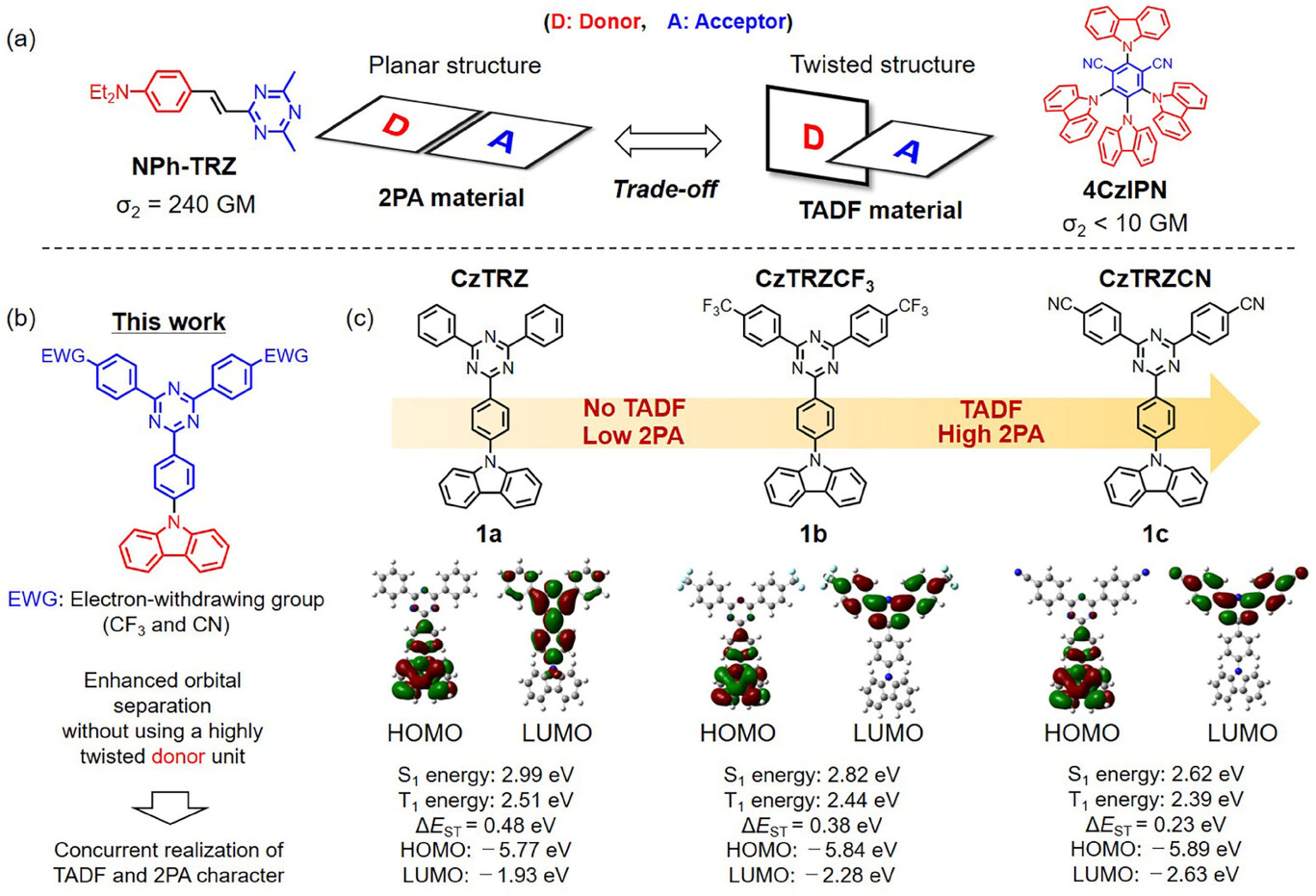
Figure 1. a) The trade-off in the molecular design between 2PA and TADF materials. b) Molecular design concept in this work. c) Chemical structures of the designed CzTRZ derivatives, their frontier molecular orbitals, and the corresponding energy levels calculated at the PBE0/6-31G(d,p) level of theory with the polarizable continuum model (PCM) with toluene as the solvent.
Technology Overview
The technology utilizes an electron-withdrawing-enhanced intramolecular charge transfer (EWICT) molecular design. By anchoring strong electron-withdrawing groups (CF3 and CN) onto the triazine acceptor of CzTRZ emitters, the system selectively stabilizes the S1 state. This minimizes the singlet-triplet energy gap ΔEST, facilitating rapid reverse intersystem crossing (RISC) while synergistically expanding the molecular non-linear optical response for two-photon absorption.
Applications & Benefits
This dual-functional molecular platform significantly enhances both organic light-emitting diodes (OLEDs) and 2PA-based bioimaging. Emitters achieve a high external quantum efficiency (EQE) of 22.3% in TADF-OLEDs with suppressed efficiency roll-off. Concurrently, their massive 2PA cross-sections enable high-contrast, deep-tissue nonlinear optical imaging, bridging the gap between high-performance display technologies and advanced biomedical applications.
Abstract:
The simultaneous realization of two-photon absorption (2PA) and thermally activated delayed fluorescence (TADF) in a single molecular system remains challenging due to an inherent trade-off in their molecular design requirements. In this study, we present a strategy to enhance both properties by introducing electron-withdrawing substituents into the CzTRZ scaffold, thereby leveraging an electron-withdrawing-enhanced intramolecular charge transfer (EWICT) character. The incorporation of TRZCF3 and TRZCN units effectively enhances the charge transfer (CT) character of CzTRZ, resulting in high 2PA cross-sections (156 GM for CzTRZCF3 and 200 GM for CzTRZCN) and a reduced singlet-triplet energy gap (ΔEST = ES1 – ET1). Computational and experimental studies reveal that incorporating TRZCF3 and TRZCN units selectively stabilizes the S1 state and reduces ΔEST, significantly facilitating the reversed intersystem crossing (RISC) process. Notably, 1c exhibits the fastest RISC rate (kRISC), leading to superior TADF properties and an external quantum efficiency (EQE) of 13.5% in OLEDs. Moreover, a relatively high two-photon brightness of 174 GM is estimated for 1c. These findings demonstrate a rational molecular design strategy for the synergistic enhancement of 2PA cross-sections and excellent OLED performance, paving the way for applications in advanced imaging probes and organic semiconductors.
Unlocking Dual Functionality in Triazine-Based Emitters: Synergistic Enhancement of Two-Photon Absorption and TADF-OLED Performance with Electron-Withdrawing Substituents
Author:Chitose Youhei, Mageswari Gomathi Vinayakam, Zenke Ryota, Ide Toshiharu, Kohata Shintaro, Lin Ja-Hon, Lin Tzu-Chau, Tsuchiya Youichi, Adachi Chihaya
Year:2025
Source publication: Advanced Materials, Volume 37, Issue 44, Nov 2025, 2509857
Subfield Highest percentage: 99% Mechanical Engineering #3/740