

High-efficiency and ultrastable solvent-free curable perovskite quantum dot inks for microLED and LED backlighting applications
This study addresses the instability and narrow processing window of metal lead halide perovskite quantum dots (PeQDs) by developing high-efficiency, ultrastable, solvent-free UV-curable PeQD inks for MicroLED and LED backlighting. By modifying the PeQD surfaces with branched thiols and encapsulating them within a protective crosslinked polymer matrix, the researchers eliminated hazardous solvents and prevented aggregation during inkjet printing. The resulting green-emitting inks exhibit an exceptional photoluminescence quantum yield (PLQY) of 98% and superior stability under ambient and thermal stress, offering a reliable, scalable material platform for next-generation high-definition displays.
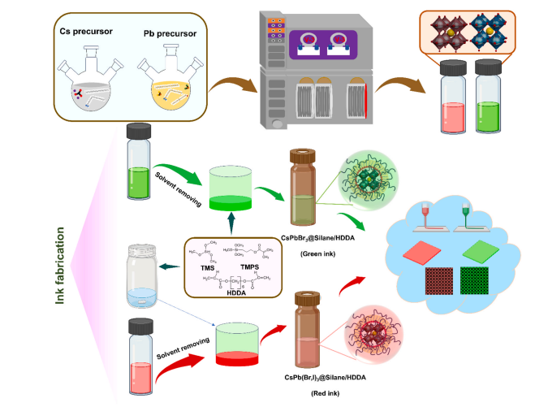
Scheme 1. Solvent-free perovskite quantum dot ink fabrication.
Technology Overview
This technology features a solvent-free, UV-curable ink platform utilizing branched thiol-ligand modified CsPbX3 perovskite quantum dots (PeQDs). It leverages a dense, crosslinked acrylate polymer network formed via photo-polymerization. This structure effectively suppresses non-radiative recombination and shields the encapsulated nanocrystals from ambient moisture, heat, and structural degradation during automated inkjet printing processes.
Applications & Benefits
Designed for MicroLED and LED backlighting displays, this ink offers a near-unity photoluminescence quantum yield (98%) and superior long-term stability against water and heat. By eliminating organic solvents, it prevents coffee-ring defects and nozzle clogging in inkjet printing, enabling precise, pixelated mass production with a wide color gamut for ultra-high-definition television and display panels.
Abstract:
Metal lead halide perovskite quantum dots (PeQDs) exhibit exceptional optoelectronic properties, showing promise as components for solar cells, lighting, display, and anticounterfeiting devices. However, the instability of PeQDs, along with synthesis and storage methods that rely on hazardous solvents, has limited their potential for commercial applications. To overcome these obstacles, we introduce a solvent-free method for fabricating high-quality green and red CsPbX3 PeQD (X = Br, I) ink. Using a fluidic system, we first obtained super-high photoluminescence quantum yield PeQDs (92 % for red CsPb(Br,I)3, and nearly 100 % for green CsPbBr3 PeQDs). The uniform nonsolvent PeQD ink is fabricated by modifying the as-formed PeQD surface with a mixture of trimethoxysilane and 3-(trimethoxysilyl)propyl methacrylate silane coupling agents to form PeQDs@silane, then dispersing the PeQDs@silane in a UV-curable 1,6-hexanediol diacrylate monomer. Our solvent-free PeQD ink exhibits bright and stable green and red emissions with long-term stability, retaining 100 % PL intensity after 115 days for CsPbBr3 and 78 days for CsPb(Br,I)3. The environment-friendly ink enables highly uniform and bright films for LED backlighting and patterns for micro-LED applications. With color coordinates near the red and green reference values, the PeQD films demonstrate a remarkable 100.28 % color gamut coverage in comparison with Rec. 2020. This scalable and environmentally friendly method provides a safer alternative than conventional solvent-based PeQD ink.
High-efficiency and ultrastable solvent-free curable perovskite quantum dot inks for microLED and LED backlighting applications
Author:Thi Ngo Loan, Huang Yu-Ting, Chang Cheng-Chieh, Verma Hemant, Lin Yen-Huei, Kuo Ching-Tai, Liao Ying-Chih, Kaun Chao-Cheng, Chung Ren-Jei, Liu Ru-Shi
Year:2025
Source publication: Nano Energy, Volume 142, Part B, September 2025, 111230
Subfield Highest percentage: 99% Electrical and Electronic Engineering #9/1030