

Quantitative evaluation of thermal damage in concrete via integrated ultrasonic pulse and acoustic emission techniques
This study introduces a non-destructive method to quantify thermal damage in concrete after fire exposure by integrating ultrasonic pulse (UP) and acoustic emission (AE) techniques. It proposes the shear-to-pressure wave velocity ratio VS/VP as a standardized indicator to assess structural integrity. By subjecting concrete specimens to target temperatures up to 800°C, the researchers demonstrated that VS/VP changes dynamically with microstructural microcracking. Combined with AE monitoring during compression tests, this integrated framework accurately evaluates crack propagation and residual mechanical strength, offering a reliable protocol for post-fire structural safety assessments.
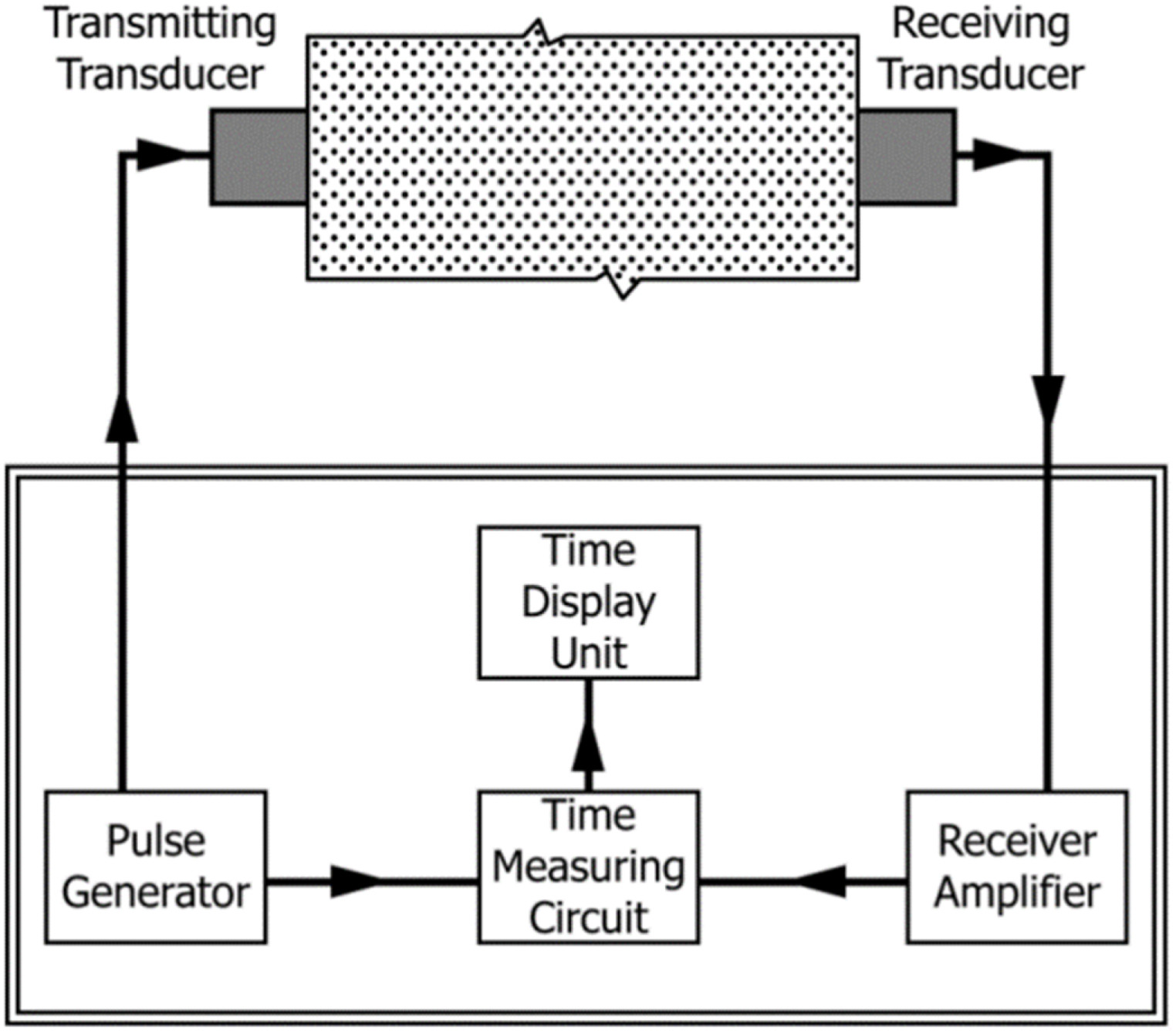
Fig. 1. Schematic diagram of ultrasonic pulse measurement equipment.
Technology Overview
This technology combines ultrasonic pulse (UP) velocity with acoustic emission (AE) monitoring. It introduces the VS/VP wave velocity ratio as a normalized damage metric to overcome traditional limitations caused by mix-design variations. This non-destructive framework maps acoustic indicators against compression-induced microcracking to track microstructural degradation and quantify heat-induced structural damage.
Applications & Benefits
Applied to post-fire building inspections, this approach replaces destructive core drilling with highly accurate, non-destructive testing. By tracking the VS/VP ratio, engineers can quickly assess internal concrete degradation, predict residual load-bearing capacity, and classify crack types. This ensures precise, data-driven safety decisions, significantly reducing inspection costs and structural rehabilitation timelines.
Abstract:
This study integrates ultrasonic pulse (UP) and acoustic emission (AE) techniques to evaluate thermal damage in concrete, proposing the shear-to-pressure wave velocity ratio (VS/VP) as a normalized indicator for post-fire assessment. Concrete specimens were exposed to controlled heating at various temperatures, followed by VS and VP measurements and AE monitoring during uniaxial compression. Crack evolution was stabilized using extensometer control to capture complete loading curves. Results show that stiffness, strength, and toughness decrease with increasing temperature, with losses exceeding 50 % above 500 °C. The failure mode shifted from snap-back to snap-through within the 200–300 °C range. AE analysis revealed earlier microcrack localization at higher temperatures, with the localization load level (applied stress normalized by peak stress) decreasing from 83 % (ambient) to 66 % (500 °C), and becoming negligible after 600 °C. The VS/VP ratio increased from 0.54 (ambient) to 0.71 at 500 °C, correlating strongly (R2 > 0.87) with temperature and stiffness, strength, and toughness reduction rates. These results highlight the potential of VS/VP as a reliable, non-destructive metric for estimating fire exposure temperatures and assessing residual structural capacity in fire-damaged concrete.

Quantitative evaluation of thermal damage in concrete via integrated ultrasonic pulse and acoustic emission techniques
Author:Chen Wei-Chih, Chen Li-Hsien, Lin Chun-Hung, Lei Ming-Yuan, Wang Tien-Chih, Ke Chih-Yang
Year:2025
Source publication: Journal of Building Engineering, Volume 111, October 2025, 113555
Subfield Highest percentage: 99% Architecture #2/210