

Orbital Topology of Chiral Crystals for Orbitronics
This study demonstrates that orbital angular momentum (OAM) drives a nontrivial band topology in structurally chiral crystals like CoSi, bypassing the need for spin-orbit coupling. Utilizing advanced momentum microscopy and first-principles calculations, the authors link bulk multifold chiral fermions to a pronounced, handedness-dependent OAM texture of surface helicoid Fermi arcs, providing key insights for orbitronics.
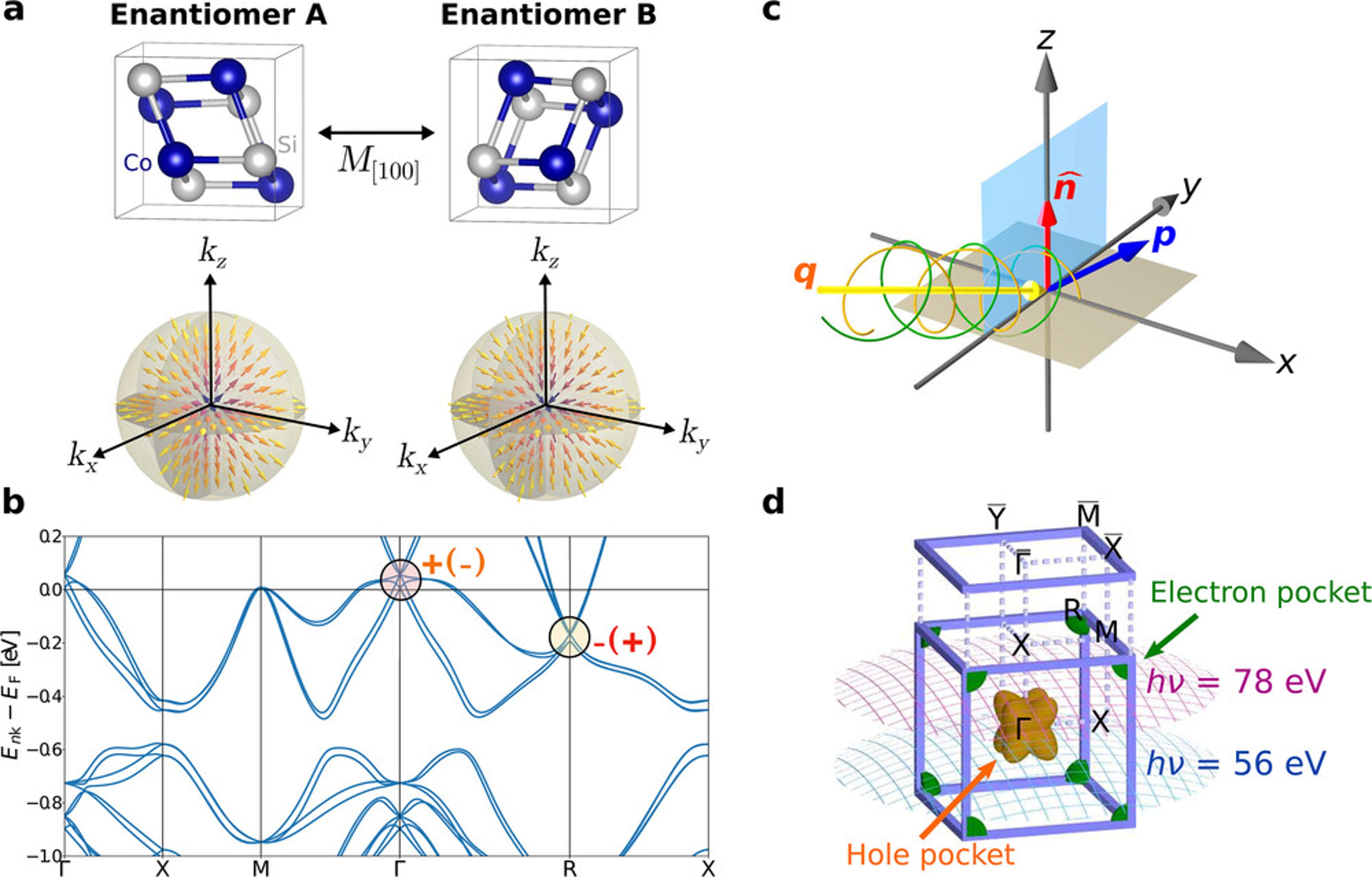
Fig. 1. Topological chiral semimetal CoSi and schematics of the experiment.
Technology Overview
The research utilizes momentum-resolved photoemission microscopy with circularly polarized light to map 2D photoelectron distributions across the entire Brillouin zone. This approach captures the circular dichroism in angular distribution (CDAD), which serves as a robust probe to experimentally detect and analyze the intrinsic bulk and surface OAM textures.
Applications & Benefits
The findings distinguish crystal enantiomers via surface Fermi arc profiles and advance orbitronic and spintronic devices. Benefits include generating non-equilibrium spin/OAM, exciting chiral phonons via electrical currents, switching structural chirality with light, and developing novel quantum transport phenomena like magnetoresistance and orbital filtering.
Abstract:
Chirality is ubiquitous in nature and manifests in a wide range of phenomena including chemical reactions, biological processes, and quantum transport of electrons. In quantum materials, the chirality of fermions, given by the relative directions between the electron spin and momentum, is connected to the band topology of electronic states. This study shows that in structurally chiral materials like CoSi, the orbital angular momentum (OAM) serves as the main driver of a nontrivial band topology in this new class of unconventional topological semimetals, even when spin-orbit coupling is negligible. A nontrivial orbital-momentum locking of multifold chiral fermions in the bulk leads to a pronounced OAM texture of the helicoid Fermi arcs at the surface. The study highlights the pivotal role of the orbital degree of freedom for the chirality and topology of electron states, in general, and paves the way towards the application of topological chiral semimetals in orbitronic devices.

Orbital Topology of Chiral Crystals for Orbitronics
Author:Hagiwara Kenta, Chen Ying-Jiun, Go Dongwook, Tan Xin Liang, Grytsiuk Sergii, Yang Kui-Hon Ou, Shu Guo-Jiun, Chien Jing, Shen Yi-Hsin, Huang Xiang-Lin
Year:2025
Source publication: Advanced Materials, Volume 37, Issue 27, July 2025
Subfield Highest percentage: 99% Mechanical Engineering #3/740