

Engineering hirudin encapsulation in pH-responsive antioxidant nanoparticles for therapeutic efficacy in ischemic stroke model mice
This study introduces HD@iNanoAOX, a novel pH-sensitive, hirudin-loaded antioxidant nanoparticle engineered to treat ischemic stroke. By encapsulating hirudin within an antioxidative polyion complex core, the design shields the drug from rapid degradation and extends its half-life. In a mouse model of middle cerebral artery occlusion (MCAO), HD@iNanoAOX gradually releases hirudin in response to the acidic ischemic environment. This combined approach successfully reduces cerebral infarct volume, mitigates oxidative stress, and prevents blood-brain barrier disruption, offering a highly effective, dual-action strategy that addresses the major limitations of conventional thrombolytic therapies.
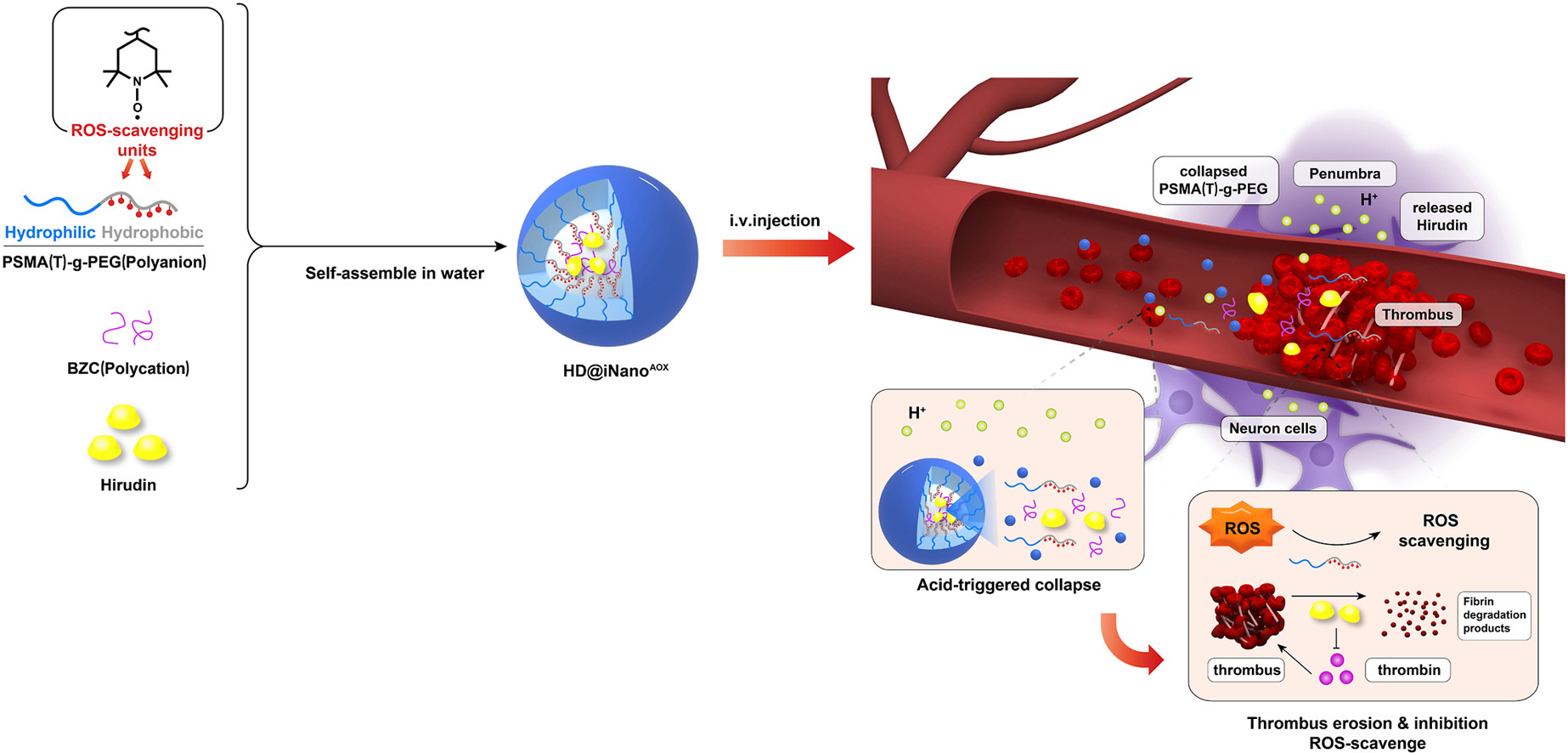
Fig. 1. Graphical abstract.
Technology Overview
The HD@iNanoAOX technology utilizes a core-shell polyion complex micelle that encapsulates anionic hirudin alongside a cationic surfactant and an antioxidant graft copolymer modified with nitroxide radicals. Under neutral conditions, the core remains intact; however, the acidic microenvironment of ischemic lesions triggers core disintegration, releasing hirudin while exposing the antioxidant moieties to scavenge reactive oxygen species.
Applications & Benefits
Designed for acute ischemic stroke therapy, HD@iNanoAOX extends hirudin's in vivo half-life from 21.9 to 91.5 minutes. By combining targeted thrombolysis with radical scavenging, it significantly reduces cerebral infarction and neurological deficits while suppressing hirudin-induced hemorrhagic transformation and blood-brain barrier disruption, minimizing severe side effects associated with standard reperfusion treatments.
Abstract:
This study introduces a novel pH-sensitive, hirudin-loaded antioxidant nanoparticle (HD@iNanoAOX) aimed at addressing the challenges of hirudin's short half-life and hemorrhagic transformation. HD@iNanoAOX was engineered to safeguard and prolong hirudin's bioactivity by encapsulating it within antioxidative nanoparticles, facilitating its gradual release in acidic environments. The efficacy of this approach was validated through both ex vivo and in vivo experiments. Ex vivo thrombolytic assays demonstrated that HD@iNanoAOX maintained effective clot lysis activity under acidic conditions. In vivo assessments revealed that HD@iNanoAOX significantly prolonged hirudin's half-life and reduced cerebral infarct volume in a mouse model of middle cerebral artery occlusion (MCAO). Furthermore, HD@iNanoAOX treatment mitigated cerebral oxidative stress, suppressed hemorrhagic transformation, and prevented blood-brain barrier (BBB) disruption. These findings suggest that the combined thrombolytic and antioxidative properties of HD@iNanoAOX offer a promising therapeutic approach for ischemic stroke. Nonetheless, further research is warranted to optimize the formulation and assess its safety and efficacy in clinical settings.
Engineering hirudin encapsulation in pH-responsive antioxidant nanoparticles for therapeutic efficacy in ischemic stroke model mice
Author:Mei Ting, Zhang Peiwen, Hu Yifan, Xiao Liman, Hou Junling, Nagasaki Yukio
Year:2025
Source publication: Biomaterials, Volume 314, March 2025, 122860
Subfield Highest percentage: 99% Biophysics #2 / 155