

Oxidized Ti Single Atoms and Co₃O₄ with Abundant Oxygen Vacancies Collaborating with Adjacent Pd Sites for an Efficient and Stable Oxygen Reduction Reaction
This paper presents a novel CP@Ti-1 heterogeneous catalyst designed to overcome the limitations of single-atom catalysts in the oxygen reduction reaction (ORR). By anchoring oxidized Ti single atoms onto cobalt-oxide-supported Pd nanoparticles, the authors successfully created abundant oxygen vacancies across both the Ti single atoms and the Co₃O₄ support. This design enables exceptional ORR mass activity and stability in alkaline fuel cells.
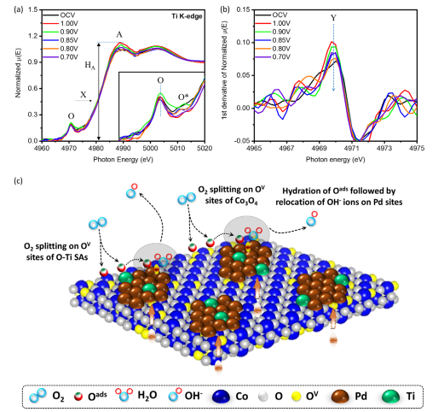
Figure 6. a) In situ XANES and b) 1st derivative spectra of the CP@Ti-1 catalyst at the Ti K-edge. c) The ORR pathways on the surface of CP@Ti-1 catalyst.
Technology Overview
The technology introduces a synergistic catalyst structure combining oxidized Ti single atoms, Pd domains, and a Co₃O₄ matrix. Through precise ion chemisorption, reduction, and surface-defect engineering via ultrasonication, abundant oxygen vacancies are intentionally generated. In situ X-ray absorption spectroscopy validates that these electronic structures optimize reaction kinetics.
Applications & Benefits
Targeted at alkaline fuel cells, this catalyst dramatically accelerates sluggish ORR kinetics. It delivers a record-high mass activity, outperforming commercial Pt/C catalysts by up to 145-fold. Furthermore, it provides exceptional industrial benefits by maintaining 100% of its initial performance after 20,000 accelerated degradation cycles, offering a highly durable and cost-effective alternative.
Abstract:
The current study addresses these key issues by providing the ensemble sites and creating oxygen vacancies in the oxidized Ti-single atoms. Here we report a novel heterogeneous catalyst comprising oxidized Ti-single atoms uniformly coated on the cobalt-oxide-supported Pd nanoparticles (denoted as CP@Ti-1), where the oxygen vacancies are introduced in oxidized Ti-single atoms as well as cobalt-oxide support. As-developed CP@Ti-1 catalyst demonstrates remarkable ORR activity with a mass activity (MA) of 9,725 mAmgTi−1 at 0.85 V vs RHE and 1,244 mAmgTi−1 at 0.90 V vs RHE in alkaline conditions. These values mark significant improvements over the commercial J.M.-Pt/C catalyst, outperforming it by 145- and 50-fold, respectively. Additionally, the CP@Ti-1 catalyst shows exceptional durability, maintaining 100% of its initial performance after 20, 000 cycles of accelerated degradation test (ADT). In-situ X-ray absorption spectroscopy (XAS) analysis reveals that the catalyst design promotes synergistic interactions between oxygen vacancies in Ti/Co atoms and adjacent Pd domains, facilitating key reactions in ORR such as oxygen splitting and hydroxide ion formation, respectively, enhancing overall catalytic efficiency. These insights promise significant advancements in both scientific research and industrial applications of ORR catalysis.
Oxidized Ti Single Atoms and Co₃O₄ with Abundant Oxygen Vacancies Collaborating with Adjacent Pd Sites for an Efficient and Stable Oxygen Reduction Reaction
Author:Chang Hong-Wei, Yang Thomas, Yan Che, Chiu Po-Han, Wu Chi-Ying, Yen Hung-Wei, Bhalothia Dinesh, Wang Kaun-Wen, Chen Po-Chun, Chen Tsan-Yao
Year:2025
Source publication: Advanced Science, Volume 12, Issue 19, May 2025, 2417789
Subfield Highest percentage: 99% Biochemistry, Genetics and Molecular Biology #1/144