

Particle and bacterial colony emissions from garments and humans in pharmaceutical cleanrooms
The aim of this study is to provide quantitative data on operators as a source of particle and bacteria emissions in the pharmaceutical cleanroom. The quantitative results of bacteria and particles discharged by pharmaceutical cleanroom operators can produce data providing support for designers, and help to improve the cleanliness of pharmaceutical cleanrooms and ensure the quality of produced drugs.
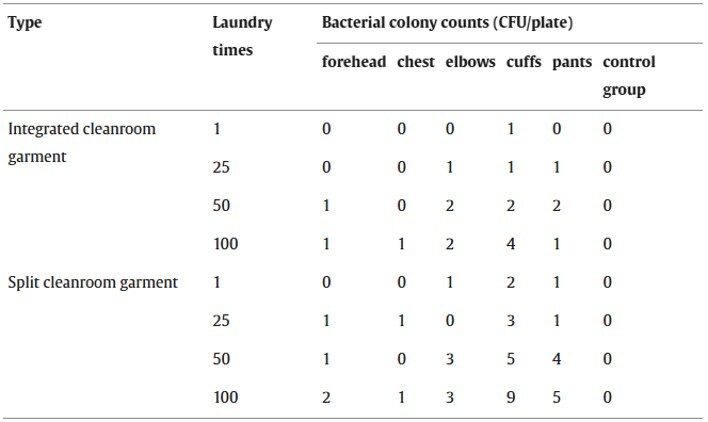
Table 10. Microbiological emission rate of integrated cleanroom garment with different laundry cycles.
Technology Overview
This study measured particle and bacterial emissions from operators wearing integrated vs. split cleanroom garments. Experiments were conducted under varied movement types and laundry cycle counts in a controlled Body-box setup. Split garments released 2–3.5× more 0.5 μm particles and 7–22.7× more 5.0 μm particles than integrated ones. Emissions increased with movement intensity and garment wear (laundry cycles). Particle release was primarily human-derived, with garments contributing less than 4%.
Applications & Benefits
Helps optimize cleanroom garment selection to minimize contamination risk. Supports regulatory compliance and enhances pharmaceutical product quality assurance. Informs standard operating procedures for personnel movement and garment maintenance. Promotes data-driven control over microbial and particle contamination in cleanroom settings. Highlights the importance of garment lifecycle management for reducing emission risks.
Abstract:
Particles and bacteria released from operators in pharmaceutical cleanrooms significantly impact the quality of pharmaceutical products. Therefore, it is necessary to study particle and bacteria emissions from operators and their garments. This paper presents the results of experimental measurements of numbers of particles and bacterial emissions from integrated and split cleanroom garments, under different movement types and laundry conditions. The experiment demonstrated that the emission rate of 0.5 μm particles from split-type garments is approximately 2.0–3.5 times higher than that of integrated cleanroom garments, and 7.0–22.7 times for 5.0 μm particles. The particle emission rate of humans is closely related to the movement types, number of laundry cycles, and garment types. The maximum particle emission rates were obtained when wearing split cleanroom garment after 100 washes and performing knee bend, with 654603 P/min for 0.5 μm and 27185 P/min for 5.0 μm particles, respectively. The particle emission rate of humans is mainly caused by personnel movement, since the emission rate of garments accounts for at most 3.89 %. The bacteria colony of humans increases with the increase of laundry cycles of cleanroom garments. The maximum bacteria colony of integrated and split cleanroom garment were 4 CFU/plate and 9 CFU/plate with the laundry cycles of 100 times. The quantitative results of bacteria and particles emitted from pharmaceutical cleanroom operators are expected to ensure drug quality during production.
Particle and bacterial colony emissions from garments and humans in pharmaceutical cleanrooms
Author:Han Meng, Angus Shiue, Chenhua Wang, Junjie Liu, Lizhi Jia, Graham Leggett
Year:2024
Source publication:Journal of Building Engineering, Volume 97, 15 November 2024
Subfield Highest percentage:99% Architecture #2 / 203
https://www.sciencedirect.com/science/article/pii/S2352710224023970