

Development of an Activity-Based Ratiometric Electrochemical Switch for Direct, Real-Time Sensing of Pantetheinase in Live Cells, Blood, and Urine Samples
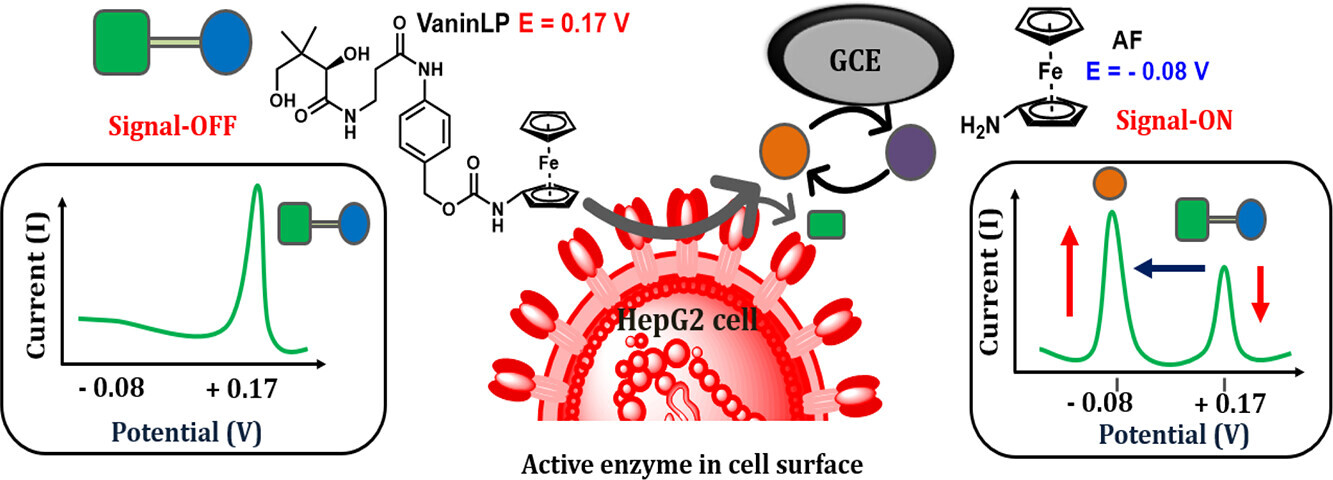
In this study, we designed and developed the first self-immolative ratiometric electrochemical latent probe, termed VaninLP, for analyzing the activity of pantetheinase in live cells and real biofluid samples. Last, the VaninLP probe was able to successfully detect and quantify pantetheinase activity in blood and urine samples, as well as on the surface of tumor cells, all without time-consuming sample processing. To the best of our knowledge, this is the first reported electrochemical detection method for pantetheinase.
Technology Overview
Developed VaninLP, the first ratiometric electrochemical probe for detecting pantetheinase activity. Designed to function effectively in turbid biopsy samples with minimal preparation. Exhibits strong substrate affinity (low Km) and broad dynamic range. Enables simple detection using minimal equipment and steps. Validated in blood, urine, and tumor cell surfaces (e.g., HepG2).
Applications & Benefits
Supports early cancer diagnostics through detection of pantetheinase activity. Ideal for clinical and point-of-care use due to low sample volume and easy handling. Compatible with disposable electrode strips for user convenience. Reduces complexity in analyzing complex biological samples. Offers high sensitivity, specificity, and operational simplicity in real-world settings.
Abstract:
Pantetheinase is a key biomarker for the diagnosis of acute kidney injury and the monitoring of malaria progression. Currently, existing methods for sensing pantetheinase, also known as Vanin-1, show considerable potential but come with certain limitations, including their inability to directly sense analytes in turbid biofluid samples without tedious sample pretreatment. Here, we describe the first activity-based electrochemical probe, termed VaninLP, for convenient and specific direct targeting of pantetheinase activity in turbid liquid biopsy samples. The probe was designed such that cleavage of the pantetheinase amide linkage, triggered by a self-immolative reaction, simultaneously ejects an amino ferrocene reporter. Among the distinctive properties of the VaninLP probe for sensing pantetheinase are its high selectivity, sensitivity, and enzyme affinity, a wide linear concentration range (8–300 ng/mL), and low limit of detection (2.47 ng/mL). The designed probe precisely targeted pantetheinase and was free of interference by other electroactive biological species. We further successfully applied the VaninLP probe to monitor and quantify the activity of pantetheinase on the surfaces of HepG2 tumor cells, blood, and urine samples. Collectively, our findings indicate that VaninLP holds significant promise as a point-of-care tool for diagnosing early-stage kidney injury, as well as monitoring the progression of malaria.
Development of an Activity-Based Ratiometric Electrochemical Switch for Direct, Real-Time Sensing of Pantetheinase in Live Cells, Blood, and Urine Samples
Author:Namasivayam Kumaragurubaran, Yan-Zhi Huang, Tomas Mockaitis, Ponnusamy Arul, Sheng-Tung Huang, Hsin-Yi Lin, Yi-Cheng Wei, Inga Morkvenaite-Vilkonciene
Year:2024
Source publication:ACS Sensors, Volume 9, Issue 10, September 27,2024
Subfield Highest percentage:99% Fluid Flow and Transfer Processes #1 / 97